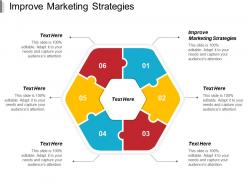
Improve marketing strategies ppt powerpoint presentation portfolio template cpb
Try Before you Buy Download Free Sample Product
Audience
Editable
of Time
Add to the informality with our Improve Marketing Strategies Ppt Powerpoint Presentation Portfolio Template Cpb. Enable discussions in a friendly atmosphere.
People who downloaded this PowerPoint presentation also viewed the following :
Improve marketing strategies ppt powerpoint presentation portfolio template cpb with all 5 slides:
Get away from ennui with our Improve Marketing Strategies Ppt Powerpoint Presentation Portfolio Template Cpb. The going will always be fresh and bubbly.
FAQs for Improve marketing strategies ppt powerpoint presentation
Key elements of a successful marketing strategy include clear target audience identification, competitive market analysis, compelling value proposition development, integrated channel selection, and measurable performance metrics. These components work together by aligning messaging with customer needs, optimizing resource allocation across platforms, and enabling data-driven adjustments, with many organizations finding that strategic integration ultimately delivers enhanced customer engagement and sustainable competitive advantage.
Businesses identify their ideal audience through comprehensive market research, demographic analysis, behavioral data examination, customer surveys, and competitive intelligence gathering. These strategic approaches enable organizations to create detailed buyer personas, segment markets effectively, and develop targeted campaigns that resonate with specific customer groups, ultimately delivering higher conversion rates and improved marketing ROI across industries.
Content marketing serves as the foundation of modern marketing strategies by building trust, establishing thought leadership, nurturing customer relationships, and driving organic engagement across digital channels. Through valuable blogs, videos, social media content, and educational resources, companies like HubSpot and Nike create meaningful connections with audiences, ultimately delivering higher conversion rates, improved brand loyalty, and sustainable competitive advantage in increasingly crowded markets.
Social media platforms enhance comprehensive marketing strategies by enabling targeted audience engagement, real-time customer feedback, and brand storytelling across multiple touchpoints. Through strategic content distribution and community building, companies in retail, hospitality, and financial services streamline customer acquisition, boost brand awareness, and drive conversions, ultimately delivering measurable ROI and competitive market positioning.
Email marketing in multi-channel strategies delivers personalized messaging, cost-effective reach, measurable analytics, automated workflows, and seamless integration capabilities. These advantages enable businesses to nurture leads across touchpoints while maintaining consistent brand communication, with many retail and financial services companies finding that strategic email integration significantly enhances customer engagement and drives higher conversion rates.
Influencer partnerships enhance market reach by leveraging established audiences, creating authentic content, and building credible endorsements that traditional advertising cannot match. Through strategic collaborations, brands access diverse demographics, generate higher engagement rates, and drive measurable conversions, with many companies finding that micro-influencer campaigns deliver significantly better ROI than broad-spectrum marketing approaches.
Businesses should track conversion rates, customer acquisition cost, return on investment, customer lifetime value, and engagement metrics across digital channels. These measurements enable organizations to optimize resource allocation, identify high-performing campaigns, and demonstrate tangible results, with many companies finding that comprehensive tracking ultimately delivers improved marketing efficiency and stronger competitive positioning.
Data analytics informs marketing strategy by identifying customer behavior patterns, measuring campaign performance, predicting market trends, and optimizing resource allocation across channels. Through advanced analytics tools, organizations can segment audiences more precisely, personalize messaging effectively, and track ROI in real-time, ultimately delivering higher conversion rates and competitive advantage in increasingly data-driven markets.
Emerging digital marketing trends include AI-powered personalization, voice search optimization, interactive content formats, social commerce integration, and privacy-first data strategies. These approaches streamline customer targeting, enhance user engagement, and deliver measurable ROI, with many retail and financial services companies finding that strategic implementation of these trends drives significantly higher conversion rates and competitive advantage.
Storytelling integrates into marketing strategies through brand narratives, customer success stories, content marketing campaigns, social media storytelling, and emotional messaging frameworks. These approaches enhance engagement by creating authentic connections, building trust, and making complex products relatable, with companies like Nike and Airbnb finding that narrative-driven campaigns significantly increase customer retention and brand loyalty.
Brand positioning is crucial for marketing strategy as it defines how customers perceive your brand relative to competitors, establishes unique value propositions, and guides messaging consistency across all channels. This strategic foundation enables companies to differentiate effectively in crowded markets, command premium pricing, and build customer loyalty, with many organizations finding that strong positioning significantly enhances campaign effectiveness and drives sustainable competitive advantage.
Small businesses can compete with larger corporations by leveraging agile digital marketing, personalized customer experiences, niche market focus, local community engagement, and strategic social media presence. These approaches enable smaller companies to build authentic relationships, respond quickly to market changes, and deliver targeted solutions that resonate deeply with specific audiences, ultimately creating competitive advantages through flexibility and customer intimacy.
Customer retention strategies include personalized communication, loyalty programs, exceptional customer service, regular feedback collection, and value-added services. These approaches enhance customer experiences by addressing individual needs, rewarding repeat business, and building emotional connections, with many retail and service organizations finding that strategic retention efforts reduce acquisition costs while increasing lifetime customer value and competitive advantage.
SEO enhances online marketing effectiveness by improving search visibility, driving qualified traffic, and reducing acquisition costs through organic reach. These optimization strategies work synergistically with content marketing, social media, and paid advertising, with many businesses finding that strong SEO foundations amplify campaign performance across all channels, ultimately delivering sustainable competitive advantage.
Companies face challenges including budget constraints, resistance to change from existing teams, difficulty measuring ROI on new initiatives, integration with current systems, and adapting to rapidly evolving digital platforms. These obstacles often stem from organizational inertia and resource allocation issues, with many businesses finding that strategic planning, employee training, and phased implementation approaches help minimize disruptions while delivering competitive advantages.
No Reviews