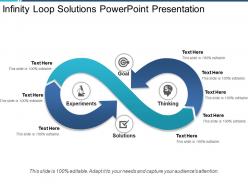
Infinity loop solutions powerpoint presentation
Try Before you Buy Download Free Sample Product
Audience
Editable
of Time
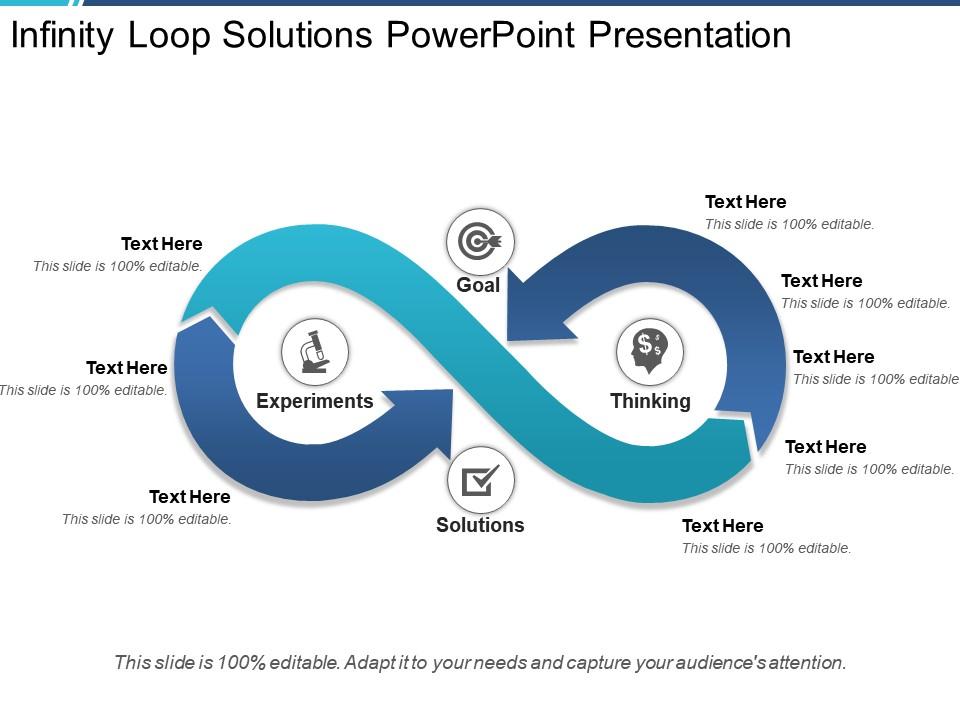
Explore infinite possibilities and solutions with our Infinity Loop Solutions PowerPoint Presentation. This infinite loop solution diagram created by SlideTeam can be used for numerous applications in daily life. This creative illustration shows how different experiments and logical and creative thinking can lead to problem solution or can lead to your target goal in any field. This infinite or unlimited loop can be used to explain various concepts and can be used to inspire students or young management professionals. Even businesses have been using this symbol in their logos, to explain their business models, marketing strategies and more. The illustration is generally used to depict the notion of endless boundaries. This PPT template allows you to edit the color, icons, text and so much more. So, if you are looking for a professionally designed, ready-to-use editable image of the infinity loop then you have come at the right place. Download our link and guide, inspire and motivate your audience. Build belief that you can do it with our Infinity Loop Solutions Powerpoint Presentation. They are equipped with all the facilities.
People who downloaded this PowerPoint presentation also viewed the following :
Infinity loop solutions powerpoint presentation with all 5 slides:
Achieve common ground with our Infinity Loop Solutions Powerpoint Presentation. Be able to arrive at a consensus.
FAQs for Infinity loop
So basically you're never actually "done" - it's all about cycling through analyze, tweak, test, repeat forever. No finish line here. Google's search algorithm is a perfect example - they're constantly adjusting it based on new data and changing conditions. Each round of changes informs what you do next, creating this feedback loop that just keeps going. You'll recognize it when your mindset shifts from "let's solve this problem" to "let's keep making this better." Honestly, it can feel weird at first since we're so used to having clear endpoints. Start by looking at where you already get feedback and build more systematic cycles around those spots.
First, figure out where feedback already happens in your workflow - that's your starting point. Set up metrics so you can track if things are actually getting better. Here's where most teams screw up though: the feedback just sits there instead of changing anything. Weekly or monthly check-ins work well, depends how fast you move. Honestly, assign someone to own this whole thing or it'll die like every other "great idea." Oh, and don't try to fix everything at once - pick one process first, nail it, then expand.
So tech, manufacturing, and retail companies crush it with infinity loop strategies - honestly makes sense since they're already swimming in data and feedback all day. Works best when your processes actually connect, you know? Like when customer complaints improve your product, which makes customers happier, which gets you better reviews. Healthcare's doing this now too, which is cool. Thing is, these industries already have systems talking to each other. One tiny improvement ripples everywhere. But if your departments never communicate? Fix that mess first before trying any fancy loop stuff.
So basically, linear methods are like following a recipe step-by-step until you're done. But the infinity loop? You keep cycling back to improve things based on what you learned. It's way better for messy, complicated problems where you don't have all the answers upfront. Like when I'm debugging code - I never get it right the first time anyway! Linear works fine if you know exactly what you're dealing with, but honestly, most interesting problems aren't that straightforward. Next time you're stuck on something complex, try looping back instead of pushing forward.
Yeah feedback's super critical here. Without it you're basically running in circles like a hamster wheel - I've totally been there before lol. The thing is, you need real data coming back to actually adjust what you're doing each time around. Both numbers and gut-check insights work. Short cycles are better too, don't wait forever to course-correct. Just make sure you're tracking stuff that actually matters and then do something with it. Otherwise you'll just pile up useless data and wonder why nothing's improving.
Start by watching your team - what makes them roll their eyes when it comes up again? Those repetitive tasks are goldmines for infinity loops. Map out how data flows through your processes, especially the stuff that circles back constantly. Customer feedback cycles are perfect for this, honestly way better than trying to tackle everything at once. Development sprints work too. Pick one annoying workflow and trace where info keeps bouncing around the same steps. You'll spot loop opportunities fast. The best part? Small tweaks in these cycles compound like crazy over time.
Honestly, the main thing is people just hate change - they're used to doing things one way and don't want to mess with it. Your legacy systems will be a total nightmare to integrate too, since they weren't designed for this stuff. Leadership always wants to see results immediately but these loops need time to actually work. Most teams don't even have the skills for iterative approaches yet, which is frustrating but true. Oh and budget fights are inevitable. My advice? Pick one department that's actually excited to try something new, prove it works there first, then use that success to convince everyone else.
Honestly, the whole trick is just automating those feedback cycles so you're not doing everything manually. Analytics platforms grab user data and dump it straight into your product pipeline - no babysitting required. AI tools are pretty solid for pattern recognition too, way quicker than trying to spot trends yourself. You can wire everything together with Zapier or build some APIs if you're feeling fancy. Once your systems talk to each other properly, each loop just runs itself. Frees you up to actually think about strategy instead of pushing data around all day.
Yeah, culture totally makes or breaks this stuff. I've watched teams crash and burn when they're too rigid - nobody wants to experiment if they'll get hammered for "failing." But places that already do the whole learn-from-mistakes thing? They pick it up way faster. You really need to look at your company culture first though. Some orgs are just... stuck, you know? If people aren't comfortable with continuous tweaking and feedback, the infinity loop thing won't work. Cross-team collaboration helps too. Honestly, I'd focus on getting that foundation right before jumping into any new processes. Otherwise you're just setting yourself up for frustration.
Netflix is probably the best example - it learns what you watch and suggests better stuff, which makes you watch more, which makes it smarter. Spotify does the same thing with those weekly playlists (honestly they're pretty good now). Amazon's warehouses automatically restock based on what they think you'll buy, then use that data to get better at predicting. Tesla's autopilot learns from every single car driving around. The trick is making sure each cycle actually improves things instead of just running in circles. You definitely need solid metrics to track if it's working.
Don't just tack metrics onto the end - weave them throughout your whole infinity loop. Monitor continuously so the data actually feeds back into each cycle. Track user behavior, system performance, business outcomes, all in real-time. Honestly, I've seen too many teams build beautiful dashboards that nobody acts on. Make sure your metrics actually drive the next iteration. Mix leading indicators (what's about to happen) with lagging ones (what already happened). Oh, and start simple - pick 3-5 metrics that really matter for your specific loop first. You can always add more later once you've got the rhythm down.
Honestly, I'd start with whatever diagramming tool you already have - even if it's just Visio. Miro's pretty solid for mapping out those annoying circular dependencies though. Lucidchart works too. The main thing is getting everyone on your team to actually use it (good luck with that). Once you've got the loops visualized, Bizagi's decent for process mapping if you want something fancier. Oh, and if you're doing dev cycles, Jira can track iterations - though it's kind of overkill sometimes. But seriously, just pick something simple first and make those loops visible to everyone.
Look, infinity loops only work when you've got your whole team actually involved. Different people spot different problems - way better than trying to figure everything out yourself. Trust me, I learned that the hard way when I tried running continuous improvement cycles solo and basically wanted to quit after two weeks. You need to split up the work across iterations or you'll burn out fast. Map out who's handling what in your current loop first. Then figure out where people need to collaborate more. The trick is making sure everyone gets their specific role in each phase, otherwise it's just chaos.
So infinity loops and design thinking are basically cousins - both hate that linear "step 1, 2, 3" bullshit because real problems don't work that way. You're bouncing between discovering what's actually wrong and building solutions, just like design thinking ping-pongs between empathy/definition and the ideate/prototype stuff. What I love about both is they never pretend you'll get it right the first time. Each loop teaches you something that makes the next one better. Honestly, try sketching your current project through both lenses - you'll probably spot gaps you missed before. Neither approach has a real "finish line" which is frustrating but also kind of liberating?
Honestly? You'll become way better at rolling with changes instead of getting blindsided by them. Once you start seeing those feedback loops everywhere - like how customer complaints actually improve your product, which makes people happier, which gives you better data - it's kinda addictive. Your team stops just putting out fires and starts hunting for ways to improve stuff before it breaks. Everyone gets into this habit of learning from what's already working (or not working, let's be real). The culture shift is probably the biggest win. Try mapping out just one process you deal with and see where outputs could loop back as inputs.
-
Amazing product with appealing content and design.
-
Excellent work done on template design and graphics.