Interview Method For Data Collection With Types Strategic Guide Of Methods To Collect Stratergy Ss
Try Before you Buy Download Free Sample Product
Audience
Editable
of Time
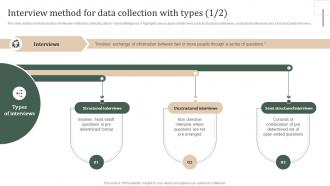
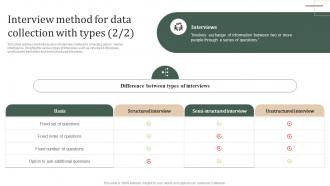
This slide outlines brief introduction of interview method for collecting data in market intelligence. It highlights various types of interviews such as structured interviews, unstructured interviews and semi structured interviews.
People who downloaded this PowerPoint presentation also viewed the following :
Interview Method For Data Collection With Types Strategic Guide Of Methods To Collect Stratergy Ss with all 7 slides:
Use our Interview Method For Data Collection With Types Strategic Guide Of Methods To Collect Stratergy Ss to effectively help you save your valuable time. They are readymade to fit into any presentation structure.
FAQs for Interview Method For Data Collection With Types Strategic Guide Of Methods To
Interview methods for data collection include structured interviews with predetermined questions, semi-structured interviews combining fixed and flexible elements, unstructured interviews allowing open dialogue, telephone interviews for remote accessibility, and focus group discussions. These approaches enable researchers to gather qualitative insights by facilitating deeper conversations, capturing nuanced perspectives, and accessing diverse participant experiences, with many organizations finding that strategic combinations deliver comprehensive data while minimizing resource constraints.
Structured interviews deliver consistent, comparable data through standardized questions and predetermined response categories, while unstructured interviews provide richer, more nuanced insights but with greater variability in quality and analysis complexity. Organizations like healthcare institutions and financial services increasingly use structured approaches for regulatory compliance and standardized assessments, while consulting firms leverage unstructured methods for strategic discovery, ultimately balancing consistency with depth based on research objectives.
Semi-structured interviews offer flexibility, depth, consistency, adaptability, and natural conversation flow for qualitative research. These approaches enable researchers to explore unexpected insights while maintaining focus, streamline data comparison across participants, and ultimately deliver richer findings, with many academic institutions and market research organizations finding that this balance enhances both data quality and research efficiency.
Interview method selection significantly impacts research validity by influencing response accuracy, participant comfort levels, data depth, and potential bias introduction. While structured interviews enhance reliability and comparability, semi-structured approaches often yield richer insights, with many researchers finding that method alignment with research objectives, participant demographics, and topic sensitivity ultimately determines data quality and findings credibility.
The interviewer significantly shapes data quality through questioning techniques, active listening skills, relationship building, and response interpretation. Through strategic probing and creating comfortable environments, experienced interviewers enhance participant openness, minimize bias, and extract deeper insights, with many research organizations finding that skilled interviewers ultimately deliver more comprehensive and actionable data outcomes.
Effective rapport-building enhances interview quality by creating psychological safety, encouraging honest responses, and reducing participant anxiety through active listening, empathy, and genuine interest. When interviewers establish trust and connection, participants share deeper insights, provide more detailed examples, and offer candid perspectives they might otherwise withhold, ultimately delivering richer, more authentic data for comprehensive analysis.
Techniques to minimize interviewer bias include standardized question protocols, multiple interviewer rotations, structured response frameworks, blind interview methods, and comprehensive bias training programs. These approaches streamline data collection by ensuring consistent questioning, reducing subjective interpretations, and maintaining objective evaluation criteria, with many research organizations finding that systematic interviewer preparation ultimately delivers more reliable insights and enhanced data quality across studies.
Cultural considerations significantly influence interview conduct through communication styles, power dynamics, language barriers, non-verbal interpretations, and trust-building approaches that vary across different cultural contexts. These factors affect data quality and interpretation, with many researchers finding that culturally adapted interview techniques, including culturally matched interviewers and culturally sensitive question framing, ultimately deliver more authentic responses and deeper insights.
Ethical considerations include informed consent, voluntary participation, confidentiality protection, data anonymization, and transparent disclosure of research purposes. These protocols enhance research credibility by establishing trust with participants, ensuring legal compliance, and maintaining professional integrity, with many organizations finding that robust ethical frameworks ultimately deliver higher response rates and more authentic insights.
Technology enhances interview data collection through automated transcription, video recording capabilities, AI-powered sentiment analysis, real-time collaboration tools, and cloud-based storage systems. These digital solutions streamline documentation processes, improve accuracy rates, and enable remote interviews across global teams, with many research organizations finding that integrated platforms ultimately deliver faster analysis and more comprehensive insights.
Pilot testing an interview guide validates question clarity, identifies potential issues, and ensures data collection effectiveness before full implementation. It enables researchers to refine interview flow, eliminate ambiguous questions, and estimate timing requirements, while revealing participant comprehension challenges, ultimately delivering more reliable data and streamlined research processes across diverse respondent groups.
Interview data can be effectively analyzed through systematic coding, thematic identification, pattern recognition, and cross-referencing responses to establish reliability and validity. Researchers typically employ qualitative analysis software, comparative analysis techniques, and triangulation methods to extract insights, with many organizations finding that structured analytical frameworks ultimately deliver actionable findings and evidence-based recommendations for strategic decision-making.
Strategies include purposive sampling across demographics, snowball sampling for hard-to-reach groups, stratified recruitment by key characteristics, cultural competency training for interviewers, and flexible interview formats. These approaches streamline representation by accommodating different communication styles, building trust through culturally aware practices, and systematically reaching varied populations, with many research organizations finding that diverse recruitment ultimately delivers richer insights and more comprehensive data outcomes.
Interview feedback enhances future data collection by identifying question ambiguities, revealing participant comfort levels, and highlighting gaps in information gathering approaches. This iterative improvement process enables researchers to refine questioning techniques, adjust interview structures, and develop more effective protocols, ultimately delivering higher quality data and more reliable insights for organizational decision-making.
Common interview challenges include participant reluctance, interviewer bias, inconsistent questioning, time constraints, and recording difficulties. These obstacles can be addressed by building rapport through active listening, using standardized guides while remaining flexible, conducting thorough preparation, and implementing multiple documentation methods, with many organizations finding that structured training and pilot testing significantly enhance data quality and participant engagement.
-
It makes easy work of my work presentations. I’ve never had to be nervous about my presentations for meetings.Â
-
Out of the box and creative design.