


Introduction Of Effective Credit Card Marketing Plan Powerpoint Presentation Slides Strategy CD V
A credit card marketing strategy plays a pivotal role in the attraction, conversion, and retention of potential customers. Our meticulously crafted PowerPoint Presentation titled, Introduction of Effective Credit Card Marketing Plan offers valuable insights to assist credit card businesses in addressing some of their key marketing challenges. Within this Social media engagement presentation, we outline the impact of a low customer acquisition rate and present effective marketing strategies to overcome this challenge, which includes leveraging sign up bonuses, personalized email campaigns, educational podcasts, and cost management. Furthermore, the Loyalty program presentation addresses the consequences of poor customer experiences and offers promotional strategies to enhance them, including print media advertising, limited time promotional campaigns, and seasonal marketing, all while considering expenditure allocation, team collaboration, and the overall impact of credit card marketing efforts. Download our 100 percentage editable and customizable template, compatible with Google Slides, to access a comprehensive resource designed to help credit card businesses navigate and overcome their marketing challenges effectively.
A credit card marketing strategy plays a pivotal role in the attraction, conversion, and retention of potential customers. ..










































-

- Google Slides is a new FREE Presentation software from Google.
- All our content is 100% compatible with Google Slides.
- Just download our designs, and upload them to Google Slides and they will work automatically.
- Amaze your audience with SlideTeam and Google Slides.
-

Want Changes to This PPT Slide? Check out our Presentation Design Services
-

- WideScreen Aspect ratio is becoming a very popular format. When you download this product, the downloaded ZIP will contain this product in both standard and widescreen format.
-

- Some older products that we have may only be in standard format, but they can easily be converted to widescreen.
- To do this, please open the SlideTeam product in Powerpoint, and go to
- Design ( On the top bar) -> Page Setup -> and select "On-screen Show (16:9)” in the drop down for "Slides Sized for".
- The slide or theme will change to widescreen, and all graphics will adjust automatically. You can similarly convert our content to any other desired screen aspect ratio.
Compatible With Google Slides

Get This In WideScreen
You must be logged in to download this presentation.


Do you want to remove this product from your favourites?
PowerPoint presentation slides
Deliver this complete deck to your team members and other collaborators. Encompassed with stylized slides presenting various concepts, this Introduction Of Effective Credit Card Marketing Plan Powerpoint Presentation Slides Strategy CD V is the best tool you can utilize. Personalize its content and graphics to make it unique and thought-provoking. All the fifty slides are editable and modifiable, so feel free to adjust them to your business setting. The font, color, and other components also come in an editable format making this PPT design the best choice for your next presentation. So, download now.

People who downloaded this PowerPoint presentation also viewed the following :
Content of this Powerpoint Presentation
Slide 1: This slide displays the title Introduction of Effective Credit Card Marketing Plan. Put your company name and begin.
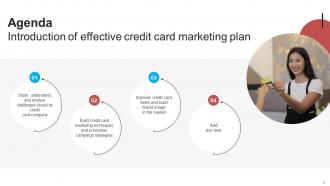
Slide 2: This slide displays the title Agenda.
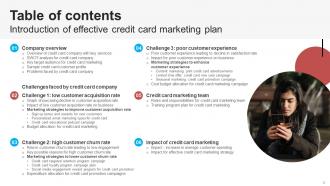
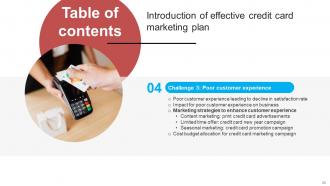
Slide 3: This slide exhibit table of content.
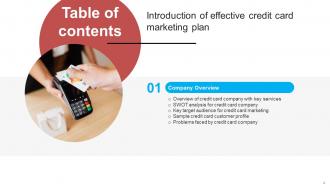
Slide 4: This slide exhibit table of content that is to be discuss further.
Slide 5: This slide represents outline for credit card company with its key services.
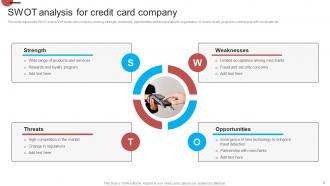
Slide 6: This slide represents SWOT analysis for credit card company covering strength, weakness, opportunities and threat related to organization.
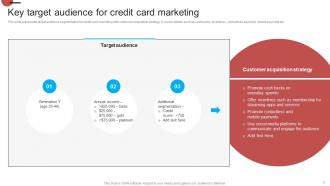
Slide 7: This slide represents target audience segmentation for credit card marketing with customer acquisition strategy.
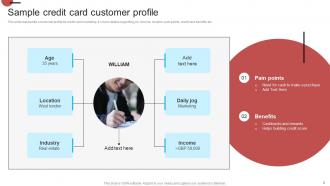
Slide 8: This slide represents a customer profile for credit card marketing.
Slide 9: This slide represents challenges faced by credit card companies.
Slide 10: This slide exhibit table of content that is to be discuss further.
Slide 11: This slide represents challenges faced by credit card companies i.e., decline in customer acquisition rate.
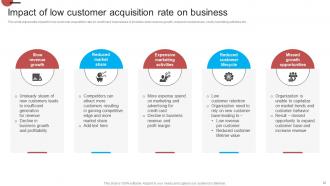
Slide 12: This slide represents impact for low customer acquisition rate on credit card businesses.
Slide 13: This slide represents marketing strategies to enhance customer acquisition rate.
Slide 14: This slide represents sign-up bonuses and rewards for new customers during credit card marketing that helps organizations enhance customer experience.
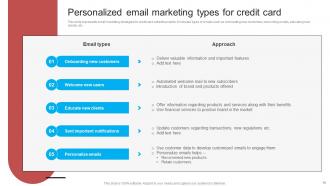
Slide 15: This slide represents email marketing strategies for credit card advertisements.
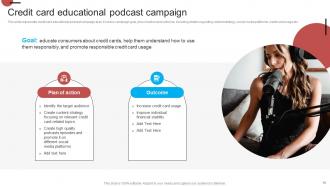
Slide 16: This slide represents credit card educational podcast campaign plan.
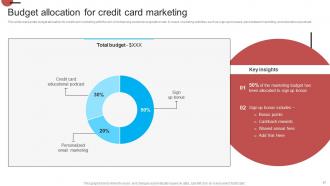
Slide 17: This slide represents budget allocation for credit card marketing with the aim of enhancing customer acquisition rate.
Slide 18: This slide exhibit table of content that is to be discuss further.
Slide 19: This slide represents challenges credit card companies face, i.e., an increase in customer churn rate.
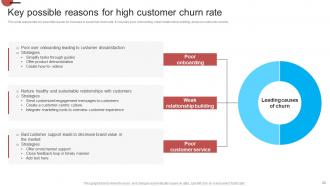
Slide 20: This slide represents key possible reason for increase in customer churn rate.
Slide 21: This slide represents marketing strategies credit card companies use to decrease customer churn rates.
Slide 22: This slide represents credit card incentive program that enables organization to attract potential customer attention.
Slide 23: This slide represents campaign plan for effective credit card loyalty program.
Slide 24: This slide represents social media reward program for credit card marketing.
Slide 25: This slide represents budget allocation for credit card marketing with the aim of decreasing customer churn rate.
Slide 26: This slide exhibit table of content that is to be discuss further.
Slide 27: This slide represents challenges credit card companies face, i.e., poor customer experience leading to declining satisfaction rates.
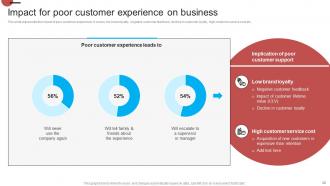
Slide 28: This slide represents the impact of poor customer experience.
Slide 29: This slide represents marketing strategies used by credit card companies to improve customer experience.
Slide 30: This slide represents print advertisements for credit card promotion that helps brand to build connection with potential audience in the market.
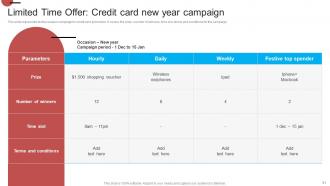
Slide 31: This slide represents festive season campaign for credit card promotion. It covers the prize, number of winners, time slot, terms and conditions for the campaign.
Slide 32: This slide represents credit card promotion campaign for end-of-season sales. It includes customer engagement rate, brand image, rewards and bonuses.
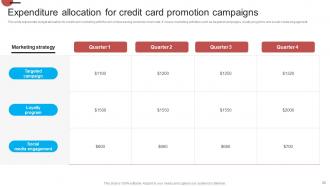
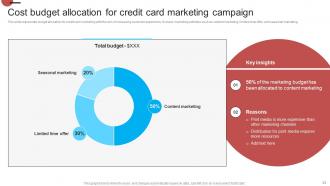
Slide 33: This slide represents budget allocation for credit card marketing with the aim of increasing customer experience.
Slide 34: This slide exhibit table of content that is to be discuss further.
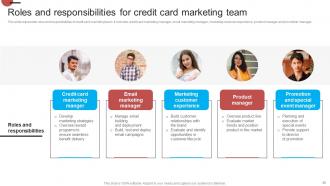
Slide 35: This slide represents roles and responsibilities of credit card marketing team.
Slide 36: This slide represents training program for credit card marketing.
Slide 37: This slide exhibit table of content that is to be discuss further.
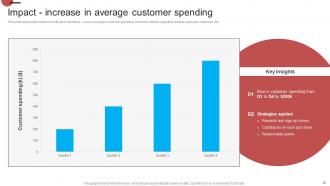
Slide 38: This slide represents impact of credit card marketing – a rise in average customer spending.
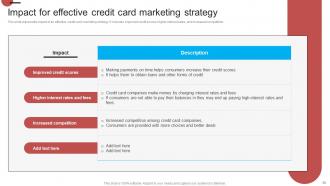
Slide 39: This slide represents impact of an effective credit card marketing strategy.
Slide 40: This is the icons slide.
Slide 41: This slide presents title for additional slides.
Slide 42: This slide represents key strategies for effective use of credit cards.
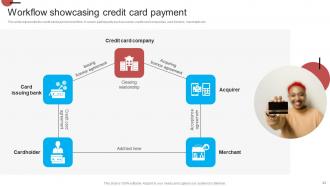
Slide 43: This slide represents the credit card payment workflow. It covers participants such as banks, credit card companies, card holders, merchants etc.
Slide 44: This slide represents types of credit cards that are issued to cardholders.
Slide 45: This slide represents key benefits that cardholders enjoy of using credit card.
Slide 46: This slide represents statistics associated with credit card market.
Slide 47: This slide represents future trends associated with credit card market. It covers barcodes, personalized moving hologram, fingerprint sensors etc.
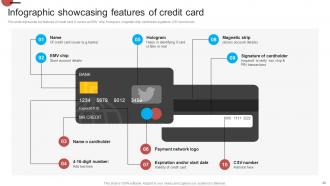
Slide 48: This slide represents key features of credit card. It covers an EMV chip, hologram, magnetic chip, cardholder signature, CSV number etc.
Slide 49: This slide represents levels of credit card tier system. It includes starter, no annual fee, mid-tier, premium, and invitation-only cards.
Slide 50: This is thank you slide & contains contact details of company like office address, phone no., etc.
Introduction Of Effective Credit Card Marketing Plan Powerpoint Presentation Slides Strategy CD V with all 59 slides:
Use our Introduction Of Effective Credit Card Marketing Plan Powerpoint Presentation Slides Strategy CD V to effectively help you save your valuable time. They are readymade to fit into any presentation structure.
-
Easy to edit slides with easy to understand instructions.
-
Wow! The design and quality of templates on SlideTeam are simply the best.
