ISO 9000 And Other Standards QCP Templates Set 2 Ppt Powerpoint Presentation Tips
Try Before you Buy Download Free Sample Product
Audience
Editable
of Time
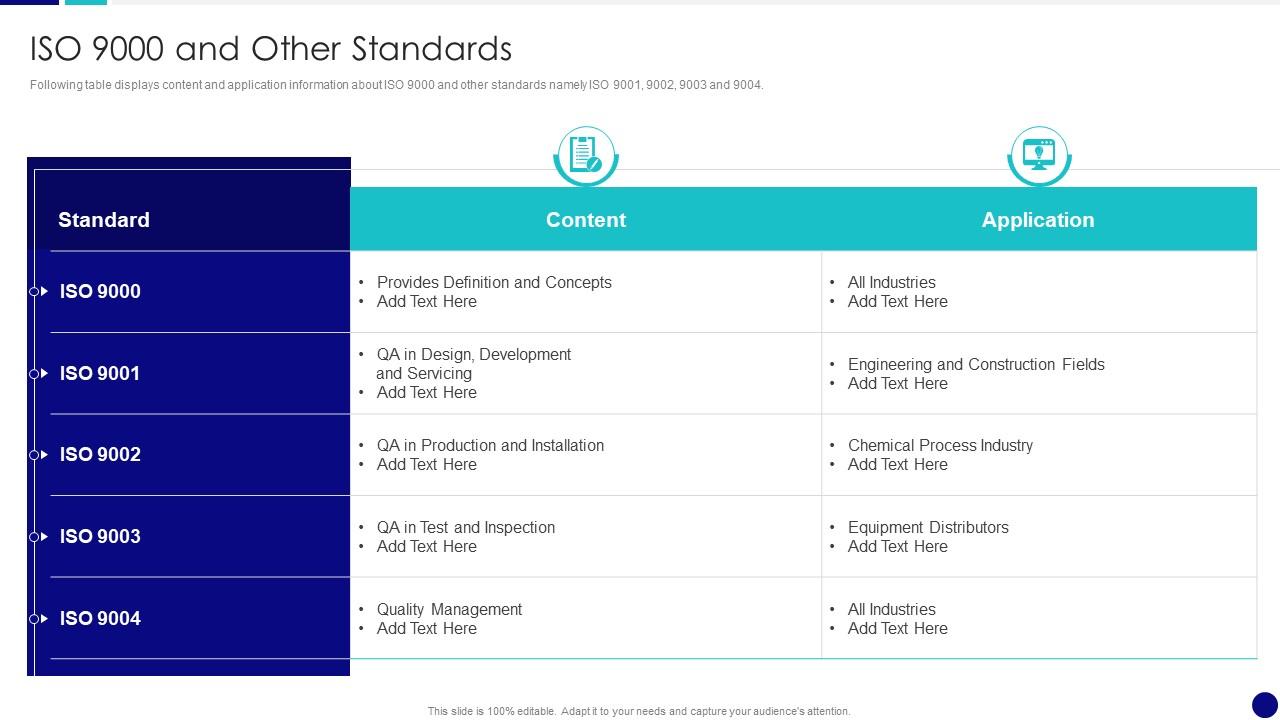
Following table displays content and application information about ISO 9000 and other standards namely ISO 9001, 9002, 9003 and 9004.
People who downloaded this PowerPoint presentation also viewed the following :
ISO 9000 And Other Standards QCP Templates Set 2 Ppt Powerpoint Presentation Tips with all 6 slides:
Use our ISO 9000 And Other Standards QCP Templates Set 2 Ppt Powerpoint Presentation Tips to effectively help you save your valuable time. They are readymade to fit into any presentation structure.
FAQs for ISO 9000 And Other Standards QCP Templates Set 2 Ppt
ISO 9000 standards are built on seven core principles: customer focus, leadership, engagement of people, process approach, improvement, evidence-based decision making, and relationship management. These principles enhance quality management by establishing systematic frameworks for consistent operations, reducing defects, and improving customer satisfaction, with many organizations across manufacturing, healthcare, and services finding that implementation ultimately delivers competitive advantage and operational excellence.
ISO 9000 provides fundamental quality management principles and vocabulary, while ISO 9001 establishes specific, auditable requirements for quality management systems that organizations must implement for certification. This distinction means businesses cannot get certified to ISO 9000 itself, but use it as foundational guidance when implementing ISO 9001 systems, ultimately streamlining their certification process and ensuring comprehensive quality framework understanding.
ISO 9000 implementation delivers enhanced customer satisfaction, improved operational efficiency, reduced costs, better risk management, and increased market credibility through systematic quality processes. Organizations across manufacturing, healthcare, and financial services find that these standards streamline workflows, minimize defects, and strengthen supplier relationships, ultimately providing competitive advantage in increasingly quality-conscious markets.
SMEs can effectively adopt ISO 9000 standards by starting with gap analysis, engaging leadership commitment, training employees, documenting processes systematically, and implementing changes incrementally rather than attempting wholesale transformation. Many manufacturing, service, and technology SMEs find that phased implementation with external consultant guidance streamlines certification timelines, reduces costs, and ultimately delivers improved operational efficiency, enhanced customer confidence, and competitive advantage in increasingly quality-focused markets.
Documentation serves as the foundation for ISO 9000 implementation by establishing clear procedures, maintaining quality records, ensuring process consistency, and enabling continuous improvement tracking. Through comprehensive documentation systems, organizations streamline compliance audits, enhance employee training effectiveness, and maintain operational transparency, with many companies finding that well-structured documentation ultimately delivers improved quality control and reduced implementation costs.
ISO 9000 standards facilitate continuous improvement through systematic quality management frameworks, regular process audits, corrective action protocols, and performance measurement requirements. These standards enable organizations to identify inefficiencies, streamline operations, and enhance customer satisfaction, with many manufacturing and service companies finding that consistent implementation ultimately delivers reduced costs, improved productivity, and sustained competitive advantage.
Common ISO 9000 maintenance challenges include ensuring consistent documentation updates, managing ongoing staff training requirements, conducting regular internal audits, adapting to evolving standard requirements, and maintaining process adherence across departments. These operational demands require dedicated resources and systematic approaches, with many organizations finding that establishing automated compliance tracking and regular cross-departmental reviews ultimately streamlines certification maintenance while enhancing overall quality management efficiency.
ISO 9000 standards align with Six Sigma and Lean through shared quality principles, process improvement methodologies, customer focus, and data-driven decision making. These frameworks complement each other strategically, with many manufacturing and service organizations finding that combining ISO's systematic documentation with Lean's waste reduction and Six Sigma's statistical control delivers enhanced operational efficiency and competitive advantage.
ISO 9000 certification significantly enhances customer satisfaction and loyalty by establishing consistent quality management systems, standardized processes, and continuous improvement frameworks. Organizations across manufacturing, healthcare, and financial services find that certification delivers more reliable products, faster complaint resolution, and enhanced service consistency, ultimately building stronger customer trust and reducing churn rates.
Organizations measure ISO 9000 effectiveness through key performance indicators like customer satisfaction scores, defect rates, process cycle times, and audit findings, alongside monitoring compliance metrics and corrective action trends. Through regular internal audits and management reviews, companies track operational improvements, cost reductions, and enhanced customer experiences, with many finding that systematic measurement ultimately delivers competitive advantage and sustained quality excellence.
**INPUT**: What is the process for obtaining ISO 9000 certification, and what are the required steps? **OUTPUT**: ISO 9000 certification involves gap analysis, documentation development, implementation, internal audits, and third-party assessment by accredited bodies. Organizations typically undergo management commitment phases, employee training, process mapping, and corrective actions, with many manufacturing and service companies finding that systematic preparation streamlines certification timelines while enhancing operational efficiency.
Organizations should review ISO 9000 compliance quarterly through internal audits and management reviews, with comprehensive annual assessments and recertification every three years. This structured approach enables continuous improvement while maintaining quality standards, with many manufacturing and service companies finding that regular reviews streamline processes, reduce defects, and ultimately deliver enhanced customer satisfaction and competitive advantage.
Internal audits serve as systematic evaluations that ensure ISO 9000 compliance, identify process improvements, verify documentation accuracy, and assess management system effectiveness across organizational functions. These audits enable companies to proactively address non-conformities, enhance operational efficiency, and maintain certification readiness, with many organizations finding that regular internal assessments ultimately strengthen quality controls and competitive positioning.
ISO 9000 standards enhance risk management by establishing systematic process documentation, continuous monitoring protocols, and preventive action frameworks that identify potential issues before they escalate. Through structured quality management systems, organizations in manufacturing, healthcare, and financial services streamline risk assessment procedures, improve operational transparency, and ensure regulatory compliance, ultimately delivering reduced liability exposure and enhanced stakeholder confidence.
**INPUT**: What are some case studies of organizations that successfully implemented ISO 9000 and the outcomes they achieved? **OUTPUT**: Organizations like Ford Motor Company, Motorola, and Boeing have successfully implemented ISO 9000, achieving significant improvements in product quality, customer satisfaction, and operational efficiency. These implementations delivered measurable outcomes including reduced defect rates, streamlined manufacturing processes, enhanced supplier relationships, and improved market competitiveness, with many finding that certification ultimately enables sustained growth and customer trust. *Word count: 60*
-
Impressive templates. Designing a presentation is fun now!
-
Easy to use and customize templates. Helped me give a last minute presentation.