

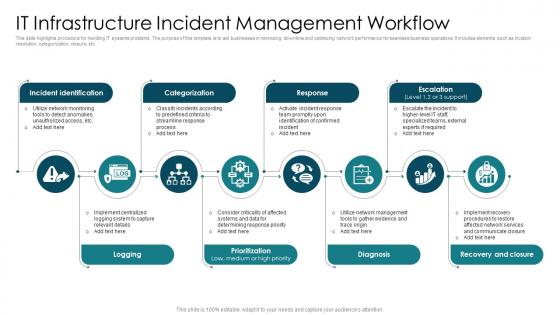
It Infrastructure Incident Management Workflow




Try Before you Buy Download Free Sample Product
 Impress Your
Audience
 100%
Editable
 Save Hours
of Time


This slide highlights procedure for handlingIT systems problems. The purpose of this template is to aid businesses in minimizing downtime and optimizing network performance for seamless business operations. It includes elements such as incident resolution, categorization, closure, etc.
People who downloaded this PowerPoint presentation also viewed the following :
It Infrastructure Incident Management Workflow with all 9 slides:
Use our It Infrastructure Incident Management Workflow to effectively help you save your valuable time. They are readymade to fit into any presentation structure.








FAQs for It Infrastructure
Effective IT incident management processes include incident detection and logging, categorization and prioritization, investigation and diagnosis, resolution and recovery, and comprehensive closure documentation. These components work together by enabling faster response times, minimizing business disruption, and maintaining service quality, with many organizations finding that structured workflows ultimately deliver improved user satisfaction and operational efficiency.
Organizations prioritize incidents using impact assessment matrices that evaluate business criticality, affected user counts, financial implications, and service dependencies. Through automated classification systems and predefined escalation protocols, IT teams can streamline response allocation, minimize downtime costs, and enhance service restoration speed, ultimately delivering improved customer experiences and operational resilience.
Communication serves as the backbone of effective IT incident management, ensuring stakeholders receive timely updates, technical teams coordinate seamlessly, and end-users understand service impacts and resolution timelines. Through structured communication protocols, organizations streamline response efforts, minimize confusion during critical outages, and maintain customer trust, with many enterprises finding that clear, consistent messaging ultimately reduces resolution times and enhances overall service reliability.
Automation improves incident management efficiency by enabling faster detection through monitoring tools, automatic ticket creation, intelligent routing to appropriate teams, and standardized response workflows. These capabilities significantly reduce manual intervention, minimize response times, and ensure consistent resolution processes, with many IT organizations finding that automated systems deliver 40-60% faster incident resolution and enhanced service reliability.
Best practices for documenting incidents include creating standardized templates, recording detailed timelines, capturing root cause analysis, documenting resolution steps, and maintaining accessible knowledge bases. These practices streamline future troubleshooting by enabling faster incident resolution, reducing repeat occurrences, and facilitating knowledge transfer across IT teams, ultimately delivering improved service reliability and operational efficiency.
Service level agreements significantly shape incident management by establishing response timeframes, escalation procedures, and performance metrics that guide prioritization and resource allocation. These contractual commitments drive organizations to implement automated ticketing systems, structured escalation paths, and continuous monitoring capabilities, ultimately delivering faster resolution times and enhanced customer satisfaction while ensuring accountability across IT teams.
Common IT incident management challenges include delayed response times, poor communication between teams, inadequate root cause analysis, inconsistent escalation procedures, and insufficient documentation practices. These obstacles can be overcome by implementing automated ticketing systems, establishing clear communication protocols, conducting thorough post-incident reviews, and creating standardized response playbooks, with many organizations finding that proactive monitoring and cross-functional training significantly reduce incident resolution times while enhancing overall system reliability.
Root cause analysis enhances future incident prevention by identifying underlying system vulnerabilities, process gaps, and recurring failure patterns that surface incidents reveal. Through systematic investigation methodologies, IT teams can implement proactive monitoring solutions, strengthen infrastructure weak points, and develop automated prevention protocols, ultimately reducing incident frequency by 40-60% while building more resilient operational frameworks.
Key metrics include Mean Time to Detection (MTTD), Mean Time to Resolution (MTTR), incident volume trends, customer satisfaction scores, and first-call resolution rates. These measurements enable organizations to identify performance gaps, optimize response processes, and demonstrate value to stakeholders, with many IT departments finding that tracking these metrics ultimately delivers faster service restoration and enhanced operational efficiency.
IT teams ensure proper training through regular tabletop exercises, scenario-based simulations, cross-functional workshops, incident playbook reviews, and role-specific skill development programs. These comprehensive approaches enhance response coordination, minimize resolution times, and improve communication protocols, with many organizations finding that consistent training reduces incident impact by up to 40% while building team confidence and operational resilience.
Popular IT incident management tools include ServiceNow, Jira Service Management, PagerDuty, Zendesk, and Freshservice, each offering distinct capabilities for tracking, escalation, and resolution workflows. While ServiceNow provides comprehensive enterprise-grade automation and ITIL compliance, PagerDuty excels in real-time alerting and on-call management, with many organizations finding that tool selection depends on their scale, budget, and integration requirements for optimal incident response.
Incident management integrates with ITSM frameworks through standardized workflows, automated ticketing systems, service level agreements, and cross-functional collaboration protocols. These integrations streamline communication between IT teams, enable faster resolution times, and provide comprehensive visibility into service performance, with many organizations finding that unified ITSM platforms ultimately deliver improved customer satisfaction and operational efficiency.
Post-incident reviews are crucial for transforming failures into strategic learning opportunities, identifying root causes, process gaps, and system vulnerabilities that led to disruptions. These comprehensive assessments enable organizations to strengthen their infrastructure, refine response protocols, and implement preventive measures, ultimately reducing future incident frequency and severity while building more resilient IT operations.
Organizations leverage incident management data for trend analysis by identifying recurring patterns, categorizing incidents by type and severity, tracking resolution times, and analyzing root causes across systems and timeframes. Through advanced analytics and reporting tools, businesses can predict potential failures, optimize resource allocation, and implement proactive measures, ultimately reducing downtime costs and enhancing operational efficiency.
Strategies include establishing clear role definitions, implementing transparent incident tracking systems, conducting blameless post-incident reviews, creating measurable response time goals, and recognizing teams for effective incident resolution. These approaches enhance accountability by promoting ownership, encouraging proactive communication, and building trust across IT teams, with many organizations finding that this ultimately reduces incident frequency and improves overall system reliability.
-
SlideTeam is my one-stop destination for templates. Highly recommended!
-
I really liked their customized design services. I got my desired template made by their expert team. Thank You!