IT Service Requests Management And Status Card

Rating:
90%
IT Service Requests Management And Status Card
Slide 1 of 6
Favourites Favourites

Try Before you Buy Download Free Sample Product

Audience Impress Your
Audience
Editable 100%
Editable
Time Save Hours
of Time
The Biggest Sale is ending soon in
0
0
:
0
0
:
0
0
Rating:
90%
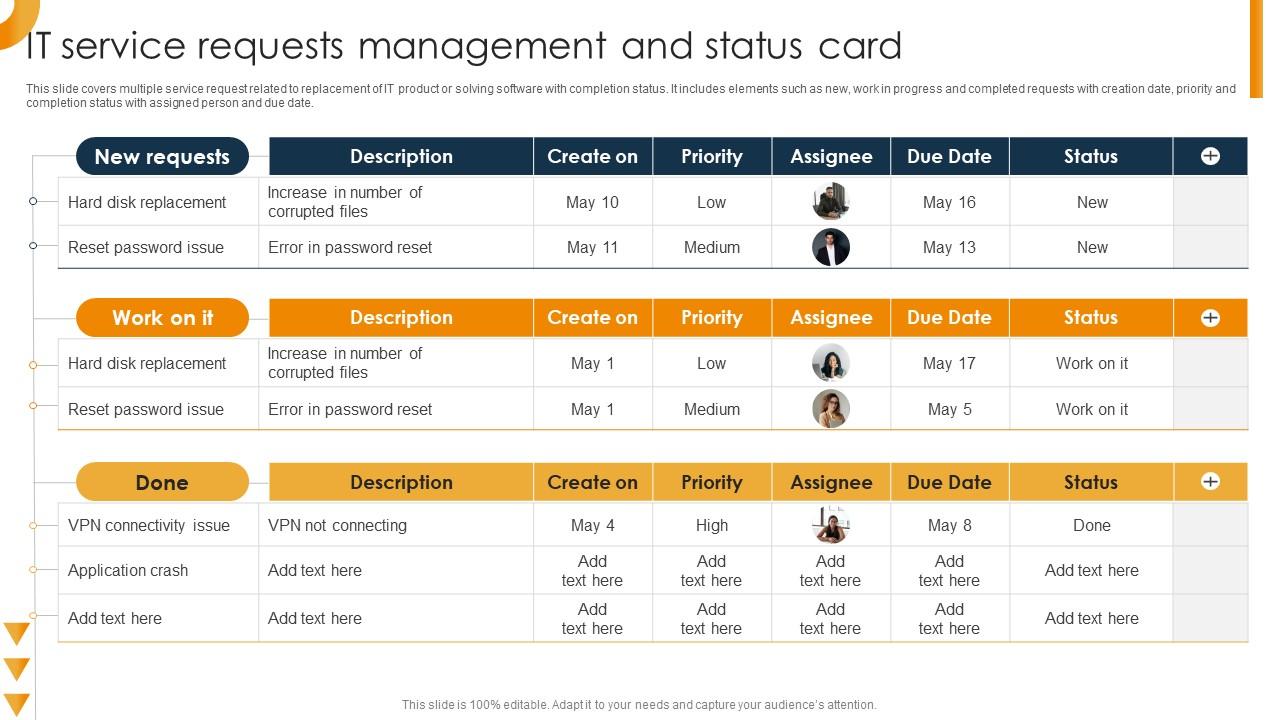
This slide covers multiple service request related to replacement of IT product or solving software with completion status. It includes elements such as new, work in progress and completed requests with creation date, priority and completion status with assigned person and due date. Introducing our IT Service Requests Management And Status Card set of slides. The topics discussed in these slides are Description, Priority, Service Requests, Management. This is an immediately available PowerPoint presentation that can be conveniently customized. Download it and convince your audience.

People who downloaded this PowerPoint presentation also viewed the following :

FAQs for IT Service Requests Management

Key elements include centralized request portals, automated workflows, clear categorization systems, defined approval hierarchies, and real-time tracking capabilities. These components streamline operations by reducing manual processing, ensuring consistent service delivery, and providing transparent status updates, with many organizations finding that automated routing and standardized templates ultimately deliver faster resolution times and improved user satisfaction.

Organizations leverage automation to enhance IT service request workflows through intelligent ticket routing, automated approval processes, self-service portals, and real-time status updates. These technologies streamline operations by reducing manual interventions, accelerating response times, and minimizing human errors, with many enterprises finding that automated workflows deliver faster service resolution and improved user satisfaction.

User experience determines IT Service Request success through intuitive interfaces, clear communication channels, transparent status tracking, and streamlined submission processes. Organizations with user-centric portals see significantly higher adoption rates and faster resolution times, while reducing help desk calls and enhancing overall employee satisfaction, ultimately delivering improved operational efficiency and stronger internal customer relationships.

IT teams can prioritize service requests through impact-urgency matrices, automated ticketing systems, SLA-based categorization, business-critical classification, and stakeholder input frameworks. These approaches streamline resource allocation by addressing high-impact issues first, automating routine requests, and establishing clear escalation paths, ultimately delivering faster resolution times and enhanced operational efficiency across organizations.

Organizations should track key metrics including request volume trends, average resolution time, first-call resolution rates, user satisfaction scores, and cost per request. These measurements enable IT teams to identify bottlenecks, optimize resource allocation, and enhance service delivery, with many enterprises finding that comprehensive metrics tracking reduces operational costs while significantly improving user experiences and strategic decision-making capabilities.

IT Service Request Management contributes to business continuity by establishing standardized workflows for critical system requests, automated escalation protocols, and comprehensive tracking of infrastructure dependencies during disruptions. Through integrated ticketing systems and predefined service catalogs, organizations streamline emergency resource allocation, accelerate restoration processes, and maintain operational visibility, with many enterprises finding that structured request management reduces recovery time significantly while enhancing resilience.

Common IT service request challenges include ticket backlogs, unclear request prioritization, inadequate resource allocation, poor communication between teams, and lack of automated workflows. Organizations overcome these through strategic implementation of ITSM platforms, standardized request categorization, and automated routing systems, with many enterprises finding that streamlined processes reduce resolution times by 40% while significantly enhancing user satisfaction and operational efficiency.

IT Service Request Management integrates with incident and problem management through shared workflows, common knowledge bases, and unified ticketing systems that enable seamless escalation and resource coordination. This strategic integration streamlines IT operations by reducing response times, minimizing duplicate efforts, and enhancing service delivery consistency, with many organizations finding that interconnected ITSM processes ultimately deliver improved user experiences and operational efficiency.

IT service request management tools include ITSM platforms like ServiceNow and Jira Service Management, automated workflow engines, AI-powered chatbots, self-service portals, and integration APIs. These technologies streamline operations by automating ticket routing, enabling self-service resolution, and providing real-time analytics, with many organizations finding that strategic combinations ultimately deliver faster response times and enhanced user experiences.

Knowledge management practices improve service request resolution by creating centralized documentation, standardizing troubleshooting procedures, and enabling self-service portals with searchable solutions. Through comprehensive knowledge bases, IT teams streamline ticket routing, reduce repetitive inquiries, and empower users with instant access to common fixes, ultimately delivering faster resolution times and enhanced operational efficiency.

Organizations can minimize service request backlogs through automated ticket routing, priority-based classification systems, self-service portals, proactive monitoring, and standardized response workflows. These practices streamline operations by reducing manual processing time, enabling faster resolution cycles, and improving resource allocation, with many IT departments finding that strategic automation ultimately delivers enhanced service quality and operational efficiency.

IT teams should handle emerging technology service requests by establishing dedicated evaluation frameworks, creating specialized support tiers, and developing standardized deployment protocols for cloud computing and IoT implementations. These approaches enable organizations to assess security implications, scalability requirements, and integration challenges systematically, with many enterprises finding that proactive governance ultimately streamlines adoption while maintaining operational control.

Teams managing IT Service Requests need comprehensive training in ITSM frameworks like ITIL, ticketing system proficiency, communication protocols, escalation procedures, and technical troubleshooting methodologies. Organizations increasingly find that combining formal certification programs with hands-on mentoring, regular knowledge base updates, and cross-functional collaboration workshops delivers faster resolution times, improved user satisfaction, and enhanced operational efficiency across service delivery teams.

Regular feedback from end-users improves IT Service Request Management by identifying process bottlenecks, revealing service gaps, and highlighting areas for automation enhancement. This user-driven insight enables IT teams to streamline request workflows, reduce resolution times, and enhance service delivery quality, with many organizations finding that systematic feedback collection ultimately delivers higher satisfaction rates and more efficient resource allocation.

Organizations can foster IT-business collaboration through cross-functional service request teams, shared SLA dashboards, regular stakeholder meetings, and embedded IT liaisons within business units. These strategies streamline communication, enhance transparency, and accelerate resolution times, with many companies finding that collaborative approaches reduce ticket volumes by 30-40% while significantly improving user satisfaction and operational efficiency.

Ratings and Reviews

90% of 100
Review Form
Write a review
Most Relevant Reviews
  1. 100%

    by Dorian Armstrong

    Graphics are very appealing to eyes.
  2. 80%

    by Donnell Bradley

    Slideteam offers pocket-friendly products. As a college student this is a really necessary thing to look at while paying for something.

2 Item(s)

per page: