Key Components Of Supply Chain Management In Aviation
Try Before you Buy Download Free Sample Product
Audience
Editable
of Time
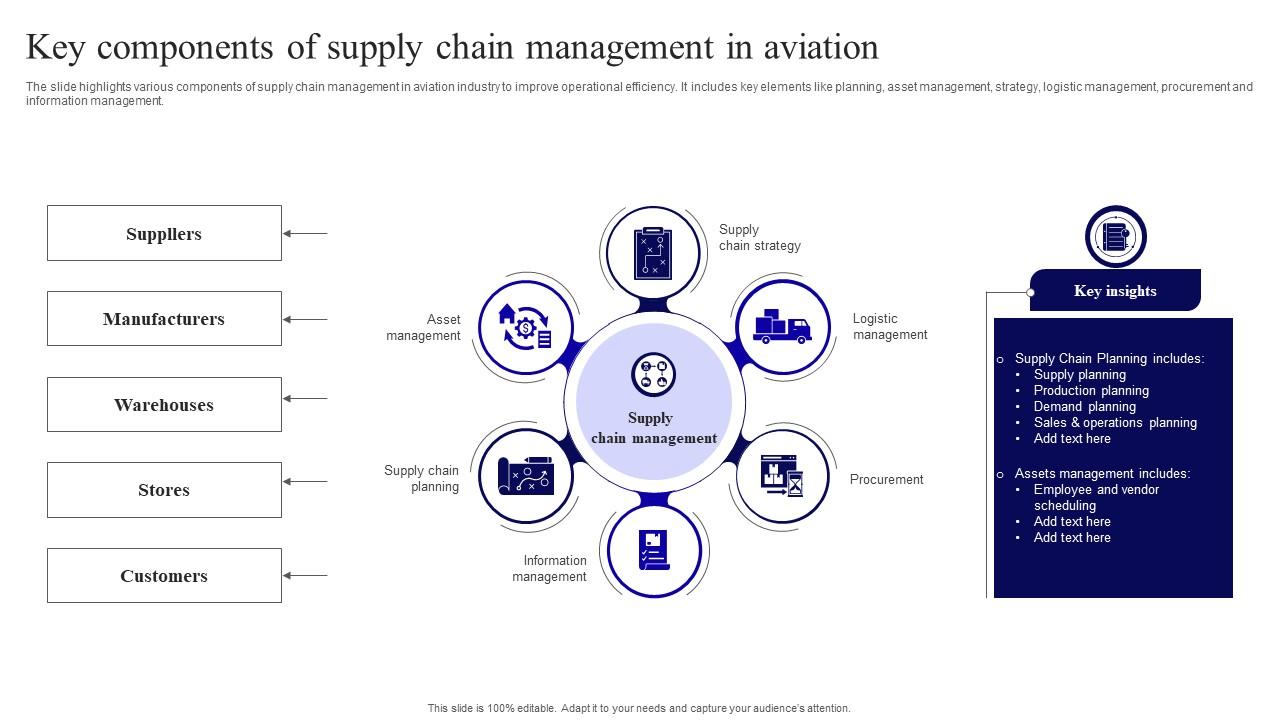
The slide highlights various components of supply chain management in aviation industry to improve operational efficiency. It includes key elements like planning, asset management, strategy, logistic management, procurement and information management.
People who downloaded this PowerPoint presentation also viewed the following :
Key Components Of Supply Chain Management In Aviation with all 6 slides:
Use our Key Components Of Supply Chain Management In Aviation to effectively help you save your valuable time. They are readymade to fit into any presentation structure.
FAQs for Key Components Of Supply Chain
Key components include demand forecasting, supplier relationship management, inventory optimization, logistics coordination, and regulatory compliance tracking. These systems enhance aviation operations by minimizing aircraft downtime, ensuring critical parts availability, and streamlining maintenance schedules, with airlines and manufacturers finding that integrated supply chain platforms deliver significant cost reductions and improved operational efficiency.
Regulatory challenges significantly impact aviation supply chain operations by requiring extensive documentation, compliance verification, and standardized certification processes across all components and suppliers. These requirements, while ensuring safety and quality standards, can extend lead times, increase costs, and create bottlenecks, with many airlines finding that proactive regulatory partnerships and digital compliance systems ultimately streamline operations and enhance competitive advantage.
Technology, particularly blockchain and IoT, revolutionizes aviation supply chain transparency by providing immutable transaction records, real-time component tracking, automated compliance monitoring, and end-to-end visibility across suppliers. These technologies enable airlines and manufacturers to streamline parts authentication, enhance maintenance scheduling, and minimize counterfeit components, ultimately delivering improved safety standards and operational efficiency.
Airlines can optimize inventory management through predictive analytics, automated reordering systems, strategic supplier partnerships, centralized warehousing, and real-time tracking technologies. These approaches streamline operations by reducing excess stock, minimizing aircraft downtime, and enhancing parts availability across maintenance hubs, with many carriers finding that integrated inventory systems deliver significant cost reductions while improving operational efficiency.
Major risks include flight cancellations and delays, increased operational costs, safety compliance challenges, inventory shortages of critical components, and significant revenue losses. These disruptions particularly impact airlines through grounding of aircraft, extended maintenance schedules, and passenger compensation costs, with many carriers finding that diversified supplier networks and strategic inventory management help minimize exposure while maintaining operational reliability.
Sustainable procurement transforms aviation supply chain strategies by prioritizing eco-friendly suppliers, implementing circular economy principles, and establishing carbon footprint reduction targets throughout vendor networks. Airlines increasingly evaluate suppliers based on environmental certifications, renewable energy usage, and waste reduction capabilities, while aerospace manufacturers integrate sustainable materials and ethical sourcing practices, ultimately delivering cost savings and regulatory compliance advantages.
Global trade policy significantly impacts aviation supply chain logistics through tariffs, trade agreements, regulatory compliance requirements, and cross-border restrictions that affect component sourcing and delivery timelines. These policies influence procurement strategies, inventory management, and supplier relationships, with many airlines and manufacturers finding that diversified global sourcing and strategic partnerships help mitigate risks while maintaining operational efficiency.
Data analytics enhances aviation supply chain forecasting by analyzing historical flight patterns, seasonal demand fluctuations, maintenance schedules, and passenger booking trends to predict parts requirements and inventory needs. Airlines like Delta and Lufthansa leverage predictive models to optimize inventory positioning, reduce stockouts, minimize carrying costs, and accelerate aircraft turnaround times, ultimately delivering improved operational efficiency and enhanced customer experiences.
Aviation suppliers' volatility can be mitigated through diversified supplier networks, strategic partnerships with multiple vendors, robust inventory management systems, and comprehensive risk assessment protocols. These approaches enable airlines and manufacturers to maintain operational continuity by reducing dependency on single sources, building buffer stocks for critical components, and establishing alternative supply channels, ultimately delivering enhanced resilience and competitive advantage in an increasingly complex aviation marketplace.
Collaboration between airlines, manufacturers, suppliers, and logistics providers enhances aviation supply chain performance by streamlining communication, synchronizing inventory management, and accelerating maintenance schedules. Through integrated platforms and shared data systems, stakeholders achieve reduced aircraft downtime, optimized parts availability, and faster turnaround times, ultimately delivering improved operational efficiency and enhanced passenger experiences.
The rise of e-commerce significantly transforms aviation supply chain dynamics through increased demand for air cargo capacity, expedited delivery requirements, enhanced tracking systems, and strategic partnerships with logistics providers. Airlines increasingly pivot toward freight-focused operations, while airports expand cargo facilities and implement automated sorting technologies, ultimately delivering faster global commerce and creating new revenue streams beyond traditional passenger services.
Geopolitical tensions significantly disrupt aviation supply chains by restricting access to critical materials, creating route diversification needs, and forcing supplier relationship restructuring. Airlines and manufacturers increasingly adopt multi-sourcing strategies, alternative routing protocols, and regional supplier networks, with many companies finding that diversified sourcing ultimately delivers greater resilience and operational flexibility.
Artificial intelligence enhances aviation supply chain decision-making through predictive analytics, demand forecasting, inventory optimization, supplier performance analysis, and real-time risk assessment. These AI-driven capabilities enable airlines and manufacturers to anticipate parts shortages, streamline procurement processes, and reduce maintenance delays, ultimately delivering improved operational efficiency and significant cost reductions across complex global supply networks.
Aviation firms can ensure supply chain resiliency by diversifying suppliers across multiple regions, maintaining strategic inventory buffers, implementing real-time visibility systems, and establishing contingency partnerships with alternative vendors. These practices enable airlines and manufacturers to quickly pivot during disruptions, minimize operational delays, and maintain service continuity, with many aviation companies finding that proactive risk assessment and flexible supplier relationships ultimately deliver competitive advantage in an increasingly volatile industry landscape.
Evolving consumer preferences drive aviation supply chains toward sustainability, personalization, and speed through eco-friendly sourcing, flexible inventory management, and enhanced digital integration. Airlines increasingly adopt sustainable fuel procurement, customizable service offerings, and real-time logistics systems, with many finding that responsive supply chains deliver improved customer satisfaction and operational efficiency in today's competitive market.
-
SlideTeam is very efficient when it comes to saving time. I am happy that I chose them for my presentation.
-
Wide collection of templates available. SlideTeam has made it easier to create presentations in just a few minutes.Â