Key Components Of Territory Management Planning

Rating:
90%
Key Components Of Territory Management Planning
Slide 1 of 9
Favourites Favourites

Try Before you Buy Download Free Sample Product

Audience Impress Your
Audience
Editable 100%
Editable
Time Save Hours
of Time
The Biggest Sale is ending soon in
0
0
:
0
0
:
0
0
Rating:
90%
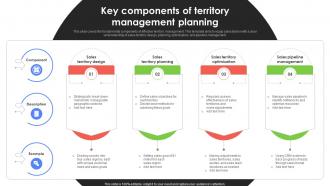
This slide covers the fundamental components of effective territory management. This template aims to equip sales teams with a clear understanding of sales territory design, planning, optimization, and pipeline management. Introducing our premium set of slides with name Key Components Of Territory Management Planning. Ellicudate the four stages and present information using this PPT slide. This is a completely adaptable PowerPoint template design that can be used to interpret topics like Sales Territory Design, Sales Territory Planning, Sales Territory Optimization. So download instantly and tailor it with your information.

People who downloaded this PowerPoint presentation also viewed the following :

FAQs for Key Components Of

Key benefits include optimized resource allocation, enhanced customer relationships, increased sales productivity, improved market coverage, and better competitive positioning. These strategies streamline operations by eliminating redundancies, maximizing rep efficiency, and ensuring consistent customer engagement, with many organizations finding that strategic territory alignment ultimately delivers higher revenue growth and sustainable competitive advantage.

Technology and CRM systems enhance territory management by automating territory assignments, tracking customer interactions, and providing real-time performance analytics across geographic regions. These platforms enable sales teams to optimize resource allocation, identify high-potential prospects, and monitor territory coverage gaps, while delivering comprehensive dashboards that streamline decision-making and ultimately boost sales productivity and revenue growth.

Organizations should track revenue growth, market penetration rates, customer acquisition costs, sales cycle lengths, and customer retention rates within each territory. These metrics enable businesses to identify high-performing regions, optimize resource allocation, and replicate successful strategies across underperforming areas, ultimately delivering improved sales efficiency and competitive advantage in increasingly complex markets.

Geographical and demographic factors significantly influence territory management by determining market potential, resource allocation requirements, and sales approach strategies. Dense urban areas with higher purchasing power may warrant smaller territories with specialized representatives, while rural regions require broader coverage areas, with demographic insights enabling companies to optimize route planning, customize product offerings, and ultimately maximize revenue per territory.

Common territory management challenges include unbalanced workloads, unclear boundaries, inadequate resource allocation, poor communication between teams, and difficulty tracking performance metrics across regions. These obstacles can be overcome by implementing data-driven territory mapping, establishing clear accountability frameworks, and utilizing CRM systems that enable real-time collaboration, ultimately delivering improved sales efficiency and enhanced customer coverage across all markets.

Businesses can align sales teams with territory management best practices by implementing clear territory boundaries, establishing data-driven assignment criteria, providing comprehensive training on local market dynamics, and creating balanced workload distribution systems. Through regular performance reviews and territory optimization tools, organizations streamline sales operations, enhance customer coverage, and ultimately deliver improved revenue outcomes while ensuring equitable opportunities across all sales representatives.

Data analytics plays a crucial role in optimizing territory allocation by analyzing customer demographics, sales performance, market potential, geographic proximity, and resource requirements. Through predictive modeling and performance metrics, organizations can strategically redistribute territories to balance workloads, maximize revenue opportunities, and improve customer coverage, ultimately delivering enhanced sales efficiency and competitive advantage.

Businesses ensure fair territory division by analyzing historical sales data, market potential, geographical factors, customer density, and workload distribution across regions. Through strategic territory mapping software and regular performance reviews, companies balance revenue opportunities with travel requirements and customer relationships, while adjusting boundaries based on market changes, ultimately delivering equitable growth opportunities for all representatives.

Territory analysis best practices include demographic research, competitive landscape mapping, customer segmentation, sales performance evaluation, and market potential assessment. These methods enable sales teams to identify high-opportunity areas, optimize resource allocation, and develop targeted strategies, with many organizations finding that systematic territory analysis increases conversion rates and revenue while reducing travel costs and improving customer coverage efficiency.

Companies should approach territory realignment by analyzing market data, customer distribution patterns, sales performance metrics, and competitive landscapes to identify optimization opportunities. This strategic process involves redistributing accounts based on potential and proximity, rebalancing workloads among sales representatives, and implementing gradual transitions, with many organizations finding that systematic realignment delivers improved coverage, enhanced customer relationships, and increased revenue performance.

Territory management significantly impacts customer satisfaction and retention by ensuring consistent account coverage, faster response times, personalized service delivery, and stronger relationship building through dedicated representatives. When sales territories are strategically organized, customers receive more focused attention, streamlined communication, and tailored solutions that address their specific regional needs, ultimately delivering enhanced experiences and improved loyalty rates.

Sales teams should receive training in territory mapping, customer segmentation, CRM utilization, time management, and data analytics to effectively manage their territories. This comprehensive approach enables representatives to prioritize high-value prospects, optimize travel routes, and track performance metrics, with many organizations finding that structured territory management training increases sales productivity by 15-20% while reducing operational costs.

Customer segmentation enables businesses to optimize territory management by grouping customers based on demographics, purchasing behavior, geographic location, and revenue potential, allowing for more strategic resource allocation. Through targeted segmentation, companies can assign specialized sales teams to high-value accounts, customize service approaches for different customer types, and prioritize territories with the greatest growth opportunities, ultimately delivering enhanced customer experiences and improved sales performance.

Essential territory management tools include CRM systems, mapping software, route optimization platforms, sales analytics dashboards, and mobile field applications. These technologies streamline operations by automating territory assignments, optimizing travel routes, and tracking performance metrics, with many sales organizations finding that strategic integration of these tools delivers improved coverage, reduced costs, and enhanced customer relationships.

Effective territory management contributes to growth strategy by optimizing resource allocation, maximizing market penetration, and identifying expansion opportunities across geographic regions. Through strategic territory alignment, companies streamline sales operations, enhance customer coverage, and accelerate revenue generation, with many organizations finding that well-structured territories deliver improved market share and competitive positioning.

Ratings and Reviews

90% of 100
Review Form
Write a review
Most Relevant Reviews
  1. 100%

    by Jack Johnson

    The best part about SlideTeam is their meticulously prepared presentations (complete-decks and single-slides both), infused with high-quality graphics and easy to edit. All-in-all worthy products.
  2. 80%

    by Douglass Riley

    “As you have innovative ideas and they are all customizable, this saves a huge chunk of your time to prepare well-read presentations.”

2 Item(s)

per page: