Key Features Of Product Planning With Its Impact

Rating:
80%
Key Features Of Product Planning With Its Impact
Slide 1 of 6
Favourites Favourites

Try Before you Buy Download Free Sample Product

Audience Impress Your
Audience
Editable 100%
Editable
Time Save Hours
of Time
The Biggest Sale is ending soon in
0
0
:
0
0
:
0
0
Rating:
80%
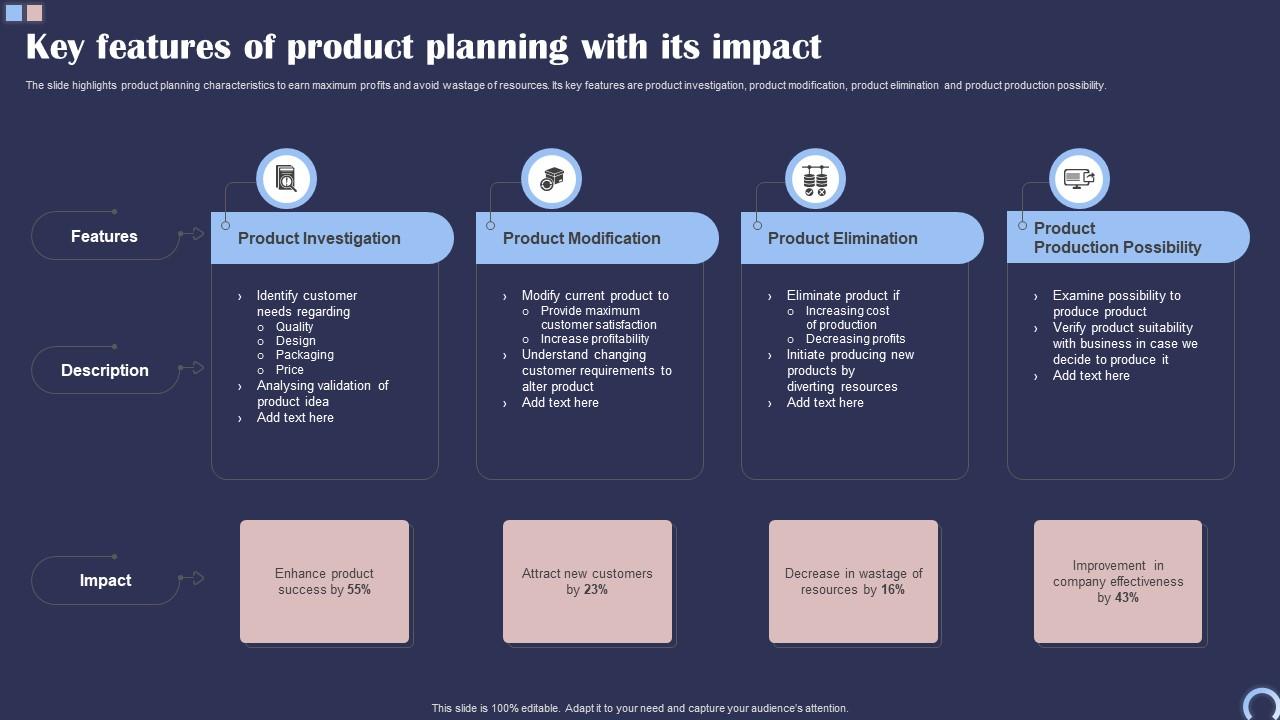
The slide highlights product planning characteristics to earn maximum profits and avoid wastage of resources. Its key features are product investigation, product modification, product elimination and product production possibility.Introducing our premium set of slides with Key Features Of Product Planning With Its Impact. Ellicudate thefour stages and present information using this PPT slide. This is a completely adaptable PowerPoint template design that can be used to interpret topics like Product Investigation, Product Modification, Product Elimination. So download instantly and tailor it with your information.

People who downloaded this PowerPoint presentation also viewed the following :

FAQs for Key Features Of Product Planning

So there are five main stages: discovery (figuring out your market), ideation (coming up with solutions), validation (testing with real users), planning (roadmaps and priorities), and execution (building the thing). Most teams totally blow it at validation though - they get way too attached to their first idea. You've gotta talk to actual customers before you even think you know what to build. I learned this the hard way on my last project, honestly. Each stage connects to the next one, so don't rush through them. Get that product-market fit locked down first or you'll just waste time and money later.

Honestly, market research is just about getting actual data instead of making stuff up about what customers want. You can test ideas before wasting time building them, figure out which features people actually care about, and find opportunities your competitors totally missed. Way better than guessing, though you'll be drowning in spreadsheets. Use it to build your roadmap around real demand, not whatever your team thinks sounds cool. Oh, and always - seriously, always - test your big assumptions with real users first. Saves you from building something nobody wants.

Dude, customer feedback is like having a GPS for your product - shows you what people actually need vs what you're guessing they want. You'll catch pain points and feature requests you'd never think of otherwise. Seriously, I've seen some brilliant features come from really pissed off support tickets that exposed huge blind spots. Set up those feedback channels early - surveys, user calls, digging through support data, that whole thing. But here's the thing most people mess up: actually tell customers when you build what they asked for. Closes the loop and they'll keep giving you gold.

Honestly, RICE scoring has saved my butt so many times - it's Reach, Impact, Confidence, Effort. Get feedback from your customers, sales team, support folks first though. They know where the real pain is. I'm obsessed with impact vs effort matrices because you can literally see the quick wins jump out at you. Super visual. Just make sure whatever you prioritize actually matches your business goals this quarter. Things change fast. Oh, and be upfront about how you're scoring stuff. Otherwise stakeholders will bug you constantly about why their pet feature didn't make the cut.

Honestly, start with something like ProductPlan or Aha! for roadmapping - they're solid for timelines and priorities. Scrum or Kanban frameworks work great for breaking stuff into sprints. User story mapping is my favorite though, it actually connects features to what people need instead of just... making features because they sound cool. For research, Typeform surveys are decent and Calendly makes scheduling interviews way easier. You'll need project management too - Asana or Linear both work. But seriously, pick maybe 3 tools max and stick with them. I used to switch tools constantly and it was such a waste of time.

Honestly, competitive analysis just stops you from building stuff nobody wants. I'm always creeping on competitor release notes - probably too much lol. But you'll spot gaps they missed and see what features users actually give a damn about. Market trends show the bigger picture too. Are you swimming against user preferences or riding a wave that's about to die? Monthly audits of your top 3 competitors work well. Pick 2-3 key market indicators and track them consistently. Helps you catch behavior shifts before everyone else notices.

Track both leading and lagging indicators - you need the full picture. Leading stuff like user engagement and feature adoption rates help you catch trends early. Revenue growth and customer retention show your long-term impact. Honestly? I've watched teams obsess over vanity metrics that mean absolutely nothing. Pick 3-5 key ones max that actually connect to your business goals. Otherwise you're just drowning in random data. Set up a basic dashboard and review weekly with your team. Keep it simple - complexity kills clarity here.

Honestly, the trick is getting everyone's input *before* you start making calls - I cannot stress this enough after watching teams blow it repeatedly. Your usual suspects need face time: engineering talks feasibility, design brings user insights, marketing handles launch stuff, sales drops customer feedback. Weekly check-ins work great, plus most people use shared roadmaps and tools like Miro to stay on the same page. Oh, and map out who actually needs to approve what decisions first - saves you from those painful "wait, nobody told marketing?" moments later. Trust me on that one.

Honestly, the biggest mistake is planning way too far out without checking if you're even right about stuff. Don't try building everything at once either - just nail the core features first. So many teams think "build it and they'll come" which is total BS. Talk to your actual users! Also, loop in engineering early or you'll end up with completely unrealistic timelines (been there). Oh and here's something random - I always forget to check in with existing customers before adding new features, which is dumb because they're right there. Start by testing your biggest assumptions, then be ruthless about prioritizing based on what people actually tell you.

Look, a roadmap is basically your visual timeline that connects daily tasks to the big picture stuff. It shows how features connect and helps you catch bottlenecks before they bite you. Way better than trying to explain scattered user stories to executives - learned that the hard way! You'll make smarter trade-offs too since moving things around becomes obvious when it's all laid out visually. Everyone stays on the same page about priorities. Start with your major themes first, then add specific features under each one. Makes the whole planning process less of a headache honestly.

Look, you gotta bake flexibility right into your roadmap from day one. Set aside some budget for experimenting with new stuff - don't blow it all on proven tech. Your engineers are usually the first to spot what's coming, so actually listen to them (crazy concept, right?). Pick maybe 2-3 emerging technologies that make sense for your product vision. Build tiny proof-of-concepts first. Test viability before you dump serious money into anything. The trick is staying ahead without chasing every flashy new thing that pops up. Been there, learned that lesson the hard way.

So basically you want to weave this stuff into your planning from day one, not tack it on later. Ask yourself where materials actually come from, what your carbon footprint looks like, whether you're paying decent wages down the chain. I'll be honest - it feels like extra work at first, but companies are expecting this now. Just add these questions to your usual decision-making checklist alongside cost and timing. Oh, and don't try to track everything at once. Pick one thing - maybe carbon or waste - and get good at measuring that first. Way less overwhelming that way.

Look, your UVP is what stops customers from scrolling past you to the next option. Without one? You're drowning in a sea of "meh, they all look the same." It shapes everything - which features you build, how you talk about your product, what fires you put out first. I swear, half the failed startups I know tried being a Swiss Army knife instead of the best damn screwdriver. Your UVP keeps everyone focused and gives your team something to rally around. Ask yourself: what's the one thing you do that nobody else can touch?

So PLM is basically your roadmap for timing decisions right. You're always choosing what features to build or where to spend money, but it helps you figure out *when* based on your product's stage. Why would you dump resources into new features when something's obviously dying? The intro/growth/maturity/decline phases should totally drive your planning - what goes on the roadmap, how you allocate resources, when to start thinking about sunsetting stuff. Map your planning cycles to where you actually are in the lifecycle. That way you're getting ahead of market shifts instead of just scrambling to catch up after they happen.

Honestly, just build feedback into everything you do. After each release, sit down with your team and figure out what sucked and what didn't. Customer feedback is pure gold - set up ways to capture it through interviews, support tickets, whatever works. Monthly check-ins are clutch too, way better than waiting until stuff breaks. Pick your metrics upfront so you can actually tell if your decisions worked out. Oh and quarterly reviews? Game changer, seriously. The whole point is making it regular, not just panic-mode damage control when things go sideways.

Ratings and Reviews

80% of 100
Review Form
Write a review
Most Relevant Reviews
  1. 80%

    by Charley Bailey

    Graphics are very appealing to eyes.
  2. 80%

    by David Snyder

    Great quality product.

2 Item(s)

per page: