KPI Metrics Scorecard To Measure Leading HR Indicators
Try Before you Buy Download Free Sample Product
Audience
Editable
of Time
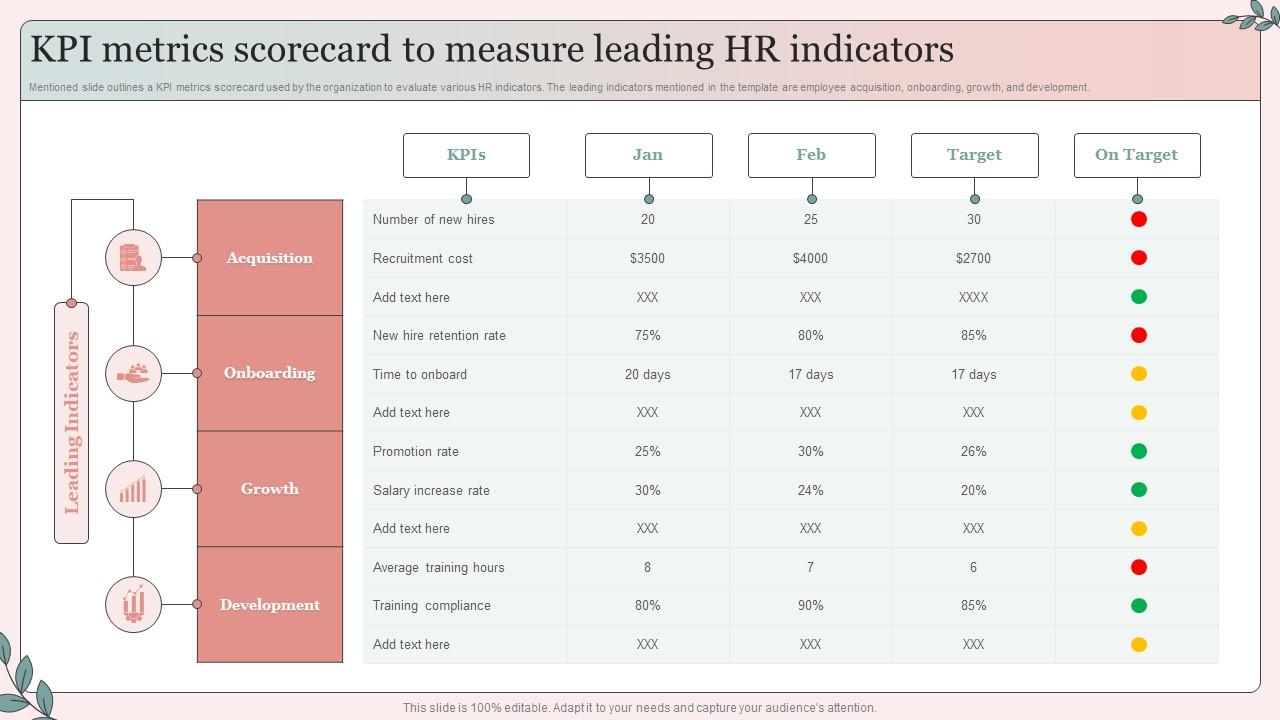
Mentioned slide outlines a KPI metrics scorecard used by the organization to evaluate various HR indicators. The leading indicators mentioned in the template are employee acquisition, onboarding, growth, and development.
People who downloaded this PowerPoint presentation also viewed the following :
KPI Metrics Scorecard To Measure Leading HR Indicators with all 6 slides:
Use our KPI Metrics Scorecard To Measure Leading HR Indicators to effectively help you save your valuable time. They are readymade to fit into any presentation structure.
FAQs for KPI Metrics Scorecard To Measure
Essential KPIs include revenue growth rate, customer acquisition cost, profit margins, employee productivity metrics, and customer satisfaction scores. These metrics enable organizations to track operational efficiency, financial health, and market competitiveness across sectors, with many businesses finding that combining financial and operational KPIs delivers comprehensive performance insights and strategic advantage.
KPIs align with strategic goals by establishing clear connections between measurable outcomes and organizational objectives, incorporating stakeholder input, and implementing regular review cycles. Through cascading goal frameworks, companies like retail chains and financial institutions translate high-level strategic priorities into department-specific metrics, while maintaining quarterly assessments that ensure KPIs evolve with changing business priorities, ultimately delivering strategic focus and operational accountability.
Data visualization transforms complex KPI metrics into clear, actionable insights through interactive dashboards, charts, graphs, and real-time displays that highlight trends and performance patterns. These visual tools enable executives and teams to quickly identify opportunities, spot anomalies, and make data-driven decisions faster, with many organizations finding that visual KPI presentations significantly enhance strategic planning and operational responsiveness.
Organizations should review KPI metrics quarterly for strategic alignment and monthly for operational performance, with annual comprehensive evaluations to ensure relevance and effectiveness. This structured approach enables businesses to maintain agility in dynamic markets while tracking progress toward goals, with many companies finding that regular reviews enhance decision-making accuracy and competitive positioning.
Common pitfalls when selecting KPIs include choosing too many metrics, focusing on vanity metrics over actionable ones, selecting indicators misaligned with strategic objectives, and picking metrics that can't drive meaningful decisions. Organizations increasingly find that streamlining to 5-7 relevant KPIs, emphasizing outcome-based measures, and ensuring clear ownership ultimately delivers better performance visibility and strategic focus.
Leading indicators predict future performance through metrics like customer acquisition rates, employee training hours, and sales pipeline activity, while lagging indicators measure historical results such as revenue, customer satisfaction scores, and market share. Organizations typically combine both types strategically, with leading indicators enabling proactive decision-making and course corrections, while lagging indicators validate outcomes and strategic effectiveness.
Overlooked industry-specific KPIs include patient readmission rates in healthcare, inventory turnover velocity in retail, customer acquisition cost per channel in SaaS, employee utilization rates in consulting, and regulatory compliance scores in financial services. These metrics often reveal operational inefficiencies and competitive gaps that traditional KPIs miss, with many organizations finding that tracking these delivers deeper insights into performance bottlenecks and strategic opportunities.
Organizations ensure KPI relevance through regular quarterly reviews, continuous market monitoring, stakeholder feedback integration, and agile adjustment processes that align with shifting business priorities. These strategic approaches enable companies to adapt performance metrics dynamically, with many finding that flexible KPI frameworks deliver enhanced competitive positioning and operational responsiveness in increasingly volatile market environments.
KPI tracking tools include Google Analytics, Tableau, Microsoft Power BI, HubSpot, and Salesforce Analytics, along with specialized dashboards like Klipfolio and Geckoboard. These platforms streamline data collection, automate reporting processes, and deliver real-time visualizations, with many organizations finding that integrated analytics solutions enhance decision-making speed and operational efficiency across departments.
KPIs drive employee performance and engagement by establishing clear expectations, providing transparent feedback mechanisms, and connecting individual contributions to organizational goals. Through performance dashboards and regular reviews, employees in sales, customer service, and operations gain visibility into their impact, while gamification and recognition programs based on KPI achievements foster motivation, ultimately creating accountability and career development pathways.
SMART criteria ensure KPIs are Specific, Measurable, Achievable, Relevant, and Time-bound, creating clear performance benchmarks that drive meaningful business outcomes. This framework enables organizations to track progress effectively, align teams around concrete objectives, and make data-driven decisions, with many companies finding that SMART KPIs significantly enhance accountability and strategic execution.
Qualitative KPIs complement quantitative measures by providing context, depth, and human insights that numbers alone cannot capture, including employee satisfaction, customer sentiment, brand perception, and cultural alignment. While quantitative metrics deliver measurable outcomes like revenue and efficiency, qualitative indicators help organizations understand the "why" behind performance trends, ultimately enabling more strategic decision-making and sustainable growth.
Effective KPI communication strategies include visual dashboards, executive summaries, contextualized reporting, regular cadence meetings, and stakeholder-specific formats tailored to different audience needs. These approaches enhance transparency by presenting data clearly, highlighting trends and variances, and connecting metrics to strategic objectives, with many organizations finding that consistent, visual communication drives better decision-making and accountability.
Organizations utilize benchmarking in KPI metrics by comparing their performance against industry standards, competitors, and best-in-class companies to identify improvement opportunities and set realistic targets. Through competitive analysis and industry research, companies can establish meaningful KPI thresholds, uncover performance gaps, and develop strategic initiatives that enhance operational efficiency, ultimately delivering sustainable competitive advantage in increasingly data-driven markets.
Employee feedback plays a crucial role in refining KPI metrics by providing frontline insights into operational realities, data accuracy, and measurement feasibility across different departments and functions. Through structured feedback processes, organizations can identify metrics that truly reflect performance while eliminating those that create inefficiencies, with many companies finding that employee-validated KPIs drive better engagement and more meaningful business outcomes.
-
“Thank you to the SlideTeam. Your presentations look really skillful and have made my life so much easier.”
-
Qualitative and comprehensive slides.