Kpis For Healthcare Quality Improvement For Patient Satisfaction
Try Before you Buy Download Free Sample Product
Audience
Editable
of Time
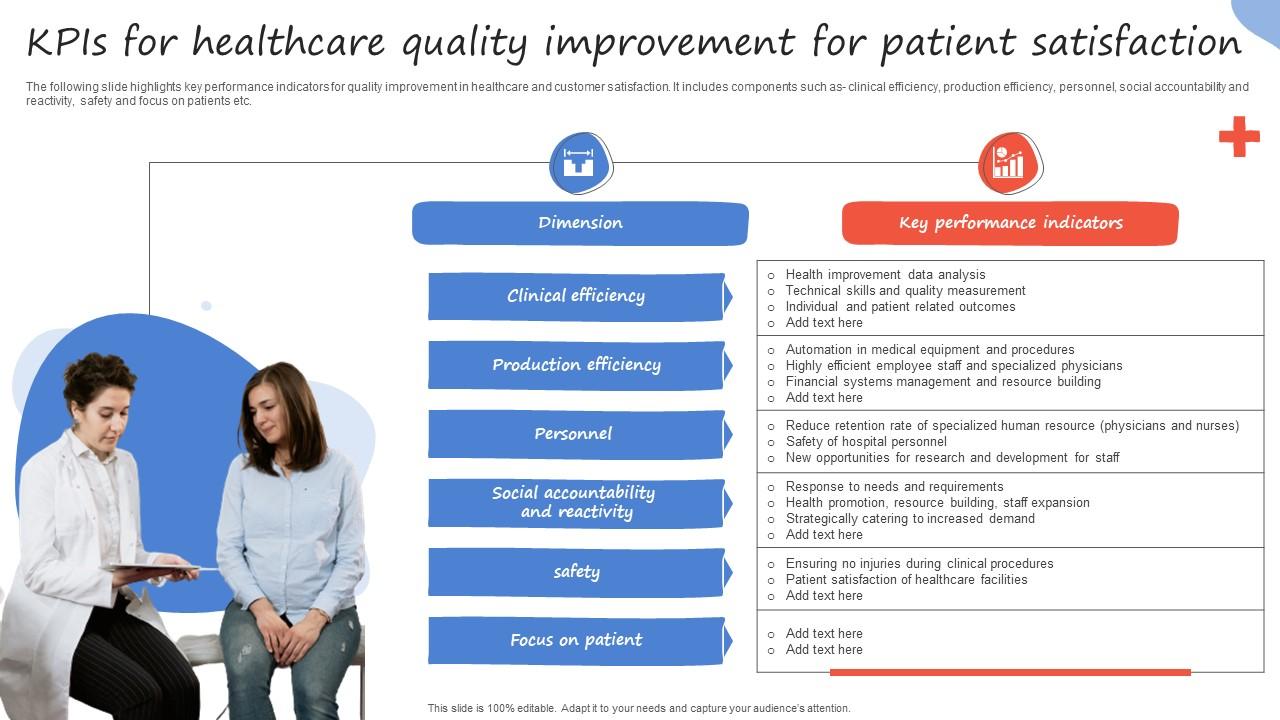
The following slide highlights key performance indicators for quality improvement in healthcare and customer satisfaction. It includes components such as- clinical efficiency, production efficiency, personnel, social accountability and reactivity, safety and focus on patients etc.
People who downloaded this PowerPoint presentation also viewed the following :
Kpis For Healthcare Quality Improvement For Patient Satisfaction with all 6 slides:
Use our Kpis For Healthcare Quality Improvement For Patient Satisfaction to effectively help you save your valuable time. They are readymade to fit into any presentation structure.
FAQs for Kpis For Healthcare Quality Improvement
Critical patient safety KPIs include medication error rates, healthcare-associated infection rates, patient fall incidents, readmission rates within 30 days, and adverse event reporting frequency. These metrics enable healthcare organizations to identify risk patterns, streamline safety protocols, and enhance patient outcomes, with many hospitals finding that systematic KPI monitoring reduces liability costs while delivering improved care quality and operational efficiency.
Patient satisfaction scores can be effectively integrated into quality improvement initiatives by establishing baseline metrics, identifying specific improvement areas, implementing targeted interventions, and creating continuous feedback loops with staff training programs. Healthcare organizations enhance care delivery by correlating satisfaction data with clinical outcomes, streamlining communication processes, and optimizing resource allocation, ultimately delivering improved patient experiences and operational efficiency.
Readmission rates serve as critical indicators of hospital care quality, measuring whether patients return within 30 days due to complications, inadequate discharge planning, or insufficient initial treatment. These metrics help hospitals identify care gaps, enhance discharge protocols, and improve care coordination, with many healthcare systems finding that reduced readmissions ultimately deliver better patient outcomes and significant cost savings.
Healthcare organizations can leverage length of stay metrics by identifying care bottlenecks, optimizing discharge planning, and streamlining patient flow processes to reduce unnecessary delays. Through data analysis and workflow improvements, hospitals can minimize costs while enhancing patient satisfaction, with many facilities finding that shorter, well-managed stays ultimately deliver better clinical outcomes and increased operational efficiency.
Best practices for tracking medication error rates include implementing comprehensive reporting systems, standardizing error classification protocols, conducting regular audits, establishing near-miss tracking, and creating blame-free reporting cultures. These approaches enhance patient safety by identifying patterns, streamlining prevention strategies, and reducing liability risks, with many healthcare organizations finding that systematic tracking ultimately delivers improved outcomes and operational efficiency.
Healthcare facilities can leverage clinical outcome measures by establishing baseline performance metrics, implementing real-time monitoring systems, and creating data-driven improvement protocols that target specific patient care areas. Through systematic tracking of readmission rates, infection controls, and patient satisfaction scores, hospitals and clinics streamline care delivery, reduce operational costs, and enhance patient experiences, ultimately delivering measurable improvements in both clinical outcomes and competitive positioning.
Staff engagement metrics directly influence patient care quality through improved communication, reduced turnover, enhanced teamwork, and increased adherence to safety protocols. Highly engaged healthcare teams deliver more personalized patient interactions, fewer medical errors, and faster response times, with many hospitals finding that engaged staff correlate with higher patient satisfaction scores and better clinical outcomes.
Organizations monitor care timeliness through emergency department wait times, appointment scheduling delays, diagnostic result turnaround times, and treatment initiation intervals. Healthcare systems enhance timeliness by implementing real-time patient tracking systems, optimizing staff scheduling algorithms, and streamlining clinical workflows, with many hospitals finding that these improvements reduce patient anxiety while increasing satisfaction scores and operational efficiency.
HCAHPS (Hospital Consumer Assessment of Healthcare Providers and Systems) serves as the standardized national survey measuring patients' perceptions of hospital care, influencing Medicare reimbursements and public quality ratings. This survey enables healthcare organizations to benchmark performance across communication, responsiveness, cleanliness, and discharge planning, with many hospitals finding that improved HCAHPS scores correlate directly with enhanced patient satisfaction and competitive market positioning.
Healthcare providers can leverage infection rate data to identify problem areas, benchmark against industry standards, track intervention effectiveness, and allocate resources strategically. Through advanced analytics platforms, hospitals and clinics streamline monitoring processes, enhance patient safety protocols, and reduce readmission costs, while ultimately delivering improved outcomes and competitive advantage in an increasingly quality-focused healthcare landscape.
Protocol adherence rates, clinical documentation accuracy, medication administration compliance, evidence-based treatment pathway adherence, and guideline deviation tracking are most effective for measuring care protocol compliance. These metrics streamline quality monitoring by identifying implementation gaps, reducing clinical variation, and enhancing patient safety outcomes, with many healthcare organizations finding that consistent protocol adherence ultimately delivers improved care standardization and regulatory compliance.
Patient demographic data can be analyzed through stratified outcome measurements, disparity mapping, risk-adjusted quality metrics, and population health analytics to identify care gaps across different groups. Healthcare organizations increasingly use these analytical approaches to examine treatment outcomes by race, age, income, and geography, enabling targeted interventions that reduce disparities while enhancing overall care quality and patient satisfaction.
Patient flow and access metrics significantly impact healthcare quality by reducing wait times, minimizing bottlenecks, and ensuring timely care delivery across emergency departments, outpatient clinics, and surgical units. Streamlined patient flow enables hospitals to enhance care coordination, improve patient satisfaction scores, and reduce readmission rates, while optimized access metrics ultimately deliver better clinical outcomes and operational efficiency in increasingly competitive healthcare environments.
Healthcare organizations can effectively benchmark their KPIs by utilizing industry databases like AHRQ, CMS Hospital Compare, and specialty-specific registries, while participating in collaborative networks and peer comparison programs. Through systematic data collection and standardized metrics, hospitals and health systems identify performance gaps, validate improvement strategies, and accelerate quality enhancements, with many organizations finding that regular benchmarking drives measurable improvements in patient outcomes and operational efficiency.
Continuous professional development enhances healthcare quality KPIs by improving clinical competencies, updating evidence-based practices, and strengthening patient safety protocols across medical teams. Through ongoing training programs, healthcare organizations see improved patient satisfaction scores, reduced medical errors, and enhanced operational efficiency, with many hospitals finding that systematic staff development directly correlates with better performance metrics and accreditation outcomes.
-
The website is jam-packed with fantastic and creative templates for a variety of business concepts. They are easy to use and customize.
-
“As you have innovative ideas and they are all customizable, this saves a huge chunk of your time to prepare well-read presentations.”