Language linguistics ppt powerpoint presentation professional example topics cpb

Rating:
100%
Language linguistics ppt powerpoint presentation professional example topics cpb
Slide 1 of 2
Favourites Favourites

Try Before you Buy Download Free Sample Product

Audience Impress Your
Audience
Editable 100%
Editable
Time Save Hours
of Time
The Biggest Sale is ending soon in
0
0
:
0
0
:
0
0
Rating:
100%
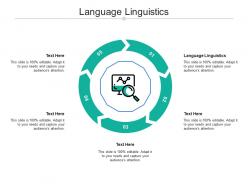
Presenting Language Linguistics Ppt Powerpoint Presentation Professional Example Topics Cpb slide which is completely adaptable. The graphics in this PowerPoint slide showcase five stages that will help you succinctly convey the information. In addition, you can alternate the color, font size, font type, and shapes of this PPT layout according to your content. This PPT presentation can be accessed with Google Slides and is available in both standard screen and widescreen aspect ratios. It is also a useful set to elucidate topics like Language Linguistics. This well-structured design can be downloaded in different formats like PDF, JPG, and PNG. So, without any delay, click on the download button now.

People who downloaded this PowerPoint presentation also viewed the following :

FAQs for Language linguistics ppt powerpoint presentation professional

So language basically breaks down into five parts. **Phonology** is all about sounds and patterns. **Morphology** looks at how you build words with prefixes, suffixes, that kind of stuff. Then there's **syntax** - which is just word order and grammar rules (seriously, this one's a pain when you're learning languages). **Semantics** deals with what words and sentences actually mean. **Pragmatics** is more about context - like how you'd say something differently to your boss versus your friend, you know? When you're breaking down a language, just pick one area to focus on first instead of trying to tackle everything at once.

Okay so sociolinguistics is basically how society affects the way we talk - like why you sound different around your boss vs your friends, or how people from different social classes speak differently. Psycholinguistics is more about what's actually happening in your brain when you're processing language. I used to get these confused all the time too lol. The way I remember it now: socio = social stuff influences language, psycho = mental processes with language. Quick test when you're reading research - just ask yourself if it's about social factors or brain stuff. Works every time.

So morphology is basically how kids figure out word parts - like adding "-ed" or "-s" to things. It's wild because they're not just memorizing, they're actually learning the system behind it all. You know how little kids say "goed" instead of "went"? That's them overgeneralizing the rules they've picked up. Pretty cool actually. This stuff directly helps with reading and vocab later on. If you're teaching language learners, I'd definitely focus on the common word endings and prefixes. Gives them way more tools to figure out new words they haven't seen before.

Oh totally! Western researchers are obsessed with individual development - like Chomsky's grammar thing or Piaget's stages. Meanwhile, collectivist cultures focus way more on social learning and community stuff. Eastern theories emphasize copying adults and respecting authority, but Western ones celebrate when kids break rules creatively. Honestly, it's wild how much a researcher's background affects what they even bother studying. You should check where studies come from when you're reading them - gives you so much more context for whether the findings actually make sense.

Honestly, being bilingual is like having a supercharged brain. Your working memory gets way stronger from constantly juggling two languages. Executive control improves too - you'll get better at switching tasks and filtering out distractions. The wildest part? Research shows it can delay dementia by 4-5 years, which is pretty incredible if you ask me. All that mental gymnastics from switching between languages makes your brain more flexible overall. My cousin's been putting off learning Spanish forever, but stuff like this makes me think she should actually go for it.

So dialects are basically how we show where we're from and who we belong with. You probably code-switch without even realizing it - formal speech at work, then your natural accent kicks in around family. It's wild how automatic it becomes. This creates tight bonds within your community but can also lead to people judging others based on how they talk (which is honestly pretty messed up). Next time you're chatting, notice how your speech changes depending on who you're with. You'll catch yourself doing this social positioning thing constantly.

So phonetics is like having a manual for your mouth - it shows you exactly where to put your tongue and how to move your vocal cords instead of just winging it. Super helpful when you're dealing with sounds that don't exist in English (looking at you, French r). You'll learn the International Phonetic Alphabet symbols for tricky sounds. It's honestly way more precise than trying to describe pronunciation with regular letters. Think of it as GPS but for speech - tells you exactly how to position everything to nail those sounds you've been butchering.

Languages evolve through sound changes, new vocabulary, and grammar getting simpler over time. Geography plays a huge role - when groups get separated, they develop differently. Contact with other languages matters too. Look at how "literally" now also means "figuratively" (which honestly still bugs me a bit). Social media has totally sped things up - new slang spreads everywhere instantly now. Migration creates cool language blends. If you're researching a specific language, check out its major contact points and population movements. Those moments usually mark the biggest changes you'll see.

So there's tons of different approaches you can take. Corpus linguistics is big - basically analyzing huge text databases. Then you've got experimental stuff like psycholinguistic studies, plus fieldwork where you actually document languages (which honestly sounds exhausting but cool). Comparative analysis looks at language families side by side. Oh, and ethnographic work means literally living with communities to see how language works in real life. Computational modeling is getting popular too, though it gets complicated quick. Sociolinguistic surveys and discourse analysis are other options. I'd say just pick one method that fits your research questions and really master that first.

Okay so language and power are totally connected - whoever gets to decide what counts as "proper" English controls who gets ahead. Standard varieties become "correct" while everything else is just "slang" or whatever, which is kinda BS linguistically speaking. But marginalized communities get hit worst by this stuff. Your accent or dialect can literally determine job opportunities, how schools treat you, even basic institutional respect. I was just thinking about this the other day actually. These language hierarchies aren't natural at all. They're built to keep existing power structures in place, so definitely question those assumptions in your work.

So basically language and thought are super connected - they influence each other constantly. Your language affects how you see and categorize stuff, but your thinking patterns also shape how language develops. The old Sapir-Whorf idea that language totally controls thought was way too extreme though. It's more like a back-and-forth thing. Different languages handle spatial stuff or colors in totally different ways, which is pretty cool. Oh, and if you're diving into this topic, definitely look at how we use metaphors in everyday speech - that's where you'll actually see this connection playing out most clearly.

So pragmatics is all about reading between the lines - like when your roommate goes "it's cold in here" but actually wants you to shut the window. Context is everything. We're constantly interpreting based on who's talking, the situation, cultural stuff we both get. Miss this and you'll totally whiff on sarcasm, hints, when people are being polite vs direct. Honestly happens to me all the time in work emails - can't tell if someone's actually mad or just being formal. Bottom line: don't just listen to the words. Think about who's saying what and why.

So each language that dies takes an entire way of seeing the world with it - like specific knowledge about plants, healing practices, how communities work together. It's genuinely devastating how much we've already lost. These aren't just different words for the same concepts either. The language shapes how people understand their environment and pass down stories. When it disappears, families lose that connection to who they are. Oh, and if you're documenting any of this stuff, don't just collect vocabulary lists. The stories and context behind words matter way more than people realize.

Yeah so tech is totally changing how we write - everything's shorter now, tons more emojis and abbreviations everywhere. I bet your own texting style has gotten way more casual over the years? Voice-to-text is weird too, it makes me structure sentences differently than I normally would. Even work emails are getting less formal these days. But honestly, this isn't new - language always shifts when new tech shows up. The printing press did it, phones did it, now smartphones are doing it. Just match whatever platform you're using and you'll be fine.

So basically, linguistics is what gives AI the foundation to actually get how language works. Speech recognition gets way better when you apply phonological rules. Grammar models need syntactic parsing. And semantic frameworks? They're what help machines figure out context and deal with ambiguity - which is honestly the hardest part. Early NLP was trash because it completely ignored all the linguistic research we'd already done! Pragmatics is another game-changer since it teaches AI about implied meaning and how conversations actually flow. If you're starting any NLP work, I'd jump into corpus linguistics first, then construction grammar.

Ratings and Reviews

100% of 100
Write a review
Most Relevant Reviews
  1. 100%

    by Chuck James

    Great quality product.

1 Item

per page: