Learning Models Of Reinforcement Deep Q Neural Network Dqn Reinforcement Learning

Rating:
90%
Learning Models Of Reinforcement Deep Q Neural Network Dqn Reinforcement Learning
Slide 1 of 6
Favourites Favourites

Try Before you Buy Download Free Sample Product

Audience Impress Your
Audience
Editable 100%
Editable
Time Save Hours
of Time
The Biggest Sale is ending soon in
0
0
:
0
0
:
0
0
Rating:
90%
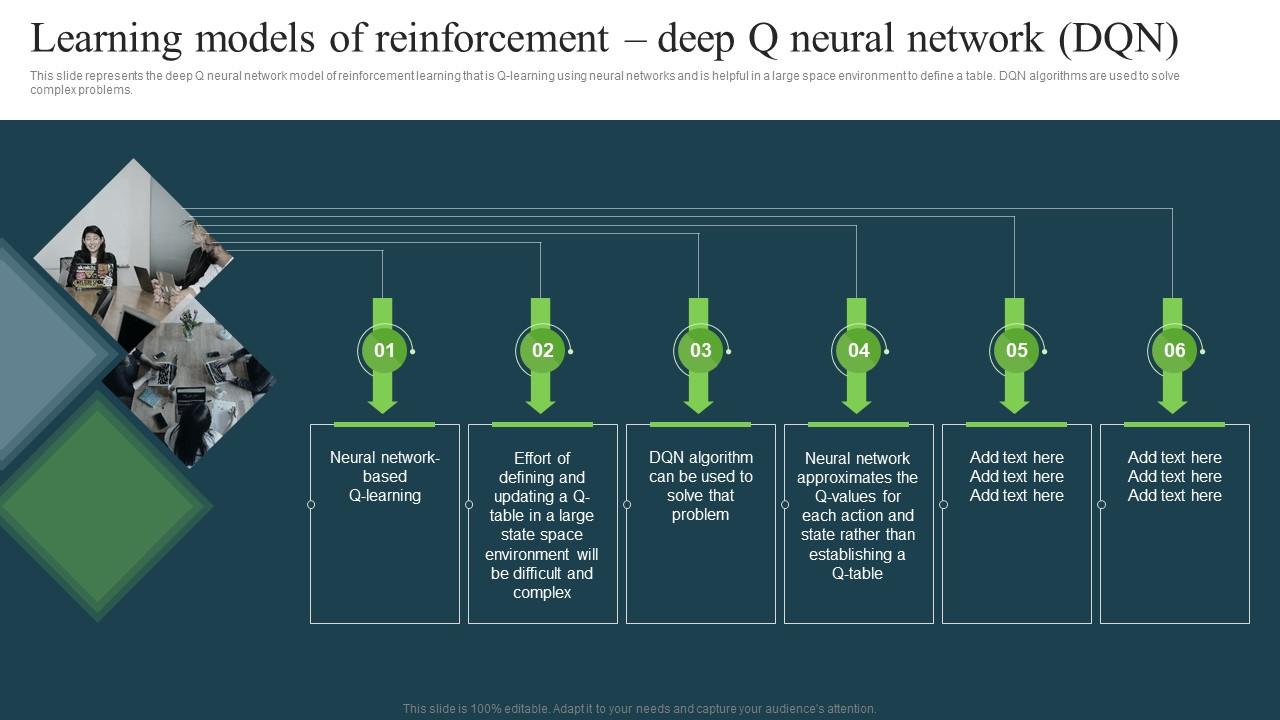
This slide represents the deep Q neural network model of reinforcement learning that is Q learning using neural networks and is helpful in a large space environment to define a table. DQN algorithms are used to solve complex problems Increase audience engagement and knowledge by dispensing information using Learning Models Of Reinforcement Deep Q Neural Network Dqn Reinforcement Learning. This template helps you present information on six stages. You can also present information on Environment, Neural Network, Values using this PPT design. This layout is completely editable so personaize it now to meet your audiences expectations.

FAQs for Learning Models Of Reinforcement Deep Q Neural Network

Reinforcement learning differs from supervised and unsupervised learning through agent-environment interaction, reward-based feedback systems, and sequential decision-making processes. While supervised learning uses labeled datasets and unsupervised learning finds hidden patterns, reinforcement learning enables dynamic adaptation through trial-and-error optimization, with applications in autonomous vehicles, trading algorithms, and robotics delivering strategic competitive advantages.

The exploration-exploitation dilemma significantly impacts reinforcement learning performance by requiring algorithms to balance discovering new strategies with leveraging known successful actions, often creating initial inefficiencies and slower convergence. Through adaptive techniques like epsilon-greedy policies and upper confidence bounds, financial institutions and healthcare systems optimize this balance for loan approval algorithms and treatment protocols, ultimately delivering improved decision-making accuracy and operational efficiency.

Reward functions serve as the primary mechanism for guiding reinforcement learning agents toward desired behaviors by providing feedback signals that indicate action quality and goal achievement. These functions essentially teach agents which decisions lead to success, with applications in autonomous vehicles learning safe driving, trading algorithms optimizing portfolio returns, and game AI developing winning strategies, ultimately enabling systems to adapt and improve performance across diverse business environments.

Markov Decision Processes are mathematical frameworks that model decision-making scenarios where outcomes are partly random and partly controlled, featuring states, actions, rewards, and transition probabilities that depend only on current conditions. These frameworks enable reinforcement learning algorithms to optimize sequential decision-making in complex environments, with applications in robotics, finance, and healthcare ultimately delivering strategic automation and enhanced operational efficiency.

Value functions estimate the expected cumulative rewards an agent can achieve from specific states or actions, providing crucial guidance for optimal decision-making in reinforcement learning systems. These mathematical frameworks enable organizations to optimize automated processes, from supply chain management to financial trading strategies, ultimately delivering improved resource allocation and strategic outcomes across industries.

Popular reinforcement learning algorithms include Q-learning, Deep Q-Networks (DQN), Policy Gradient methods, Actor-Critic algorithms, and Proximal Policy Optimization (PPO). These algorithms enable organizations to optimize decision-making processes across industries, with financial services using them for algorithmic trading, healthcare for treatment protocols, and manufacturing for supply chain optimization, ultimately delivering improved operational efficiency and competitive advantage.

Policy gradients improve upon traditional value-based methods by directly optimizing the policy through gradient ascent, handling continuous action spaces more naturally, and enabling stochastic policies that can explore probabilistically. These approaches streamline decision-making in complex environments like robotic control and autonomous systems, with many organizations finding that policy gradients deliver more stable learning and better performance in high-dimensional spaces, ultimately enhancing operational efficiency.

Transfer learning in reinforcement learning enables agents to leverage knowledge from previously learned tasks to accelerate learning in new, related environments. This approach significantly reduces training time and data requirements by transferring policies, value functions, or learned representations across similar domains, with many organizations finding that agents can adapt to new scenarios like robotics applications or game variations more efficiently than starting from scratch.

Practitioners encounter computational complexity, sample inefficiency, and environment variability when scaling reinforcement learning algorithms to real-world applications. These challenges manifest in areas like autonomous vehicles navigating unpredictable traffic patterns and financial institutions optimizing trading strategies, with many organizations finding that hybrid approaches combining RL with traditional methods ultimately deliver more reliable outcomes and faster deployment timelines.

Simulation environments enable reinforcement learning agents to train through risk-free trial and error, accelerated learning cycles, and controlled variable testing across diverse scenarios. These virtual platforms allow organizations in gaming, autonomous vehicles, and financial trading to rapidly iterate algorithms, minimize real-world costs, and safely explore edge cases, ultimately delivering robust AI systems ready for deployment.

Reinforcement learning applications include autonomous surgical robots in healthcare, algorithmic trading systems in finance, warehouse automation in logistics, personalized treatment protocols in medical care, and adaptive manufacturing processes in robotics. These technologies streamline operations by optimizing decision-making, reducing human error, and enhancing precision, with many organizations finding that reinforcement learning ultimately delivers improved efficiency and competitive advantage.

Multi-agent systems utilize reinforcement learning through distributed learning algorithms, shared reward mechanisms, communication protocols, and competitive training environments. These approaches enable agents to learn optimal strategies by observing other agents' behaviors, coordinating actions, and adapting to dynamic interactions, with applications in autonomous vehicle fleets, financial trading systems, and supply chain management ultimately delivering improved collective performance and strategic decision-making.

Studying reinforcement learning training dynamics reveals critical insights about policy optimization, reward signal efficiency, exploration-exploitation balance, and convergence stability across different environments. These insights enable organizations in finance, robotics, and gaming to optimize model performance, reduce training costs, and accelerate deployment timelines, ultimately delivering more robust automated systems and competitive advantages.

Recent advancements in deep learning significantly enhance reinforcement learning through improved neural network architectures, advanced optimization techniques, and sophisticated representation learning capabilities. These developments enable RL algorithms to handle complex, high-dimensional environments more effectively, with applications in autonomous vehicles, financial trading, and robotics finding dramatically improved performance and adaptability.

Ethical considerations for reinforcement learning systems include algorithmic bias, transparency in decision-making processes, accountability for automated outcomes, fairness across diverse populations, and data privacy protection. Organizations must establish robust oversight mechanisms, implement explainable AI frameworks, and conduct regular bias audits, with many financial institutions and healthcare providers finding that ethical AI governance ultimately delivers greater stakeholder trust and regulatory compliance.

Ratings and Reviews

90% of 100
Review Form
Write a review
Most Relevant Reviews
  1. 100%

    by James Rodriguez

    The ease of modifying templates is just superb! Also, the vast collection offers plenty of options to choose from.
  2. 80%

    by Delbert Palmer

    Satisfied with the way SlideTeam resolved my query regarding the right business PPTs that I was having difficulty finding. I found the perfect match with their assistance.

2 Item(s)

per page: