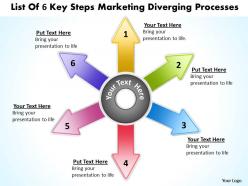
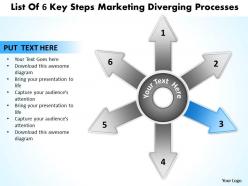
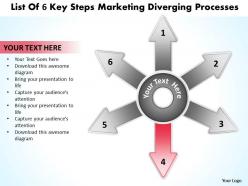
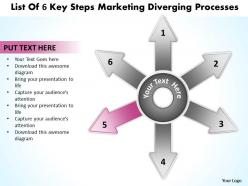
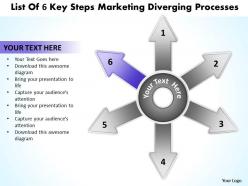
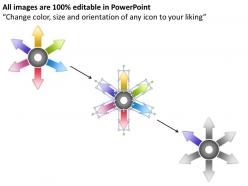
List of 6 key steps marketing diverging processes radial chart powerpoint templates
Try Before you Buy Download Free Sample Product
Audience
Editable
of Time
Strike the iron while its hot. Give it the shape you want with our list of 6 key steps marketing diverging processes Radial Chart PowerPoint templates.
People who downloaded this PowerPoint presentation also viewed the following :
List of 6 key steps marketing diverging processes radial chart powerpoint templates with all 12 slides:
Chart your plans on our list of 6 key steps marketing diverging processes Radial Chart PowerPoint templates. Signal your ideas for the days to come.
FAQs for List of 6 key steps marketing diverging processes radial
The key stages in a marketing process include market research, target audience identification, strategy development, campaign implementation, and performance analysis. These stages work together by gathering customer insights, defining clear objectives, creating compelling content, executing across multiple channels, and measuring ROI, with many organizations finding that this systematic approach ultimately delivers higher conversion rates and sustainable competitive advantage.
Market research influences marketing strategy development by providing data-driven insights into customer preferences, competitive landscapes, and market opportunities that guide strategic decisions. Through comprehensive analysis, organizations can identify target segments, optimize messaging approaches, and allocate resources more effectively, ultimately delivering campaigns that resonate with audiences and drive measurable business growth.
Customer segmentation serves as the foundation for targeted marketing by dividing audiences based on demographics, behavior, purchasing patterns, psychographics, and geographic location. This strategic approach enables businesses to deliver personalized messaging, optimize resource allocation, and enhance campaign effectiveness, with many retail and financial services companies finding that segmented strategies significantly improve conversion rates and customer lifetime value.
Businesses can measure marketing campaign effectiveness through key performance indicators like conversion rates, return on investment, customer acquisition costs, engagement metrics, and attribution tracking across multiple channels. These measurement approaches enable organizations to optimize resource allocation, identify high-performing strategies, and demonstrate tangible value, with many companies finding that comprehensive analytics ultimately deliver improved campaign performance and stronger competitive advantage.
Common pitfalls in marketing planning include inadequate market research, unclear target audience definition, unrealistic budget allocation, lack of competitive analysis, and insufficient performance metrics. These oversights can derail campaigns before launch, with many organizations finding that thorough upfront planning, strategic resource allocation, and clear measurable objectives ultimately deliver higher ROI and sustainable competitive advantage.
Digital marketing trends significantly reshape traditional marketing processes by introducing data-driven personalization, real-time analytics, automated customer journeys, and multi-channel integration capabilities. These innovations enable organizations to streamline campaign development, enhance targeting precision, and accelerate response times, with many retail and financial services companies finding that strategic combination of digital tools with traditional approaches ultimately delivers improved ROI and competitive advantage.
Effective marketing process management tools include customer relationship management (CRM) platforms, marketing automation software, project management systems, analytics dashboards, and content management platforms. These technologies streamline campaign execution, lead nurturing, and performance tracking by automating repetitive tasks, centralizing customer data, and providing real-time insights, with many organizations finding that integrated toolsets significantly enhance operational efficiency and marketing ROI.
Companies can align sales and marketing teams through shared goals, integrated CRM systems, regular communication meetings, unified customer data, and collaborative content development. This strategic alignment streamlines lead qualification, enhances customer experiences, and accelerates revenue growth, with many organizations finding that coordinated teams deliver significantly higher conversion rates and improved market responsiveness.
Key metrics include conversion rates, customer acquisition costs, return on advertising spend, lead generation numbers, and engagement rates across channels. These measurements enable organizations to optimize campaign performance, reallocate resources strategically, and demonstrate ROI, with many marketing teams finding that consistent tracking ultimately delivers improved budget efficiency and competitive market positioning.
Branding serves as the foundational framework that guides every marketing activity, from market research and positioning to campaign development and customer engagement strategies. It provides consistent messaging, visual identity, and value propositions that streamline marketing efforts, enhance customer recognition, and ultimately deliver stronger market differentiation and customer loyalty across all channels.
Effective content marketing techniques include storytelling narratives, SEO-optimized blog content, interactive videos, social media campaigns, and personalized email sequences. These approaches streamline audience engagement by building brand authority, generating qualified leads, and nurturing customer relationships, with many organizations finding that strategic content integration ultimately delivers higher conversion rates and sustainable competitive advantage.
Feedback loops integrate into marketing processes through real-time analytics, customer surveys, A/B testing, social media monitoring, and performance dashboards that track campaign effectiveness. These systems enable marketing teams to quickly identify underperforming strategies, optimize messaging and targeting, and enhance customer engagement, with many organizations finding that continuous feedback cycles deliver significantly higher ROI and improved customer experiences.
Artificial intelligence, automation platforms, predictive analytics, customer data platforms, and omnichannel integration are revolutionizing marketing processes across industries. These technologies streamline campaign management, personalize customer experiences, and optimize resource allocation, with retail and financial services organizations finding that automated workflows reduce costs while delivering faster, more targeted marketing outcomes and competitive advantage.
Cross-channel integration is essential in modern marketing, enabling consistent messaging, unified customer experiences, and comprehensive data insights across all touchpoints. Through strategic coordination of digital and traditional channels, organizations streamline campaign management, enhance customer journey tracking, and maximize ROI, with many retail and financial services companies finding that integrated approaches deliver significantly higher engagement rates and competitive advantage.
Technology streamlines marketing processes through automation platforms, CRM systems, AI-powered analytics, social media management tools, and personalized content engines. These solutions enhance customer engagement by delivering targeted campaigns, real-time interactions, and data-driven insights, with many retail and financial services companies finding significantly improved conversion rates and customer satisfaction.
-
Thanks for all your great templates they have saved me lots of time and accelerate my presentations. Great product, keep them up!
-
Unique and attractive product design.