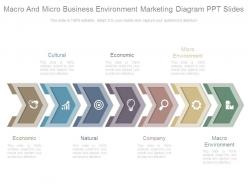
Macro and micro business environment marketing diagram ppt slides
Try Before you Buy Download Free Sample Product
Audience
Editable
of Time
Highlight attempts at instigation with our Macro And Micro Business Environment Marketing Diagram Ppt Slides. Expose the distribution of false information.
People who downloaded this PowerPoint presentation also viewed the following :
Macro and micro business environment marketing diagram ppt slides with all 7 slides:
Act assertively with our Macro And Micro Business Environment Marketing Diagram Ppt Slides. Be not afraid to follow your dream.
FAQs for Macro and micro business environment marketing
Business environment analysis includes market conditions, competitive landscape, regulatory frameworks, technological trends, economic indicators, and stakeholder dynamics. These components enable organizations to identify emerging opportunities, anticipate market shifts, and mitigate potential risks through data-driven insights, with many companies finding that comprehensive environmental scanning ultimately delivers stronger strategic positioning and sustainable competitive advantage.
Political factors significantly impact business operations through regulatory frameworks, tax policies, trade agreements, government stability, and policy changes across different regions. International companies operating in emerging markets like Southeast Asia or Latin America often face varying political risks, compliance requirements, and regulatory environments, while those in stable democracies benefit from predictable policies, ultimately requiring strategic adaptation and risk management approaches.
Economic trends and indicators influence business decision-making by providing insights into market conditions, consumer spending patterns, inflation rates, employment levels, and growth forecasts. Through analyzing GDP fluctuations, interest rates, and sector-specific data, organizations streamline resource allocation, optimize pricing strategies, and enhance investment timing, with many companies finding that proactive economic monitoring ultimately delivers competitive advantage and improved operational efficiency.
Socio-cultural changes reshape consumer behavior by altering values, lifestyle preferences, communication patterns, and purchasing priorities across different demographics. Through evolving social norms, brands in retail, technology, and consumer goods increasingly adapt their messaging, product development, and customer engagement strategies, with many finding that cultural responsiveness directly enhances brand loyalty and market positioning.
Technology revolutionizes competitive landscapes by enabling automation, data-driven decision making, digital transformation, and enhanced customer experiences across industries. Through AI, cloud computing, and analytics, companies streamline operations, reduce costs, and deliver faster services, with sectors like banking, retail, and manufacturing finding that technological adoption ultimately determines market leadership and long-term viability.
Businesses can assess environmental risks through scenario planning, SWOT analysis, stakeholder mapping, regulatory monitoring, and competitive intelligence gathering. These strategic approaches enable organizations to identify potential disruptions early, develop contingency plans, and adapt their operations proactively, with many companies finding that systematic risk assessment delivers enhanced resilience and sustainable competitive advantage.
Regulatory changes significantly impact business operations through altered compliance requirements, modified reporting standards, updated risk management protocols, and revised operational procedures. These shifts often present both challenges and opportunities, with many organizations finding that proactive adaptation streamlines processes, enhances transparency, and delivers competitive advantages while ensuring sustainable compliance frameworks.
Global market dynamics influence local business strategies by driving competitive positioning, supply chain adjustments, regulatory compliance, and customer expectation alignment across diverse markets. Through international trade patterns, currency fluctuations, and emerging market opportunities, businesses adapt their pricing models, product offerings, and operational frameworks, with many organizations finding that strategic localization combined with global insights delivers enhanced market penetration and sustainable competitive advantage.
Business environment analysis commonly utilizes PESTLE analysis, Porter's Five Forces, SWOT analysis, competitor benchmarking, and market research tools. These frameworks enable organizations to systematically evaluate political, economic, social, and competitive factors, with many companies finding that strategic combinations of these approaches deliver comprehensive market insights and competitive positioning advantages.
Businesses maintain agility through continuous market monitoring, flexible organizational structures, cross-functional teams, scenario planning, and rapid decision-making processes. These approaches enable companies to pivot strategies quickly, reallocate resources efficiently, and respond to emerging opportunities, with many organizations finding that investing in adaptive capabilities ultimately delivers sustained competitive advantage in increasingly dynamic markets.
Stakeholder analysis is crucial for understanding the business environment because it identifies key parties who influence or are affected by business decisions, including customers, suppliers, investors, employees, and regulatory bodies. Through comprehensive stakeholder mapping, organizations can anticipate market shifts, manage risks more effectively, and build strategic partnerships, with many companies finding that proactive stakeholder engagement ultimately delivers competitive advantage and sustainable growth.
Demographic shifts fundamentally reshape market segmentation by creating new consumer categories, altering purchasing power distribution, and changing lifestyle preferences across age groups, income levels, and geographic regions. These changes enable companies to develop more precise targeting strategies, particularly in healthcare, financial services, and retail sectors, with many organizations finding that demographic-driven segmentation delivers enhanced customer engagement and competitive advantage.
Businesses can leverage changing economic conditions through strategic pivots, diversified revenue streams, technology investments, supply chain optimization, and targeted market expansion. During economic shifts, companies often find opportunities in emerging markets, cost-effective automation, strategic partnerships, and evolving consumer preferences, ultimately delivering competitive advantages and enhanced operational efficiency in an increasingly dynamic landscape.
The competitive landscape drives strategic alliances by creating opportunities for market expansion, resource sharing, and technological advancement while presenting challenges in partner selection and competitive positioning. Through strategic partnerships, organizations enhance their market reach, access complementary capabilities, and reduce operational costs, with many companies in sectors like telecommunications and pharmaceuticals finding that collaborative approaches ultimately deliver sustained competitive advantage.
Businesses can mitigate political instability through diversification strategies, scenario planning, local partnerships, flexible supply chains, and political risk insurance. These approaches enable organizations to spread operational risk across multiple markets, adapt quickly to regulatory changes, and maintain continuity during uncertainty, with many multinational companies finding that strategic diversification ultimately delivers greater resilience and competitive advantage.
-
Best way of representation of the topic.
-
Illustrative design with editable content. Exceptional value for money. Highly pleased with the product.