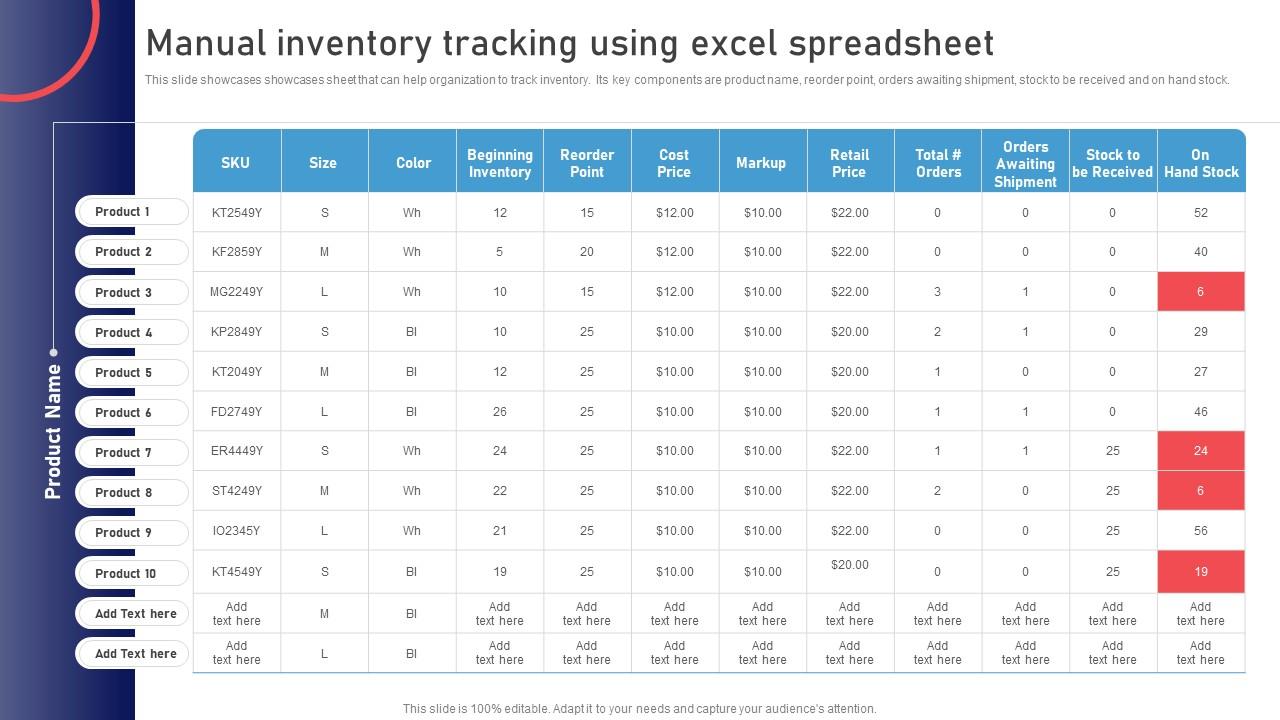
Manual Inventory Tracking Using Excel Spreadsheet Stock Management Strategies For Improved
Try Before you Buy Download Free Sample Product
Audience
Editable
of Time
This slide showcases showcases sheet that can help organization to track inventory. Its key components are product name, reorder point, orders awaiting shipment, stock to be received and on hand stock.
People who downloaded this PowerPoint presentation also viewed the following :
Manual Inventory Tracking Using Excel Spreadsheet Stock Management Strategies For Improved with all 6 slides:
Use our Manual Inventory Tracking Using Excel Spreadsheet Stock Management Strategies For Improved to effectively help you save your valuable time. They are readymade to fit into any presentation structure.
FAQs for Manual Inventory Tracking Using Excel Spreadsheet Stock Management
Key principles of effective inventory management include demand forecasting, optimal stock levels, ABC classification, regular auditing, and supplier relationship management. These approaches streamline operations by minimizing carrying costs, reducing stockouts, and improving cash flow, with many retail and manufacturing organizations finding that strategic inventory optimization ultimately delivers enhanced customer satisfaction and competitive advantage.
AI and automation enhance inventory tracking by providing real-time visibility, predictive analytics, and automated reordering capabilities across supply chains. Through machine learning algorithms and IoT sensors, retailers and manufacturers streamline stock monitoring, reduce human error, and optimize warehouse operations, while minimizing carrying costs and stockouts, ultimately delivering faster fulfillment and improved customer satisfaction.
Common inventory management mistakes include overstocking, understocking, poor demand forecasting, inadequate tracking systems, and lack of supplier coordination. These errors significantly impact cash flow, storage costs, and customer satisfaction, with many retailers and manufacturers finding that implementing automated inventory systems, regular audits, and data-driven forecasting ultimately delivers better profit margins and operational efficiency.
Businesses minimize inventory holding costs through demand forecasting, just-in-time ordering, automated reorder systems, supplier relationship optimization, and strategic warehouse placement. These approaches streamline operations by reducing excess stock, minimizing storage expenses, and improving cash flow, with many retailers and manufacturers finding that technology-driven inventory management delivers significant cost reductions while maintaining service levels.
Demand forecasting serves as the foundation for effective inventory management by predicting future customer needs, optimizing stock levels, and minimizing carrying costs while preventing stockouts. Through advanced analytics and historical data analysis, retailers and manufacturers can streamline purchasing decisions, reduce waste, and enhance customer satisfaction, ultimately delivering improved cash flow and competitive advantage in increasingly dynamic markets.
Seasonal inventory strategies include demand forecasting analytics, flexible supplier agreements, safety stock optimization, pre-season ordering, and cross-docking distribution methods. These approaches streamline inventory flow by minimizing excess stock, reducing storage costs, and ensuring product availability during peak periods, with many retailers finding that strategic seasonal planning ultimately delivers improved cash flow and enhanced customer satisfaction.
Just-in-time inventory management works by synchronizing production schedules with demand forecasts, maintaining minimal stock levels, and establishing reliable supplier relationships to deliver materials precisely when needed. This approach enables manufacturers and retailers to reduce carrying costs, minimize waste, and improve cash flow, while enhancing operational efficiency and responsiveness to market changes in increasingly competitive business environments.
Key inventory performance metrics include inventory turnover ratio, days sales outstanding, stockout frequency, carrying costs, and gross margin return on investment. These metrics enable businesses to optimize stock levels, reduce holding expenses, and improve cash flow, with many retailers and manufacturers finding that regular monitoring of these indicators delivers enhanced operational efficiency and competitive advantage.
Data analytics enhances inventory management decision-making by providing demand forecasting, identifying optimal stock levels, and revealing purchasing patterns through historical analysis. Through predictive algorithms and real-time monitoring, retailers and manufacturers can minimize carrying costs, reduce stockouts, and optimize warehouse space allocation, ultimately delivering improved cash flow and customer satisfaction.
Perpetual inventory systems continuously track stock levels in real-time through automated updates with each transaction, while periodic systems update inventory counts only at scheduled intervals through physical counts. Perpetual systems enable retailers and manufacturers to maintain accurate stock visibility, reduce carrying costs, and prevent stockouts, whereas periodic systems require less technology investment but offer limited real-time control, with many growing businesses finding perpetual systems deliver superior operational efficiency.
Businesses can implement successful inventory turnover strategies through demand forecasting, ABC analysis for prioritizing high-value items, automated reorder systems, and regular stock audits. These approaches streamline operations by reducing carrying costs, minimizing stockouts, and optimizing warehouse space, with many retail and manufacturing companies finding that strategic inventory rotation ultimately delivers improved cash flow and enhanced customer satisfaction.
Effective inventory management directly enhances customer satisfaction by ensuring product availability, reducing stockouts, and enabling faster order fulfillment across all channels. Through strategic inventory optimization, retailers and manufacturers minimize delivery delays, improve order accuracy, and maintain consistent service levels, while reducing costs and building customer loyalty, ultimately delivering competitive advantage in an increasingly demanding marketplace.
Companies can balance inventory through demand forecasting, ABC analysis for prioritization, just-in-time ordering, and safety stock calculations. By implementing automated reorder points and vendor-managed inventory systems, organizations streamline operations while minimizing carrying costs, with many retailers and manufacturers finding that strategic inventory optimization ultimately delivers improved cash flow and enhanced customer satisfaction.
Best practices for conducting an inventory audit include establishing clear protocols, using systematic counting methods, implementing cycle counting schedules, maintaining accurate documentation, and leveraging barcode or RFID technology for precision. These approaches streamline operations by reducing discrepancies, enhancing inventory accuracy, and improving financial reporting, with many retailers and manufacturers finding that regular audits ultimately deliver better cost control and operational efficiency.
Businesses can utilize drop shipping to minimize inventory holding costs, reduce warehouse space requirements, and expand product offerings without upfront investment. This approach enables companies, especially in retail and e-commerce, to test new markets, respond quickly to demand fluctuations, and focus resources on core competencies, ultimately delivering improved cash flow and operational flexibility.
-
I'm happy to discover your PowerPoint presentations and templates. They met my expectations precisely. Very innovative!
-
Best way of representation of the topic.