Manual Inventory Tracking Using Excel Spreadsheet Strategies To Order And Maintain Optimum

Rating:
90%
Manual Inventory Tracking Using Excel Spreadsheet Strategies To Order And Maintain Optimum
Slide 1 of 6
Favourites Favourites

Try Before you Buy Download Free Sample Product

Audience Impress Your
Audience
Editable 100%
Editable
Time Save Hours
of Time
The Biggest Sale is ending soon in
0
0
:
0
0
:
0
0
Rating:
90%
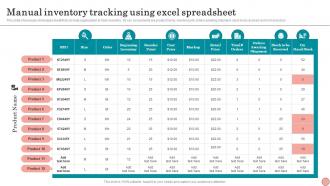
This slide showcases showcases sheet that can help organization to track inventory. Its key components are product name, reorder point, orders awaiting shipment, stock to be received and on hand stock. Present the topic in a bit more detail with this Manual Inventory Tracking Using Excel Spreadsheet Strategies To Order And Maintain Optimum. Use it as a tool for discussion and navigation on Tracking, Spreadsheet, Inventory. This template is free to edit as deemed fit for your organization. Therefore download it now.

People who downloaded this PowerPoint presentation also viewed the following :

FAQs for Manual Inventory Tracking Using Excel Spreadsheet Strategies To Order

Manual inventory tracking offers direct hands-on control, lower upfront costs, immediate implementation without technical setup, and detailed product familiarity through physical handling. While automated systems deliver speed and accuracy, manual approaches enable smaller businesses to maintain tight oversight of their operations, with many retailers and warehouses finding that this personal touch enhances product knowledge and quality control processes.

Businesses can effectively implement manual inventory management through standardized tracking sheets, regular physical counts, designated storage locations with clear labeling, and consistent documentation processes. While requiring more labor-intensive effort, many retail stores and small warehouses find that systematic manual approaches with trained staff deliver accurate inventory control, reduce costs compared to software solutions, and provide hands-on operational understanding.

Companies using manual inventory tracking face significant challenges including human error in data entry, time-consuming stock counts, delayed inventory updates, difficulty tracking item locations, and inconsistent record-keeping across departments. These inefficiencies often result in stockouts, overstocking, and poor demand forecasting, with many retailers and manufacturers finding that manual processes ultimately increase operational costs while reducing customer satisfaction and competitive responsiveness.

Manual inventory tracking significantly impacts financial reporting through increased human error risks, delayed data updates, and inconsistent record-keeping, often leading to inaccurate cost of goods sold calculations and inventory valuations. These challenges create discrepancies in financial statements, with many retailers and manufacturers finding that manual processes ultimately compromise audit readiness and regulatory compliance while hindering strategic decision-making capabilities.

Essential tools for effective manual inventory tracking include inventory sheets, barcode scanners, counting scales, clipboards, calculators, and organizational bins or labels. These resources work together by streamlining data collection, minimizing counting errors, and ensuring systematic organization, with many retail and warehouse operations finding that combining digital tools with physical organization delivers improved accuracy and operational efficiency.

Businesses ensure data accuracy in manual inventory processes through standardized counting procedures, regular cycle counts, dual verification systems, and comprehensive staff training protocols. These methods streamline operations by minimizing human error, establishing clear accountability chains, and implementing cross-checking mechanisms, with many organizations finding that systematic approaches ultimately deliver improved inventory visibility and reduced discrepancies.

Barcode systems and RFID enhance manual inventory tracking by automating data capture, reducing human error, and accelerating stock updates across warehouses and retail locations. These technologies streamline inventory processes by enabling instant scanning, real-time visibility, and seamless integration with management systems, with many organizations finding significantly improved accuracy and operational efficiency.

Seasonal fluctuations create significant challenges for manual inventory management through increased demand variability, longer tracking times, and higher error rates during peak periods. Strategic approaches include implementing buffer stock calculations, establishing seasonal forecasting templates, and creating dedicated tracking protocols for high-turnover items, with many retailers finding that pre-season preparation ultimately delivers smoother operations and reduced stockouts.

Best practices for manual inventory audits include establishing consistent counting schedules, implementing dual verification processes, organizing inventory by categories or zones, maintaining detailed documentation, and conducting surprise spot checks throughout the year. These systematic approaches enhance accuracy by minimizing human error, ensuring proper stock rotation, and identifying discrepancies early, with many retail and manufacturing organizations finding that structured audit protocols ultimately deliver improved inventory control and reduced operational costs.

Manual inventory tracking improves supply chain visibility by providing real-time stock level monitoring, detailed product movement records, and direct oversight of warehouse operations. Through hands-on documentation and regular physical counts, businesses gain precise inventory data, identify discrepancies quickly, and make informed procurement decisions, while enabling better demand forecasting and reducing stockouts across their operations.

Businesses can measure manual inventory tracking effectiveness through accuracy rates, stockout frequency, carrying cost analysis, cycle count variances, and order fulfillment times. Through regular audits and performance metrics, organizations in retail, manufacturing, and warehousing can identify discrepancies, optimize reorder points, and reduce excess inventory, ultimately delivering improved cash flow and operational efficiency while maintaining customer satisfaction.

Visual aids like spreadsheets, charts, dashboards, and color-coded systems significantly enhance manual inventory management by improving data organization, tracking accuracy, and decision-making speed. These tools enable businesses to identify stock patterns, monitor reorder points, and visualize inventory trends more effectively, with many retail and manufacturing organizations finding that structured visual approaches reduce errors while streamlining their operational efficiency.

Employees involved in manual inventory tracking need strong attention to detail, basic math skills, organizational abilities, and familiarity with inventory management principles and record-keeping systems. Training should cover proper counting techniques, documentation procedures, safety protocols, and inventory software basics, with many organizations finding that cross-training employees across multiple warehouse functions ultimately enhances accuracy and operational flexibility.

Manual inventory tracking integrates with sales and procurement through shared documentation systems, regular communication protocols, and synchronized update schedules that connect stock levels to purchase orders and sales forecasts. Many retail and manufacturing organizations enhance this integration by establishing daily reporting workflows, cross-departmental check-ins, and standardized forms, ultimately delivering improved coordination and reduced stockouts while maintaining cost-effective operations.

Manual inventory tracking presents risks including human error, data inconsistencies, theft vulnerability, stockouts, and delayed reporting that can disrupt operations and customer satisfaction. Organizations mitigate these challenges by implementing automated inventory systems, regular audits, barcode scanning, and real-time dashboards, ultimately delivering enhanced accuracy, streamlined operations, and competitive advantage in increasingly demanding markets.

Ratings and Reviews

90% of 100
Write a review
Most Relevant Reviews
  1. 100%

    by Jones Adams

    The design is clean-cut, modern, and sleek, keeping the users' needs in mind. The multiple uses make this product worth every penny!
  2. 80%

    by Smith Diaz

    Wide collection of templates available. SlideTeam has made it easier to create presentations in just a few minutes. 

2 Item(s)

per page: