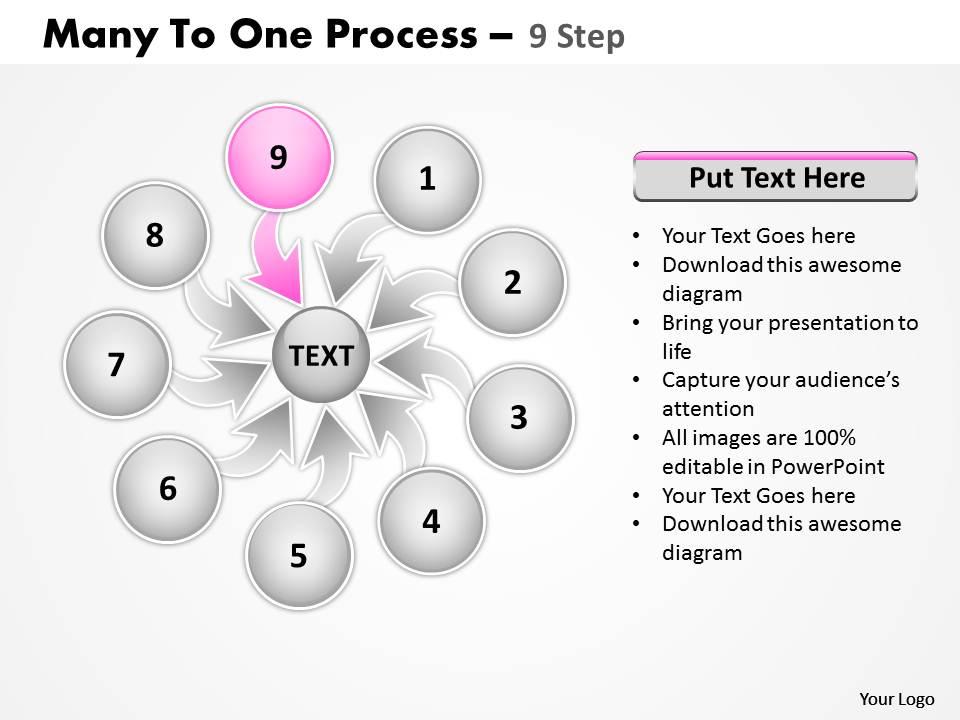
Many to one process 9 step 1
Try Before you Buy Download Free Sample Product
Audience
Editable
of Time
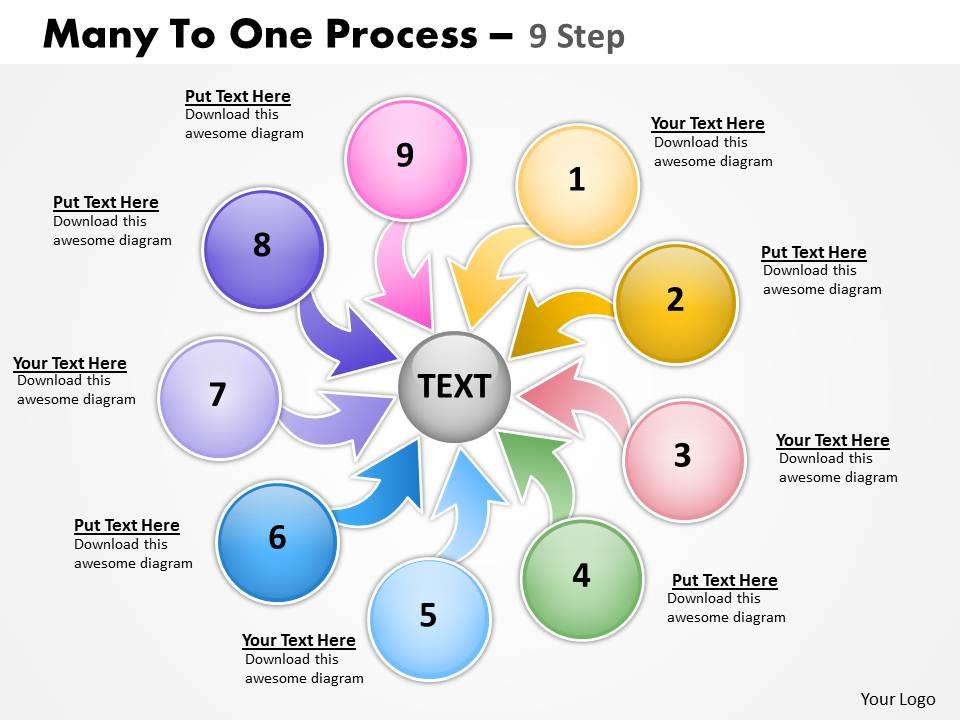
Discover the business processes and the exact plans while using many to one process 9 step 1 PPT slide template. This is one of the driving force of the business presentations. One to many relationship exist in almost every database especially when one row in a table could be linked with many other rows. However it is essential to note that one to many presentation icon is not the property of the data, rather it is the relationship itself. In fact the process model is the description of as process at a level where there are so many types. The best advantage of many to one process model is this that it can be used repeatedly for demonstrating the development process as it has a lot of instantiations. And the other possible use of this process model is it can be prescribed for introducing to the concepts of the thread.Our Many To One Process 9 Step 1 are building a great reputation. Of being the driving force of a good presentation.
People who downloaded this PowerPoint presentation also viewed the following :
Many to one process 9 step 1 with all 15 slides:
Our Many To One Process 9 Step 1 will obey your command. They will respond dutifully.
FAQs for Many to one process
Many-to-one processes in data management are defined by multiple input sources converging into a single output destination, data consolidation from various formats or systems, standardized transformation rules, and centralized validation mechanisms. These characteristics enable organizations to streamline disparate data streams from departments like sales, marketing, and operations into unified repositories, ultimately delivering improved data consistency, reduced redundancy, and enhanced analytical capabilities across enterprise systems.
Many-to-one processes significantly enhance data normalization by eliminating redundant information storage, establishing clear referential integrity through foreign keys, and reducing data inconsistencies across tables. Through normalized schemas, databases achieve improved storage efficiency, faster query performance, and streamlined maintenance operations, while ensuring data accuracy and consistency, ultimately delivering more reliable database systems and reduced operational costs.
A many-to-one relationship enhances data retrieval efficiency by reducing storage redundancy, minimizing query complexity, and enabling faster joins through normalized structures. This approach streamlines database operations significantly, with many financial institutions and retail organizations finding that centralized reference tables accelerate customer lookup processes, reduce maintenance overhead, and ultimately deliver faster response times while maintaining data integrity across multiple transactions.
Companies leverage many-to-one processes for customer segmentation by consolidating multiple data sources, behavioral patterns, transaction histories, and demographic information into unified customer profiles. This strategic combination enables organizations to identify distinct segments, personalize marketing campaigns, and optimize resource allocation, with retail and financial services companies finding that consolidated insights deliver more targeted experiences and improved conversion rates.
Common applications include data aggregation, ensemble learning, feature fusion, multi-input neural networks, and recommendation systems. These approaches streamline complex datasets by combining multiple sources, sensors, or models into unified predictions, with financial institutions using ensemble methods for fraud detection and retailers leveraging multi-input systems for personalized recommendations, ultimately delivering enhanced accuracy and operational efficiency.
Many-to-one processes consolidate multiple inputs into single outputs, contrasting with one-to-many distribution scenarios and one-to-one direct exchanges. In manufacturing, suppliers feed into centralized production, while customer service channels funnel into unified response systems, ultimately streamlining operations and enabling organizations to achieve greater efficiency and standardized outcomes.
Implementing many-to-one processes in large enterprise systems presents challenges including data synchronization complexities, performance bottlenecks during peak loads, integration difficulties across legacy systems, and potential single points of failure. These obstacles can impact operational efficiency and system reliability, though many organizations find that strategic planning, robust infrastructure design, and phased implementation approaches ultimately deliver streamlined operations and enhanced data consistency.
Data integrity in many-to-one relationships is maintained through referential integrity constraints, foreign key validation, cascade operations, data normalization, and transaction management controls. These mechanisms work together by preventing orphaned records, ensuring consistent updates across related tables, and validating data dependencies, with many database systems finding that automated constraint enforcement significantly reduces data inconsistencies while streamlining operational efficiency.
Tools for visualizing many-to-one processes include process mapping software like Visio and Lucidchart, data visualization platforms such as Tableau and Power BI, workflow automation tools, and specialized business process modeling applications. These technologies streamline complex process documentation by enabling clear input tracking, convergence point identification, and bottleneck analysis, with many organizations finding that effective visualization ultimately delivers improved operational efficiency and faster decision-making across departments.
Many-to-one processes are critical in manufacturing where multiple assembly lines feed into final production, financial services where various data sources enable loan approvals, and healthcare where different diagnostic inputs inform patient treatment decisions. These processes streamline operations by consolidating diverse inputs, reducing processing time, and enhancing decision accuracy, ultimately delivering operational efficiency and competitive advantage across industries.
Many-to-one processes influence RESTful API design by requiring consolidated endpoints that can handle multiple input sources, implementing efficient data aggregation patterns, and establishing clear resource hierarchies that map diverse inputs to single outputs. These APIs typically utilize batch processing endpoints, parameterized queries, and structured request formats, enabling systems to streamline data collection from various sources while maintaining REST principles and delivering simplified integration experiences.
Poorly optimized many-to-one relationships create significant performance bottlenecks through excessive database queries, memory overhead, and slow data retrieval, ultimately degrading system responsiveness and user experience. These inefficiencies particularly impact high-transaction environments like e-commerce platforms and financial systems, with many organizations finding that proper indexing, query optimization, and caching strategies deliver substantially faster processing times and improved scalability.
Organizations can measure many-to-one process success through key performance indicators like processing time reduction, cost per transaction, error rates, throughput volumes, and resource utilization efficiency. Financial services and manufacturing companies increasingly track these metrics alongside customer satisfaction scores and operational bottlenecks, with many finding that streamlined consolidation processes deliver measurable improvements in productivity and service quality.
**INPUT**: What best practices should be followed when mapping many-to-one relationships in ER diagrams? **OUTPUT**: Best practices include using clear cardinality notation, placing foreign keys in child entities, maintaining consistent naming conventions, and ensuring referential integrity constraints. These approaches streamline database design by reducing redundancy, enhancing data consistency, and improving query performance, with many organizations finding that proper relationship mapping ultimately delivers more scalable systems and faster application development cycles.
Predictive analytics enhances many-to-one decision-making by analyzing historical patterns, identifying key success factors, and forecasting outcomes across multiple inputs to streamline selection processes. Banks use these models for loan approvals, hospitals for treatment protocols, and retailers for supplier selection, ultimately delivering faster decisions, reduced risks, and improved resource allocation efficiency.
-
Easily Editable.
-
The Designed Graphic are very professional and classic.