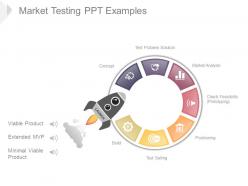
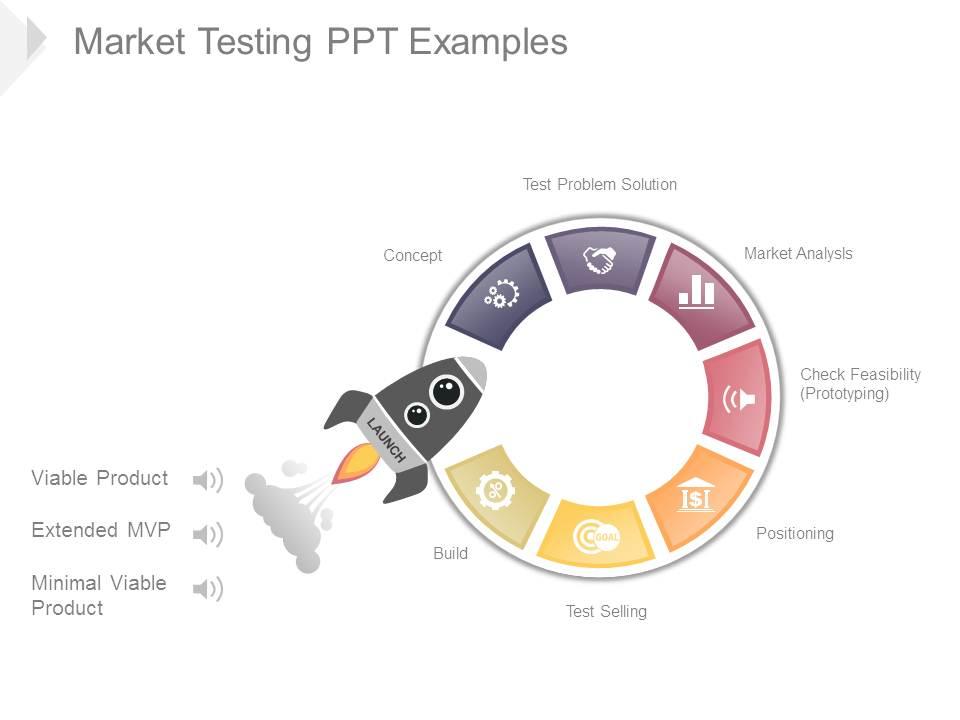
Market testing ppt examples
Try Before you Buy Download Free Sample Product
Audience
Editable
of Time
Guide their growth with our Market Testing Ppt Examples. Empower them to achieve their goals.
People who downloaded this PowerPoint presentation also viewed the following :
Market testing ppt examples with all 7 slides:
Our Market Testing Ppt Examples facilitate creation of guidelines. It makes investigations easier.
FAQs for Market
Market testing's key objectives include validating customer demand, assessing price sensitivity, identifying target segments, evaluating competitive positioning, and refining marketing strategies before full launch. These comprehensive assessments enable companies to minimize risk, optimize resource allocation, and enhance product-market fit, with many organizations finding that thorough market testing significantly reduces launch failures while accelerating time-to-profitability.
Market testing reveals customer preferences, purchasing behaviors, demographic patterns, geographic concentrations, and response variations through direct interaction with diverse user groups. By analyzing real-world feedback from different segments, companies can identify which demographics show strongest engagement, highest conversion rates, and greatest long-term value potential, ultimately enabling more precise targeting strategies and resource allocation.
The most common market testing methods include surveys and questionnaires, focus groups, A/B testing, pilot programs, and beta testing with select customer segments. These approaches enable businesses to gather consumer feedback, validate product concepts, and assess market demand before full-scale launches, with many organizations finding that strategic combinations of multiple testing methods deliver more comprehensive insights and reduce launch risks.
Market testing success is measured through key performance indicators including sales conversion rates, customer acquisition costs, engagement metrics, retention rates, and revenue per customer. These metrics enable businesses to assess product-market fit, pricing effectiveness, and scalability potential across different demographics, with many organizations finding that comprehensive measurement frameworks ultimately deliver actionable insights for full-scale launch decisions.
Customer feedback serves as the foundation of market testing, providing critical insights into product viability, user experience, pricing acceptance, feature preferences, and market demand patterns. Through surveys, focus groups, beta testing, and direct interviews, businesses can identify potential issues, refine their offerings, and validate market assumptions before full launch, ultimately reducing risk and enhancing product-market fit.
Digital tools enhance market testing through advanced analytics, A/B testing platforms, social media insights, survey automation, and real-time data collection capabilities. These technologies streamline feedback gathering, accelerate iteration cycles, and deliver precise consumer behavior insights, with retail brands and tech companies finding that digital-first testing approaches reduce time-to-market while maximizing strategic decision-making accuracy.
Common market testing pitfalls include testing with unrepresentative samples, asking leading questions, ignoring negative feedback, testing too late in development, and insufficient sample sizes. These missteps can result in misleading data and costly product failures, with many organizations finding that thorough planning, objective questioning, and diverse participant groups ultimately deliver more accurate insights and competitive advantage.
A/B testing optimizes market testing by comparing different product versions, pricing strategies, messaging approaches, and user experiences simultaneously across targeted customer segments. This method enables businesses to make data-driven decisions about feature prioritization, marketing campaigns, and product positioning, while minimizing risk and maximizing conversion rates, ultimately delivering measurable improvements in customer engagement and revenue generation.
Sample size selection for market testing should consider target population size, desired confidence level, acceptable margin of error, budget constraints, and expected response rates. These factors work together to balance statistical validity with practical feasibility, with many organizations finding that larger samples provide more reliable insights but require greater resource allocation, ultimately delivering more actionable data for strategic decision-making.
Market testing for B2B products focuses on smaller, targeted stakeholder groups, longer decision cycles, and relationship-based feedback, while B2C testing emphasizes larger sample sizes, emotional responses, and rapid consumer behavior patterns. B2B testing typically involves pilot programs with key clients and detailed ROI assessments, whereas B2C approaches leverage focus groups, surveys, and digital analytics to capture broader market sentiment.
**INPUT**: What insights can competitor analysis provide during the market testing phase? **OUTPUT**: Competitor analysis during market testing reveals pricing strategies, target audience preferences, marketing messaging effectiveness, distribution channels, and feature gaps in existing solutions. These insights enable companies to refine their positioning, identify underserved market segments, and optimize product features, while many organizations find that competitive intelligence accelerates time-to-market and delivers significant competitive advantages.
Aligning market testing with your marketing strategy involves integrating testing phases with campaign timelines, budget allocation, and target audience segmentation to ensure cohesive messaging and resource optimization. By synchronizing testing insights with broader marketing objectives, companies can refine positioning, validate messaging effectiveness, and scale successful approaches across channels, ultimately delivering consistent brand experiences while maximizing campaign ROI and strategic alignment.
Market testing ethical considerations include obtaining informed consent, protecting participant privacy, ensuring transparent data usage, avoiding deceptive practices, and maintaining fair compensation structures. These principles enable organizations to build consumer trust while gathering reliable insights, with many companies finding that ethical testing approaches ultimately deliver more accurate data, stronger brand reputation, and sustainable competitive advantages in increasingly privacy-conscious markets.
Seasonal trends significantly impact market testing by influencing consumer behavior, purchasing patterns, and product demand throughout different times of the year. Testing during peak seasons like holidays or summer may yield inflated results, while off-season testing could underestimate true market potential, with many retailers finding that strategic timing across multiple seasons delivers more accurate, actionable insights for product launches.
Data analysis is crucial for market testing evaluation because it transforms raw feedback into actionable insights, identifies patterns in consumer behavior, and quantifies market potential through statistical validation. Through comprehensive analytics, businesses can measure response rates, segment customer preferences, and predict scalability, with many organizations finding that data-driven interpretations significantly reduce launch risks while maximizing competitive positioning.
-
Great product with effective design. Helped a lot in our corporate presentations. Easy to edit and stunning visuals.
-
Easy to edit slides with easy to understand instructions.