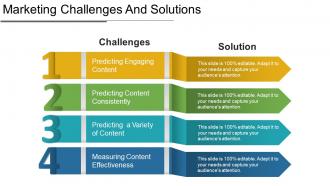
Défis et solutions marketing Images PowerPoint
Try Before you Buy Download Free Sample Product
Audience
Editable
of Time
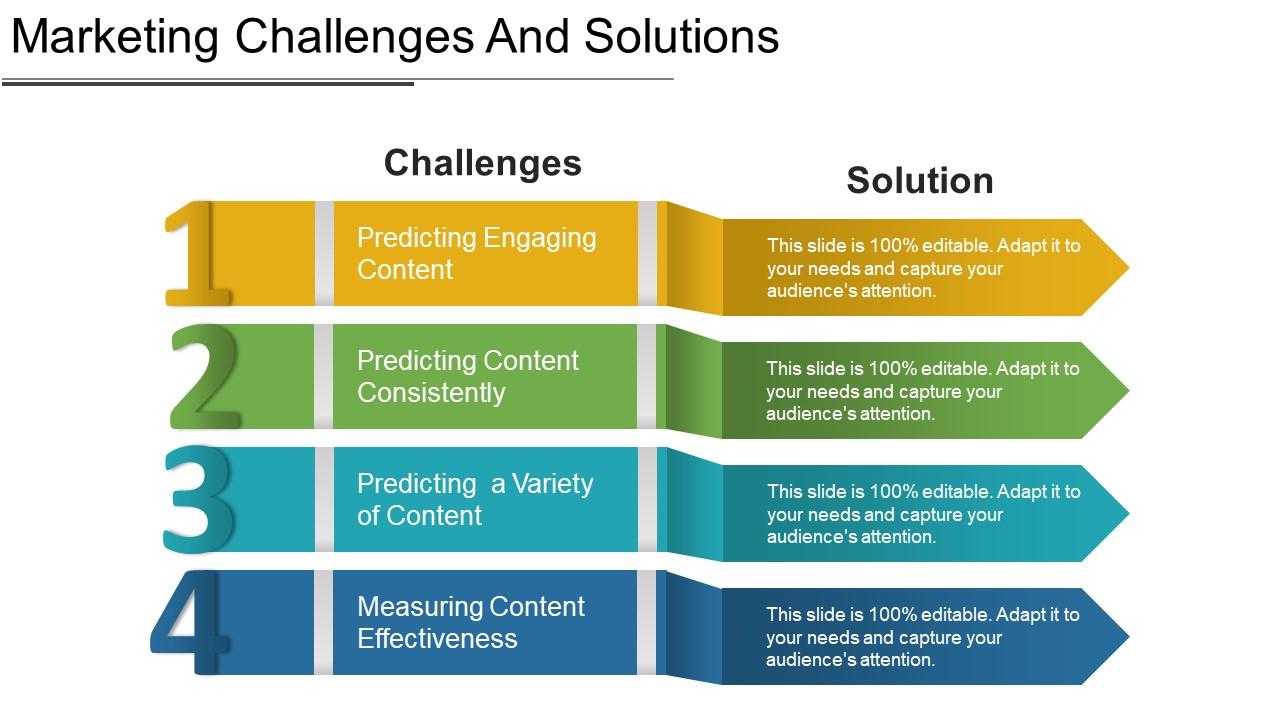
Présentation des défis et solutions marketing Modèle d'images PowerPoint qui vous aidera à résoudre les principaux problèmes de l'organisation. Cette diapositive peut être utilisée pour décrire la procédure de résolution des problèmes de gestion de projet dans l'organisation. Présentez les principaux défis sur la voie du succès et concevez des stratégies pour surmonter ces défis. Analyser les différentes manières de traiter des problèmes complexes. Parmi les solutions disponibles, vous pouvez choisir la meilleure alternative après une évaluation appropriée. Les professionnels, les gestionnaires et autres professionnels du marketing peuvent obtenir cette diapositive PPT facilement disponible. Vous pouvez facilement reconnaître les problèmes et évaluer les solutions à l'aide de ce modèle prêt à l'emploi. Formulez des plans pour résoudre le problème d'organisation à l'aide de cette diapositive PowerPoint de résolution de problèmes conçue par des professionnels. Téléchargez dès maintenant ce modèle de contenu prêt et préparez des présentations PPT percutantes sans aucun tracas.
Caractéristiques de ces diapositives de présentation PowerPoint :
Présentation des défis et solutions marketing Images PowerPoint. La diapositive peut être modifiée selon vos désirs. Apportez des modifications aux couleurs, à l'arrière-plan et au type de police de la mise en page. Augmentez ou diminuez la taille de l'icône et transformez-la en formats tels que JPG, JPEG et PDF. Va bien avec Google Slides. Il peut être projeté en plein écran devant des milliers de personnes. De plus, le modèle est entièrement compatible avec les principales versions de Microsoft et peut être présenté devant un large segment en raison de ses graphiques haute résolution.
People who downloaded this PowerPoint presentation also viewed the following :
Défis et solutions marketing Images PowerPoint avec les 5 diapositives :
Éclairez les gens sur les genres actuels avec nos images PowerPoint de défis et solutions marketing. Élaborer sur les arts contemporains.
FAQs for Marketing challenges and
Ugh, budget and time constraints are killer - you're probably drowning in both right now. Keeping up with every platform is exhausting too. Most people I know just post random stuff without tracking if it actually does anything, which makes measuring ROI basically impossible. Competing with companies that have huge ad budgets? Yeah, that sucks. Here's what I'd do though - find where your customers actually spend time online and stick to maybe 2 platforms max. Use the free analytics tools first to figure out what's hitting before you spread yourself too thin elsewhere.
Honestly, start tracking stuff from the beginning or you'll hate yourself later. Set up conversion tracking and UTM parameters right away - define what "winning" actually looks like before you go live. The math is pretty straightforward: (revenue - campaign cost) / campaign cost x 100. Don't get caught up in vanity metrics like impressions though. Focus on what actually moves the needle for your business. Google Analytics works fine, or use your CRM to connect the dots between touchpoints and actual sales. Even messy data is better than no data, so just start somewhere.
Dude, feedback is literally your way out of marketing hell. When campaigns flop or you can't figure out why nobody's buying, that's where you find the answers. Most teams just collect it and then... nothing. Such a waste. Ask specific questions about your recent stuff and actually listen to what people tell you. You'll catch messaging that sucks, find new problems to solve, and figure out what actually makes people want to buy. It's like having a cheat sheet for your strategy - honestly wish more people would use it properly instead of letting it collect dust.
Honestly, social media can fix most of your marketing headaches if you're smart about it. First thing - check your analytics to see where your people actually are, then stick to just 2-3 platforms instead of spreading yourself thin everywhere. When you're struggling with credibility, user-generated content is pure gold for building trust. Tight budget? Targeted ads will stretch your dollars way further than broad campaigns. Oh, and stories plus live videos are insanely good for engagement right now. Start by looking at what you've got currently and figure out your biggest pain points first.
Honestly? Stop trying to beat everyone at their own game. Find your weird little corner and own it completely - not the generic "we're better" stuff everyone claims. Your competitors are probably all doing the same boring content, so actually solve real problems people have. Micro-influencers are way better than big names anyway, costs less too. Check what your top 3 competitors are doing, then do the opposite. Local SEO is surprisingly underrated if that fits your business. Sometimes the best move is just showing up where they don't bother going.
Dude, you absolutely need to do market research first. I can't stress this enough - without it you're basically just guessing what's broken and throwing money at random fixes. Talk to your actual customers before changing anything big. Do surveys, interviews, whatever. The stuff they tell you will blow your mind, honestly. I've watched so many teams skip this step (because it feels slow, I get it) then wonder why their campaigns still suck. Research shows you the real problems your audience has and why your current stuff isn't hitting. Don't be one of those teams.
Honestly, just meet people where they already are instead of forcing them onto your preferred platform. Take one piece of content and chop it up - video becomes clips, quotes, carousel posts, whatever. Interactive stuff works crazy well too. Polls, user campaigns, even those dumb "this or that" stories (but people eat that up). Pick like 2-3 places where your audience actually spends time and test what hits. Oh, and keep your main message consistent but tweak how you say it for each platform's weird little culture. That's really it.
Honestly, data analytics is a game changer - it stops you from just guessing what works in your marketing. You can actually see which campaigns are driving real conversions and which channels are just burning money. Plus you'll catch customer behavior patterns that would be impossible to spot otherwise. I know the data feels crazy overwhelming at first (trust me), but start with just one metric. Maybe cost per acquisition or customer lifetime value? Then build from there. Within a few weeks you'll be making way smarter decisions instead of just hoping stuff works.
Okay so first thing - ditch the vanity metrics and focus on what actually matters. Revenue attribution, qualified leads, customer acquisition cost. That's the stuff leadership cares about. Set up monthly check-ins (quarterly if you're swamped) to show how your campaigns tie to company goals. Build a simple dashboard that puts marketing performance next to business impact - trust me, budget conversations become so much easier when you can show real numbers. The whole point is making sure your KPIs match what they're trying to achieve, whether it's growth or whatever. Makes you look way more strategic too.
Honestly, personalized marketing is a game changer because you're actually talking to people about stuff they care about. No more throwing spaghetti at the wall hoping it sticks. You can adjust your messaging and timing based on what each group actually wants - feels way more like a real conversation than screaming into the abyss, you know? People engage more when they feel understood. Start by collecting good data and figuring out your different audience segments. Then test different approaches for each group. I swear the engagement rates will surprise you once you nail it.
Honestly, economic ups and downs mess with everything marketing-wise. Budgets get cut first (obviously), and suddenly your customers only care about essentials. Price becomes huge. What used to work? Forget it. You've gotta pivot fast - focus on value instead of fancy features, move money to cheaper digital stuff, and keep your existing customers happy since finding new ones costs way more. Oh, and build some flexibility into your plans from day one. The economy's always doing something weird, so you might as well be ready for it.
Honestly, influencer partnerships are clutch because people trust the influencers they follow way more than random ads. It's basically borrowed credibility - their audience becomes your audience. The best part? These creators already know exactly what their followers want, so you don't have to guess. I'd definitely start with micro-influencers though. Their engagement rates are usually way better than the big names, plus they're more affordable. Just make sure their vibe actually matches your brand - nothing's worse than a partnership that feels forced. Oh, and check that their followers are actually your target demo, not just random people.
Honestly, AI tools are crushing it right now for personalization - they can crunch through customer data way faster than any team could. Marketing automation's gotten pretty slick too, handling lead scoring and email flows without much babysitting. Oh, and since cookies are basically dead (thank you, privacy laws), there's tons of new tracking solutions popping up. Attribution modeling's way better now at showing which channels actually work instead of just guessing. My take? Pick one AI tool first and see how it moves your numbers. Don't go crazy buying everything at once - learned that one the hard way.
Oh man, you really gotta watch out for this stuff! What kills it in the US might totally bomb somewhere else - learned that when my friend's thumbs up ad campaign was apparently offensive in parts of the Middle East. Whoops. Different countries have weird color associations and communication styles you'd never think of. Honestly, hiring local teams or cultural consultants is worth every penny. They get the weird little details we'd miss. Also test everything with focus groups first - way cheaper than fixing a disaster later. Trust me on this one.
Honestly, content marketing is way better than just shouting "we're awesome!" in ads. You actually get to prove it. Write helpful blog posts, make videos that solve real problems - basically show your expertise instead of claiming you have it. People can see what you're really about, you know? The tricky part is staying consistent with posting and keeping your message on point. Oh, and here's what works - think of one thing people totally misunderstand about your brand, then create stuff that naturally shows them they're wrong. Way more effective than traditional advertising.
-
Excellent products for quick understanding.
-
Nice and innovative design.