


Marketing company evaluation scorecard powerpoint presentation slides





Try Before you Buy Download Free Sample Product
 Impress Your
 Audience
 100%
100% Editable
 Save Hours
 of Time


Marketing company evaluation scorecard represents the organizations progress toward a specified goal or objective exercised for marketing in many industries throughout the public and private sectors. Here is a competently designed Marketing Company Evaluation Scorecard template that showcases performance metrics used to identify, improve, and control various functions and their resulting outcomes, enabling managers to better align within the enterprise. This template covers business annual and monthly revenue evaluation, conversion rate, and customer acquisition target. Our presentation also includes price and service quality, financial evaluation of current assets, corporate target, financial goals, and internal objectives. Lastly, the PPT depicts customer assessment, sales profit, customer lifetime value, and gross profit margin. Book a free demo with our research team and customize this editable scorecard template. Download it now.
People who downloaded this PowerPoint presentation also viewed the following :
Content of this Powerpoint Presentation
Slide 1: This slide displays title i.e. 'Marketing Company Evaluation Scoreboard'.
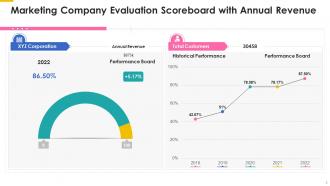
Slide 2: This slide presents Marketing Company Evaluation Scoreboard with Annual Revenue.
Slide 3: This slide exhibits Marketing Company Monthly Revenue Evaluation Scorecard with Region.
Slide 4: This slide depicts Marketing Company Revenue Evaluation Scorecard with Conversion Rate.
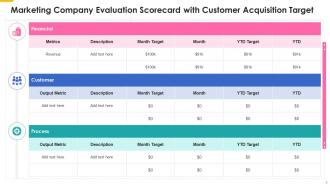
Slide 5: This slide showcases Marketing Company Evaluation Scorecard with Customer Acquisition Target.
Slide 6: This slide highlights Marketing Company Evaluation Scorecard with Price and Service Quality.
Slide 7: This slide illustrates Marketing Company 10 Years Revenue Evaluation Scorecard.
Slide 8: This slide displays Marketing Company Current Financial Evaluation Scorecard.
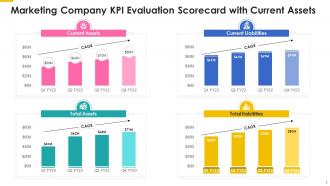
Slide 9: This slide presents Marketing Company KPI Evaluation Scorecard with Current Assets.
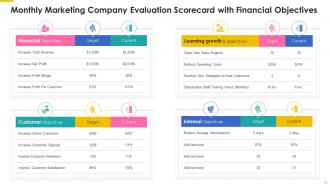
Slide 10: This slide exhibits Monthly Marketing Company Evaluation Scorecard with Financial Objectives.
Slide 11: This slide depicts Marketing Company Evaluation Scorecard with Monthly Revenue.
Slide 12: This slide showcases Marketing Company Revenue and Customer Evaluation Scorecard.
Slide 13: This is the icons slide.
Slide 14: This slide presents title for additional slides.
Slide 15: This slide shows about your company, target audience and its client's values.
Slide 16: This slide shows details of team members like name, designation, etc.
Slide 17: This slide showcases financials.
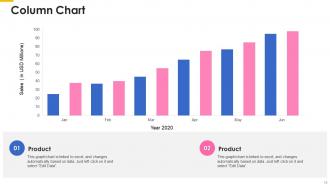
Slide 18: This slide exhibits monthly sales column charts for different products. The charts are linked to Excel.
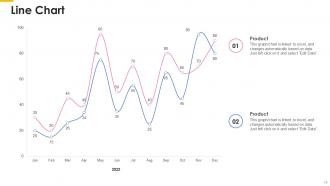
Slide 19: This slide displays monthly line charts for different products. The charts are linked to Excel.
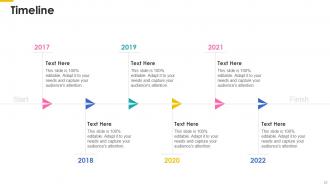
Slide 20: This slide exhibits yearly timeline.
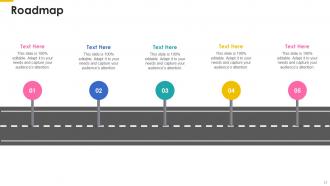
Slide 21: This slide shows roadmap.
Slide 22: This is thank you slide & contains contact details of company like office address, phone no., etc.
Marketing company evaluation scorecard powerpoint presentation slides with all 27 slides:
Use our Marketing Company Evaluation Scorecard Powerpoint Presentation Slides to effectively help you save your valuable time. They are readymade to fit into any presentation structure.













FAQs for Marketing company evaluation scorecard
Marketing Evaluation Scorecards include performance metrics, ROI analysis, campaign effectiveness indicators, customer acquisition costs, and brand awareness measurements. These components streamline marketing assessment by tracking conversion rates, engagement levels, and revenue attribution, with many organizations finding that comprehensive scorecards enhance strategic decision-making and optimize resource allocation across channels.
Businesses measure marketing ROI effectively using scorecards that track conversion rates, customer acquisition costs, lifetime value, revenue attribution, and campaign performance metrics. These comprehensive frameworks enable organizations to compare marketing channels, optimize budget allocation, and demonstrate tangible returns, with many companies finding that structured measurement ultimately delivers 20-30% improved marketing efficiency and strategic decision-making.
Marketing Evaluation Scorecards should prioritize customer acquisition cost, conversion rates, return on investment, lead quality scores, and customer lifetime value. These metrics enable organizations to streamline campaign effectiveness, optimize resource allocation, and enhance targeting strategies, with many businesses finding that this strategic combination ultimately delivers improved market positioning and measurable competitive advantage.
A Marketing Evaluation Scorecard supports strategic decision-making by providing standardized metrics, performance benchmarks, campaign ROI analysis, market trend insights, and resource allocation guidance. Through systematic evaluation frameworks, organizations can identify high-performing channels, optimize budget distribution, and pivot strategies based on data-driven insights, ultimately enhancing marketing effectiveness and competitive positioning.
Marketing Evaluation Scorecards can be tailored by incorporating industry-specific metrics, regulatory requirements, customer journey characteristics, and competitive benchmarks unique to each sector. For instance, healthcare organizations emphasize patient acquisition costs and compliance metrics, while retail focuses on conversion rates and seasonal performance indicators, ultimately enabling more precise measurement and strategic optimization across diverse business environments.
Marketing Evaluation Scorecards should be updated monthly for tactical metrics and quarterly for strategic assessments, with annual comprehensive reviews to maintain optimal effectiveness. This balanced approach enables organizations to track campaign performance, adjust resource allocation, and respond to market changes, while many companies find that frequent tactical updates combined with strategic quarterly reviews ultimately deliver better ROI and competitive advantage.
Customer feedback serves as a critical performance indicator within Marketing Evaluation Scorecards, measuring customer satisfaction, brand perception, Net Promoter Scores, and overall campaign effectiveness across multiple touchpoints. This feedback enables organizations to assess marketing ROI more accurately, identify areas for strategic improvement, and enhance customer experiences, with many companies finding that systematic feedback integration ultimately delivers better targeting, messaging optimization, and competitive advantage.
Technology and analytics enhance Marketing Evaluation Scorecards by automating data collection, providing real-time performance tracking, and enabling predictive insights through advanced algorithms. Through integrated dashboards and AI-powered analytics, organizations streamline campaign assessment, identify optimization opportunities faster, and deliver more accurate ROI measurements, ultimately enabling data-driven decisions that significantly improve marketing effectiveness.
Common pitfalls include setting too many metrics, lacking stakeholder buy-in, choosing vanity metrics over actionable KPIs, insufficient data integration, and irregular review cycles. These challenges can undermine scorecard effectiveness by creating confusion, resistance, and missed optimization opportunities, with many organizations finding that focusing on fewer, strategic metrics with consistent monitoring delivers better decision-making and campaign performance.
A Marketing Evaluation Scorecard helps align marketing goals with business objectives by establishing clear metrics that directly connect marketing activities to revenue growth, customer acquisition costs, and strategic outcomes. Through systematic tracking of KPIs like conversion rates, customer lifetime value, and ROI across campaigns, organizations can ensure marketing investments support broader business priorities, ultimately delivering measurable results and competitive advantage.
Successful Marketing Evaluation Scorecards include Coca-Cola's brand equity metrics, HubSpot's lead-to-customer conversion tracking, and Salesforce's multi-channel attribution models. These frameworks enable organizations to measure campaign ROI, customer acquisition costs, and brand awareness simultaneously, with many companies finding that integrated scorecards deliver enhanced marketing accountability and strategic decision-making capabilities.
Small businesses can leverage a Marketing Evaluation Scorecard by systematically tracking campaign performance, measuring ROI across channels, and identifying high-impact strategies within limited budgets. This approach enables resource optimization, data-driven decision making, and strategic budget allocation, with many small retailers and service providers finding that consistent evaluation delivers improved customer acquisition costs and sustainable growth.
Best practices for presenting Marketing Evaluation Scorecard data include creating clear visual hierarchies, using consistent color coding, highlighting key performance indicators prominently, and organizing metrics by campaign phases or customer journey stages. These approaches streamline stakeholder communication by emphasizing actionable insights, comparing performance against benchmarks, and presenting trend analysis clearly, with many marketing teams finding that strategic data visualization ultimately enhances decision-making speed and campaign optimization effectiveness.
Marketing teams can collaborate to create comprehensive scorecards by establishing cross-functional working groups, aligning on shared KPIs across channels, conducting regular stakeholder input sessions, and implementing collaborative review processes. Through unified dashboards and structured feedback loops, teams from digital, content, and analytics departments can streamline data integration, enhance measurement consistency, and ultimately deliver more strategic insights for campaign optimization and resource allocation.
Marketing Evaluation Scorecard development is best supported by tools like Google Analytics, HubSpot, Tableau, Microsoft Excel, Salesforce Analytics, and marketing automation platforms such as Marketo or Pardot. These technologies streamline data collection, visualization, and performance tracking across campaigns, with many organizations finding that integrated dashboards ultimately deliver comprehensive insights and enhanced decision-making capabilities.
-
Unique research projects to present in meeting.
-
Informative design.