Marketing Promotion Strategy Gantt Chart
Try Before you Buy Download Free Sample Product
Audience
Editable
of Time
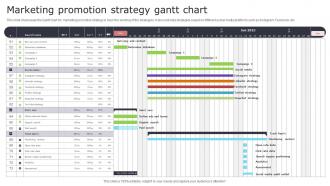
This slide showcases the Gantt chart for marketing promotion strategy to track the working of the strategies. It also includes strategies based on different social media platforms such as Instagram, Facebook, etc.
People who downloaded this PowerPoint presentation also viewed the following :
Marketing Promotion Strategy Gantt Chart with all 6 slides:
Use our Marketing Promotion Strategy Gantt Chart to effectively help you save your valuable time. They are readymade to fit into any presentation structure.
FAQs for Marketing Promotion
Key components of an effective marketing promotion strategy include clear target audience identification, compelling value propositions, multi-channel campaign coordination, strategic timing, and measurable performance metrics. These elements work together by aligning messaging across platforms, optimizing budget allocation, and maximizing customer engagement, with many organizations finding that integrated approaches deliver higher conversion rates and stronger brand recognition.
Businesses can leverage social media platforms by creating targeted content campaigns, engaging directly with customers, utilizing influencer partnerships, and implementing data-driven advertising strategies. Through platforms like Instagram and LinkedIn, companies streamline brand awareness, accelerate customer acquisition, and enhance market reach, with many organizations finding that strategic social media integration delivers measurable ROI and competitive advantage.
Customer personas play a crucial role in shaping marketing promotion strategy by enabling targeted messaging, channel selection, timing optimization, and budget allocation that resonates with specific audience segments. These detailed customer profiles help marketers craft personalized campaigns, choose appropriate platforms like social media for younger demographics or email for professionals, and develop promotional offers that address distinct pain points, ultimately delivering higher engagement rates and improved ROI across diverse market segments.
Businesses can measure promotional campaign success through key performance indicators like conversion rates, return on investment, customer acquisition costs, brand awareness metrics, and sales revenue growth. Through analytics platforms and tracking tools, companies in retail, hospitality, and e-commerce monitor engagement levels, website traffic, and customer lifetime value, ultimately delivering actionable insights for optimizing future campaigns.
Digital marketing integration with traditional promotional strategies includes consistent messaging across channels, synchronized timing, unified branding, cross-platform data tracking, and complementary audience targeting. This strategic combination enables businesses to maximize reach through television and social media synergy, direct mail with email follow-ups, and event marketing with digital amplification, ultimately delivering enhanced customer experiences and improved ROI across all promotional investments.
Seasonal trends significantly influence marketing promotion strategies by dictating timing, messaging, product focus, budget allocation, and channel selection throughout the year. Retailers leverage holiday seasons for major campaigns, while industries like travel and fashion align promotions with weather patterns and consumer behavior cycles, ultimately maximizing relevance and sales conversion rates.
Small businesses can leverage social media collaborations, user-generated content campaigns, local partnership exchanges, referral reward programs, and community event sponsorships to maximize promotional impact. These cost-effective tactics enable businesses to build authentic customer relationships, expand their reach through cross-promotion, and generate organic buzz, ultimately delivering higher engagement rates and customer loyalty than traditional advertising methods.
Storytelling in marketing promotions engages consumers by creating emotional connections, building brand authenticity, and making messages memorable through relatable narratives and characters. Through compelling brand stories, companies enhance customer loyalty, differentiate from competitors, and drive purchasing decisions, with retail brands and service providers finding that narrative-driven campaigns deliver significantly higher engagement rates and stronger consumer relationships.
Ethical promotional strategies should prioritize transparency, truthfulness, data privacy protection, fair competition practices, and respect for consumer autonomy. These considerations enhance brand credibility by avoiding misleading claims, securing customer consent for data usage, and ensuring promotional content serves genuine consumer needs, with many organizations finding that ethical approaches ultimately deliver stronger customer loyalty and sustainable competitive advantage.
Data analytics informs promotional campaign adjustments by tracking customer engagement metrics, conversion rates, channel performance, and real-time response patterns across different audience segments. Through advanced analytics platforms, marketers can identify underperforming elements, optimize messaging and targeting mid-campaign, and reallocate budgets to high-converting channels, ultimately maximizing ROI and campaign effectiveness.
Influencer marketing offers authentic audience connections, targeted reach, enhanced credibility, cost-effective campaigns, and measurable engagement metrics. While it delivers significant brand awareness and trust-building through personal endorsements, it also presents challenges with influencer authenticity, campaign control, and ROI measurement, with many brands finding that strategic influencer partnerships ultimately drive higher conversion rates and customer loyalty.
Cross-promotional partnerships enhance marketing strategies by expanding audience reach, sharing costs, and leveraging complementary brand strengths to create more compelling campaigns. Through strategic collaborations, companies access new customer segments, reduce acquisition costs, and build credibility through trusted partner associations, with many organizations finding that these partnerships deliver significantly higher engagement rates and cost-effective market penetration.
Technological advancements revolutionize modern marketing promotion strategies by enabling precise audience targeting, real-time personalization, and automated campaign optimization across multiple digital channels. Through AI-driven analytics, social media platforms, and mobile technologies, businesses streamline customer engagement, enhance conversion rates, and deliver measurable ROI, with many organizations finding that integrated digital approaches significantly outperform traditional promotional methods.
Customer feedback can be effectively incorporated into promotional strategies through survey analysis, social media monitoring, review mining, focus group insights, and purchase behavior tracking. These data sources enable marketers to refine messaging, adjust targeting parameters, and optimize channel selection, with many retail and service organizations finding that feedback-driven campaigns deliver higher engagement rates and improved conversion outcomes.
Cultural differences significantly affect global marketing promotion strategies through language adaptation, color symbolism, religious considerations, communication styles, and consumer behavior patterns. Companies like McDonald's and Coca-Cola tailor messaging, imagery, and promotional timing to local customs, while brands such as Nike adjust campaigns for collectivist versus individualist societies, ultimately ensuring cultural relevance and market resonance.
-
Excellent design and quick turnaround.
-
I downloaded some of the presentations for work. They were simple to modify and saved me a lot of time and effort.