


Marketing strategies playbook powerpoint presentation slides




Try Before you Buy Download Free Sample Product
 Impress Your
 Audience
 100%
100% Editable
 Save Hours
 of Time


Strategies playbook is considered an essential document that helps the marketing team deploy best practices, tactics, and strategies along the various stages of the marketing process. Check out our competently designed Marketing Strategies Playbook template that caters to details about the firms offerings and marketing performance. It covers guidelines to progress through the marketing process journey, including key activities across the marketing process, marketing meeting plan, product positioning and messaging, ideal customer profile development, aligning buyers journey with the marketing process, customer experience journey mapping, etc. The playbook covers different marketing methodologies in MEDDIC, SNAP selling, and gap selling for deal closure. It covers details about marketing pitching through content with marketing content management, content planning worksheet, prospects nurturing content program, and potential buyer leads promoting plan. Moreover, it caters to initiatives to manage marketing team productivity through effective communication, a marketing enhancement checklist, productivity enhancement management system. Marketing performances and activities are tracked through essential metrics and dashboards. Download it now.
People who downloaded this PowerPoint presentation also viewed the following :
Content of this Powerpoint Presentation
Slide 1: This slide introduces Marketing Strategies Playbook. State Your Company Name and begin.
Slide 2: This slide shows Agenda for Marketing Strategies Playbook.
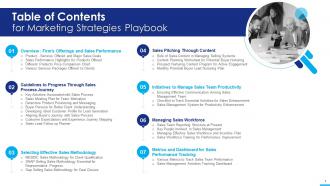
Slide 3: This slide presents Table of Content for the presentation.
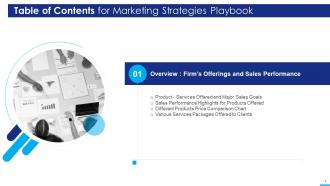
Slide 4: This slide highlights title for topics that are to be covered next in the template.
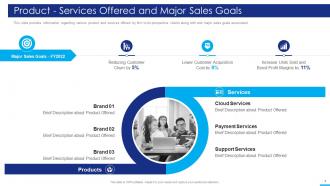
Slide 5: This slide displays various product and services offered by firm to its prospective clients.
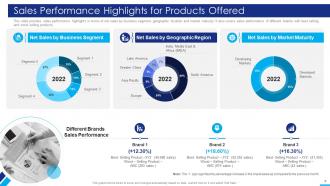
Slide 6: This slide represents sales performance highlights in terms of net sales by business segment, geographic location, etc.
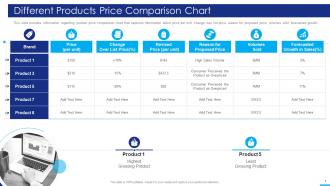
Slide 7: This slide shows product price comparison chart that captures information about price per unit, change over list price, etc.
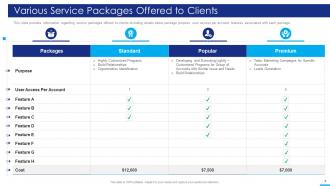
Slide 8: This slide presents Various Service Packages Offered to Clients.
Slide 9: This slide shows Table of Contents for Sales Playbook Template.
Slide 10: This slide displays key activities involved in sales process such as prospecting, preparation, qualification, etc.
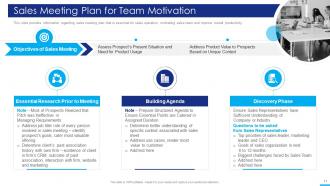
Slide 11: This slide represents sales meeting plan that is essential for sales operation, motivating sales team and improve overall productivity.
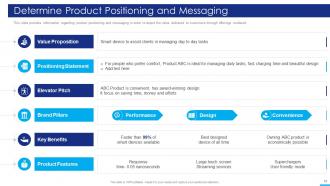
Slide 12: This slide shows product positioning and messaging in order to depict the value delivered to customers.
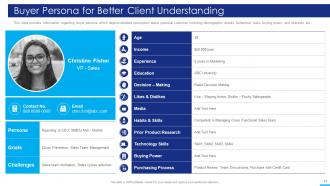
Slide 13: This slide presents buyer persona which depicts detailed description about potential customer.
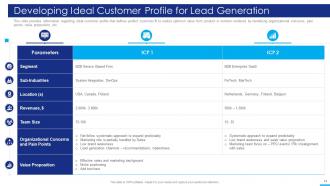
Slide 14: This slide shows Developing Ideal Customer Profile for Lead Generation.
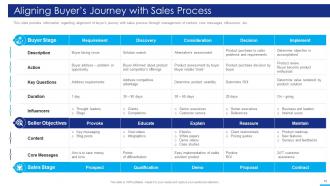
Slide 15: This slide displays alignment of buyer’s journey with sales process through management of content, core messages, influencers, etc.
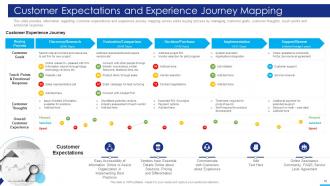
Slide 16: This slide represents Customer Expectations and Experience Journey Mapping.
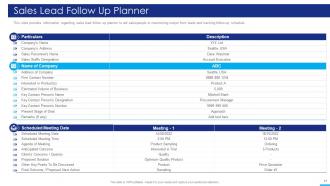
Slide 17: This slide shows sales lead follow up planner to aid salespeople in maximizing output from leads and tracking follow-up schedule.
Slide 18: This slide presents Table of Contents for Sales Playbook Template.
Slide 19: This slide shows guidelines that assist sales representatives in closing deal with clients.
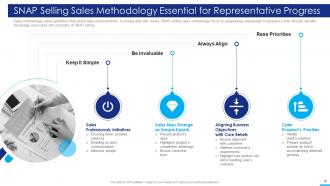
Slide 20: This slide displays SNAP Selling Sales Methodology Essential for Representative Progress.
Slide 21: This slide represents Gap Selling Sales Methodology for Deal Closure.
Slide 22: This slide shows Table of Contents for Sales Playbook Template.
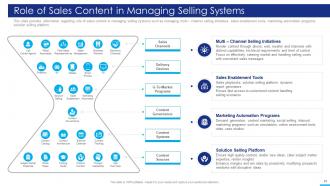
Slide 23: This slide presents Role of Sales Content in Managing Selling Systems.
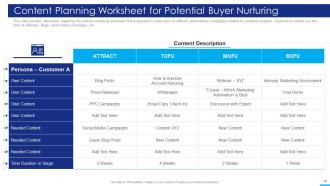
Slide 24: This slide shows content marketing worksheet that is prepared to keep track on different personalized campaigns.
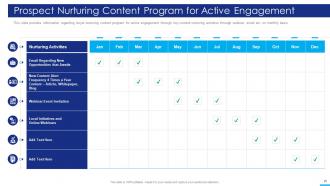
Slide 25: This slide displays Prospect Nurturing Content Program for Active Engagement.
Slide 26: This slide represents regarding monthly buyer lead nurturing plan for active engagement through various activities.
Slide 27: This slide shows Table of Contents for Sales Playbook Template.
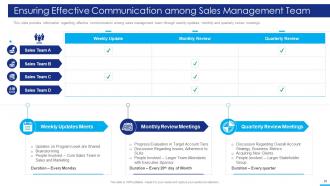
Slide 28: This slide presents effective communication among sales management team through weekly updates, monthly and quarterly review.
Slide 29: This slide shows Checklist to Track Essential Activities for Sales Enhancement.
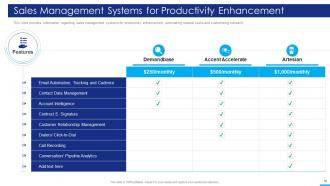
Slide 30: This slide displays Sales Management Systems for Productivity Enhancement.
Slide 31: This slide represents Table of Contents for Sales Playbook Template.
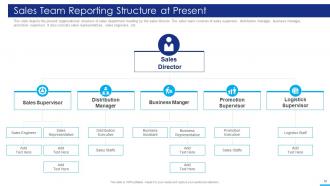
Slide 32: This slide depicts the present organizational structure of sales department heading by the sales director.
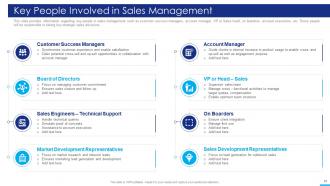
Slide 33: This slide presents key people in sales management such as customer success managers, account manager, etc.
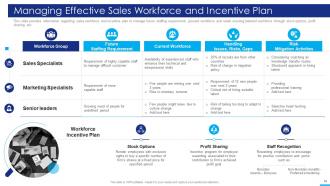
Slide 34: This slide shows sales workforce and incentive plan to manage future staffing requirement, present workforce, etc.
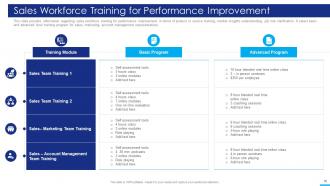
Slide 35: This slide displays Sales Workforce Training for Performance Improvement.
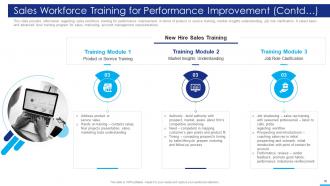
Slide 36: This slide represents sales workforce training for performance improvement in terms of product or service training.
Slide 37: This slide shows Table of Contents for Sales Playbook Template.
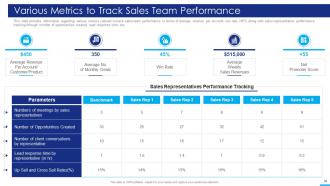
Slide 38: This slide presents Various Metrics to Track Sales Team Performance.
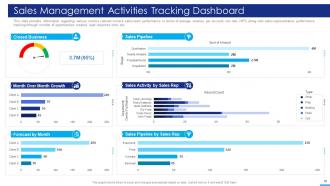
Slide 39: This slide shows various metrics catered to track sales team performance in terms of average revenue per account.
Slide 40: This slide displays Icons for Marketing Strategies Playbook.
Slide 41: This slide is titled as Additional Slides for moving forward.
Slide 42: This is Our Team slide with names and designation.
Slide 43: This is Our Mission slide with related imagery and text.
Slide 44: This slide shows Post It Notes. Post your important notes here.
Slide 45: This slide provides 30 60 90 Days Plan with text boxes.
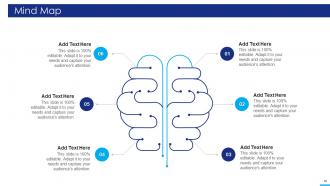
Slide 46: This slide displays Mind Map with related imagery.
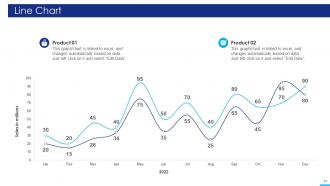
Slide 47: This slide describes Line chart with two products comparison.
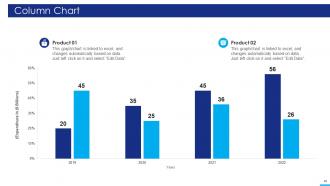
Slide 48: This slide displays Column chart with two products comparison.
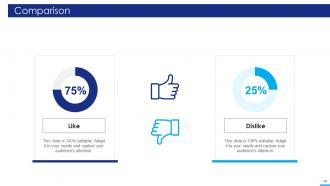
Slide 49: This is a Comparison slide to state comparison between commodities, entities etc.
Slide 50: This is Our Target slide. State your targets here.
Slide 51: This is a Thank You slide with address, contact numbers and email address.
Marketing strategies playbook powerpoint presentation slides with all 56 slides:
Use our Marketing Strategies Playbook Powerpoint Presentation Slides to effectively help you save your valuable time. They are readymade to fit into any presentation structure.















FAQs for Marketing strategies playbook
Honestly, most people mess this up by skipping the basics. Figure out your audience first - like actually figure it out, not just guess. What makes you different from everyone else? That's your value prop right there. Pick channels where your people actually are, not where some article said they "should" be. I learned this the hard way lol. Set real numbers you can track so you know if you're wasting money or not. Budget's obviously huge since you can't do everything at once. But seriously, nail down who you're talking to first and everything else gets way easier.
Okay so basically you wanna stop trying to appeal to literally everyone - that never works anyway. Break your audience into groups based on who they are, how they act, what they need. Then you can actually speak to each group in a way that hits different. Way better than some bland message that nobody cares about. Think sniper rifle vs shotgun approach, you know? You'll figure out what each group actually values and position your stuff accordingly. Honestly I'd start small - pick like 2-3 main segments and test different messaging with each. See what sticks.
Honestly, personas are like your marketing GPS - without them you're just driving around lost. They tell you what to say, where to show up, and who to target. I always tell people to actually talk to their customers first (novel concept, right?). Ask what problems they're dealing with, how they buy stuff, what their day looks like. You'll get way better copy straight from their mouths than anything you brainstorm in a conference room. Once you know who you're talking to, everything else clicks into place. Skip this step and you're basically throwing spaghetti at the wall hoping something sticks.
Okay so here's the thing - content marketing isn't some standalone thing you do on the side. Map it to your customer journey first, then figure out where your people actually spend time online. Blog posts can feed your email list, webinars get chopped up for social, case studies help your sales team close deals. Most people make this way harder than it needs to be tbh. Start with an audit of what you've got already. You'll probably find some decent stuff just sitting there. Then fill in the obvious gaps and stop overthinking it.
Honestly, just focus on the stuff that actually makes you money - conversion rates, how much you're spending to get customers (CAC), and return on ad spend. Don't get caught up in follower counts like I did for way too long lol. Click-through rates and time on page are solid too. Oh, and lifetime value if you can figure that out. Keep your dashboard super simple - maybe 5 metrics tops. I check mine every week or so to catch any weird trends. Trust me, less is more here. You don't want to drown in data when you should be making decisions.
Okay so basically you're flipping everything upside down - no more throwing money at TV ads hoping someone's watching. Now you can actually see what people are doing and talk directly to them. The amount of data available is honestly insane compared to just a few years back. Your old-school stuff doesn't just vanish, but it has to work together with all the digital pieces. People expect everything to connect seamlessly now. I'd start by figuring out where your customers are actually hanging out online - might surprise you. Then see how that lines up with what you're doing currently.
Honestly, social media analytics are a game-changer because you can see what's actually working instead of just throwing content at the wall. Check which posts perform best and when your followers are online - saves you so much guesswork. The demographic data is super helpful too. I love that you can catch trends early and beat competitors to them. ROI tracking becomes way more accurate, and you can tweak campaigns while they're running rather than waiting until it's too late. Pick maybe 3-4 metrics that matter for your goals and review weekly.
So basically A/B testing is where you make two versions of something - like an email subject line or landing page - and see which one people actually respond to better. Split your audience in half, show each group a different version, then track the results. Way better than just guessing what'll work, honestly. The numbers don't lie! I'd start simple though - maybe test two different button colors or something. Once you get the hang of it, you can try bigger changes. It's kinda addictive once you realize how wrong your assumptions usually are lol.
Honestly, just start with content marketing and social media since they're free if you do it yourself. Email marketing is dirt cheap and the ROI is insane. SEO takes forever but it's worth it - organic traffic keeps growing even when you're not actively working on it. Try partnering with other bootstrapped startups for cross-promos. Getting your early customers to create content for you is basically free marketing gold. Don't touch paid ads yet unless your funnel is actually converting well (learned that one the hard way). Pick maybe 2-3 channels and crush those instead of doing everything poorly.
Look for influencers whose followers actually match your customers - that's the key part. Give them creative control instead of micromanaging every post. Honestly, micro-influencers are way better than the big names since their engagement is usually higher and they won't drain your budget. You'll get better results building ongoing relationships rather than just paying for random one-offs. When someone's personal brand clicks with yours naturally, it shows. Forced collabs are super obvious and people scroll right past them. I'd start small in your specific niche first.
Honestly, most brands suck at this stuff so you've got room to stand out. Start with basic segmentation - send different emails to different groups instead of blasting everyone. Loyalty programs work if the perks don't suck (looking at you, 5% off after spending $500). Social listening is where it gets interesting though - jump into conversations where people actually mention problems you can solve. Interactive content like polls keeps people engaged without being salesy. The whole trick is being helpful instead of pushy. Oh, and actually respond when people reach out - sounds obvious but apparently it's not? Audit what you're doing now and find spots to add real value.
Honestly, you've gotta become obsessed with your data and actually listen to customers. Track social media vibes, watch how people behave on your site, send out quick surveys when things feel off. Most companies just wing it without checking - drives me crazy. Be ready to pivot fast though. Maybe you're dumping Facebook ads for TikTok, or ditching discount messaging for quality-focused stuff. I do weekly performance reviews and test new ideas immediately. Oh, and start small with everything! Measure like your life depends on it, then scale whatever's working.
Honestly, this is what makes or breaks campaigns. You've got to tie your marketing directly to what the business actually wants - more revenue, new markets, keeping customers around. Otherwise you're just burning money and praying something works (trust me on this one). The best part? Leadership can't argue with real ROI numbers. When budgets get tight, you'll know exactly which campaigns matter most. Quick test: does this move us closer to our quarterly goals? If not, scrap it.
Dude, stories hit different than just throwing stats at people. Your brain literally can't help but get pulled into a good narrative - it's like emotional hijacking but in a good way lol. People will remember your story about overcoming something way longer than they'll remember "20% more effective." Look at Nike - they're not selling sneakers, they're selling that whole "just do it" mentality. Figure out the one story that explains why your thing actually matters to real people. Then just... tell that story everywhere instead of listing features. Works every time.
Honestly, just stick to three basics: be truthful, respectful, and transparent about what you're doing. Never promise stuff you can't deliver - people hate that. Also don't get weird with emotional manipulation or sketchy data practices. Oh, and check if your targeting accidentally screws over vulnerable people (learned that one the hard way). Before launching anything, I always do this quick gut check: would I cringe if my mom saw this ad? Does it actually help people or just push them to buy? Sounds simple but it'll save you from so much drama later.
-
Good research work and creative work done on every template.
-
Great designs, Easily Editable.