

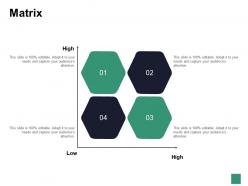
Matrix business management planning strategy marketing planning





Try Before you Buy Download Free Sample Product
 Impress Your
 Audience
 100%
100% Editable
 Save Hours
 of Time


Our Matrix Business Management Planning Strategy Marketing Planning keep anxiety at bay. They don't allow doubts to creep in.
People who downloaded this PowerPoint presentation also viewed the following :
Matrix business management planning strategy marketing planning with all 5 slides:
Identify causes of hostility with our Matrix Business Management Planning Strategy Marketing Planning. Bring about an end to implacable differences.



FAQs for Matrix business management planning
**INPUT**: What are the key components of an effective matrix planning strategy? **OUTPUT**: Key components of an effective matrix planning strategy include cross-functional team coordination, clear role definitions, dual reporting structures, resource allocation frameworks, and communication protocols. These elements streamline project execution by eliminating silos, enhancing collaboration across departments, and enabling faster decision-making, with many organizations finding that strategic matrix implementation ultimately delivers improved operational efficiency and competitive advantage.
Organizations ensure clear communication in matrix environments by establishing standardized reporting protocols, defining explicit role boundaries, implementing regular cross-functional meetings, and utilizing collaborative digital platforms. Through structured communication frameworks, teams can navigate dual reporting relationships more effectively, minimize conflicts between functional and project priorities, and maintain transparency across departments, ultimately delivering improved coordination and faster project execution.
Tools for matrix planning include project management platforms like Microsoft Project and Asana, collaboration software such as Slack and Teams, resource management systems, analytics dashboards, and specialized matrix planning applications. These technologies streamline coordination by automating task allocation, enhancing cross-functional communication, and providing real-time visibility into project dependencies, with many organizations finding that integrated platforms ultimately deliver improved resource utilization and faster project completion across multiple business units.
Matrix planning enhances team dynamics by creating cross-functional collaboration, shared accountability, and transparent communication channels across departments and projects. This approach enables organizations to leverage diverse expertise, reduce silos, and accelerate decision-making, with many companies finding that matrix structures ultimately deliver improved resource utilization and faster project outcomes.
Common challenges include unclear role definitions, conflicting priorities between functional and project managers, communication breakdowns across departments, resource allocation disputes, and accountability issues. These obstacles often emerge in organizations where dual reporting relationships create confusion, with many companies finding that establishing clear governance frameworks, regular cross-functional meetings, and defined escalation processes ultimately delivers smoother operations and better strategic alignment.
Matrix planning enhances resource allocation efficiency by providing visual clarity of resource distribution, enabling cross-functional coordination, identifying bottlenecks, and optimizing workforce utilization across multiple projects simultaneously. Through strategic matrix frameworks, organizations streamline decision-making processes, reduce resource conflicts, and maximize productivity, with many companies finding that this approach delivers significantly improved project outcomes and operational efficiency.
Organizations can measure matrix planning strategy success through key performance indicators like project completion rates, resource utilization efficiency, cross-functional collaboration scores, and stakeholder satisfaction metrics. Many companies track communication effectiveness, decision-making speed, and goal achievement across multiple dimensions, with successful implementations typically showing improved operational efficiency and enhanced strategic alignment.
Stakeholder involvement ensures matrix planning addresses diverse perspectives, resource constraints, and organizational priorities through collaborative input and buy-in. Cross-functional teams, department heads, and key decision-makers contribute strategic insights that enhance planning accuracy and implementation success, with many organizations finding that early stakeholder engagement significantly reduces project conflicts and accelerates delivery timelines.
Matrix planning can be adjusted by modifying reporting relationships, decision-making hierarchies, and communication channels to match organizational needs, whether flat, hierarchical, or hybrid structures. Organizations streamline this process by customizing project ownership protocols, resource allocation methods, and accountability frameworks, with many companies finding that flexible matrix approaches ultimately enhance cross-functional collaboration while maintaining operational efficiency.
Training teams in matrix planning requires structured workshops covering resource allocation methodologies, cross-functional collaboration techniques, priority mapping frameworks, and conflict resolution strategies. Organizations should implement hands-on simulations using real project scenarios, provide ongoing coaching support, and establish clear communication protocols, with many teams finding that regular practice sessions and mentorship programs ultimately enhance coordination efficiency and project success rates.
Matrix planning enhances agile project management by providing visual clarity across sprints, team responsibilities, and deliverable dependencies, enabling faster decision-making and resource allocation. Through cross-functional mapping, agile teams streamline communication, identify bottlenecks early, and maintain alignment between stakeholders, ultimately delivering more predictable outcomes and enhanced project transparency.
Matrix planning differs from traditional project planning through cross-functional resource sharing, dual reporting structures, integrated team coordination, and flexible role assignments across multiple projects simultaneously. While traditional methods follow linear hierarchies with dedicated resources, matrix planning enables organizations to optimize talent utilization, accelerate project delivery, and enhance knowledge transfer, with many enterprises finding this approach delivers greater operational efficiency and competitive advantage.
Matrix planning facilitates better risk management by providing comprehensive visibility across project dimensions, enabling systematic risk identification, assessment, and mitigation tracking throughout multiple project phases simultaneously. Through structured matrix frameworks, project managers can map dependencies, resource conflicts, and potential bottlenecks more effectively, while cross-functional teams gain shared accountability for risk ownership, ultimately delivering more resilient project outcomes and strategic risk mitigation.
Matrix planning significantly enhances decision-making processes by providing structured frameworks for evaluating multiple variables, prioritizing initiatives based on data-driven criteria, and visualizing complex relationships between different strategic elements. This approach enables organizations to make more informed choices by systematically comparing options across key dimensions, ultimately delivering faster consensus-building, reduced decision paralysis, and improved strategic alignment across teams.
Organizations leverage feedback loops within matrix planning by establishing regular cross-functional check-ins, implementing real-time performance dashboards, and creating structured review cycles between functional and project managers. These mechanisms enable continuous course correction, enhance resource allocation transparency, and strengthen communication across matrix relationships, with many companies finding that systematic feedback integration ultimately delivers faster project adaptation and improved strategic alignment in increasingly complex organizational environments.
No Reviews