

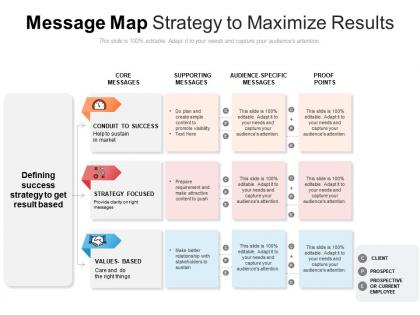
Message map strategy to maximize results




Try Before you Buy Download Free Sample Product
 Impress Your
 Audience
 100%
100% Editable
 Save Hours
 of Time


Our Message Map Strategy To Maximize Results are topically designed to provide an attractive backdrop to any subject. Use them to look like a presentation pro.
People who downloaded this PowerPoint presentation also viewed the following :
Message map strategy to maximize results with all 2 slides:
Use our Message Map Strategy To Maximize Results to effectively help you save your valuable time. They are readymade to fit into any presentation structure.
FAQs for Message map strategy
Message mapping is basically about making sure people actually remember what you said instead of zoning out halfway through. I always think of it like giving directions - you wouldn't dump 20 random street names on someone, right? You'd give them the main turns they need to remember. Start with your 3-5 biggest points first. Everything else should back up those key messages. Without this structure, people get totally lost in all your details (even the really good ones) and walk away remembering nothing. It's honestly the difference between a presentation that sticks and one that doesn't.
Message mapping works because you're actually talking about stuff your audience cares about, not what you assume they should. When you match your messages to their real problems and goals, boom - suddenly your content feels personal and relevant. It's honestly like night and day compared to generic sales pitches. People think "finally, someone who gets it" instead of just scrolling past another boring marketing thing. I always tell people to start simple: write down your audience's top 3 concerns, then create messages that speak directly to each one. Makes such a difference.
So you'll want three main pieces: your central message, proof points, and responses to pushback. Pick one clear main point - everything else should back this up. Build maybe 3-4 supporting arguments with actual data or examples underneath. Here's what trips people up though - they never think through objections ahead of time. Someone asks "what about cost?" or whatever, and they just stand there looking lost. Honestly, I've watched so many good presentations crash because of this. Run your whole thing by someone else first. They'll catch stuff you're blind to.
So traditional outlining? You just dump what YOU want to say into bullet points. Message mapping flips that completely - you start with what your audience actually cares about. Way more strategic, honestly. Instead of hierarchical structure, you're connecting specific messages to real problems people have. Then you figure out what action you want them to take. The whole time you're asking "okay but why should they care?" I always forget this part, but traditional outlines miss whether anyone will actually respond to your content. Try listing their pain points first next time, then build messages around those. Game changer.
Honestly, just use whatever your team's already comfortable with. Miro and Lucidchart are solid for the visual stuff. PowerPoint works too - I know it sounds boring but I've seen people build really clean message maps in basic slide decks. Figma's great if you're already in there for design work. Oh, and don't sleep on Google Slides either. Some teams swear by Notion or Mural for the more structured approach. The main thing is you want something where you can easily connect your main message to all the supporting points and shuffle things around when you inevitably change your mind.
Yeah, message mapping totally works across different industries. The basic idea is the same everywhere - figure out your key messages, then match them up with what your audience actually cares about. I've watched it work for everything from tech startups to big retail chains. Healthcare, finance, whatever - doesn't really matter. What changes is just the specific pain points and how people talk in that industry. The framework itself? Pretty much identical. You're still prioritizing based on business goals and making sure everything stays consistent. Honestly, any business that communicates with customers can use this stuff. Just adapt it to your audience and you'll be good.
Figure out who you're talking to first - what bugs them, what they care about, how they like to communicate. Your main message doesn't change, but how you say it totally does. Tech people want numbers and details. Executives? They just want to know the bottom line and ROI. I learned this the hard way once. Make different versions of your key points using words each group actually uses. Oh, and definitely test this stuff with real people from each audience before you go all-in. Saves you from looking clueless later.
Dude, visuals are a game-changer for message mapping. They turn those abstract concepts into something people can actually grasp - infographics, diagrams, videos, whatever works. Way more memorable than walls of text that nobody reads anyway. Plus when you're forced to visualize a message, you'll catch gaps in your strategy real quick. Like, if you can't picture how to show it, maybe the message isn't clear enough? Start with your most important messages and just sketch out a few ideas. Even rough mockups help you see what's working and what isn't.
Quarterly is the bare minimum, but honestly? Fast-moving industries like tech need monthly check-ins because everything changes constantly. More stable sectors can probably get away with every 6 months. Watch for the obvious triggers - product launches, new competitors, regulatory stuff. But the real tell is when your sales team starts complaining that messaging isn't working anymore. That's your cue right there. Set a calendar reminder so you don't forget, and flag it whenever there's a disconnect between your map and actual customer conversations. Those real-world chats will tell you everything.
Oh man, the classic mistake? Stuffing every single message you can think of into one map. Total disaster - you'll confuse everyone including yourself. Pick 3-5 core messages tops. Make sure they actually connect to your main story instead of just... existing randomly. And please don't sit in a room making up what you think people want to hear without actually asking them first. I've watched so many campaigns flop because of this. Test your messages with real people before you lock anything in. Trust me on this one.
Honestly, feedback is like your BS detector for messaging. Test your key messages with actual people - customers, stakeholders, whoever. Their reactions tell you everything. Are they confused by your jargon? Do they care about the benefits you're pushing? That confusion is actually super valuable data. You can tweak your messaging order, ditch the weak stuff, or just explain things better. I always think it's weird when people skip this step and wonder why their messaging doesn't work. Test early, test often, then fix what's broken. Rinse and repeat until it clicks.
Apple's probably the best example - they've stuck with that "think different" vibe everywhere for years. Microsoft did something similar when they ditched their boring corporate image and went all-in on the productivity angle during their cloud push. Oh, and Salesforce is great at this too - they take all their techy CRM stuff and just call it "customer success," which actually makes sense to salespeople. The thing is, none of these companies just set it and forgot it. They're constantly tweaking based on what works. I'd start by checking if your messaging is even consistent across your channels first - that's usually where the biggest gaps are.
So message mapping is basically your cheat sheet for staying consistent across all presentations. You write down your main talking points, proof, and tone so everyone tells the same story. Trust me, without it teams contradict each other constantly - I've seen it happen too many times. Your sales people and marketing team pull from the same playbook, so customers aren't getting mixed messages. Map out maybe 3-5 core messages first. Oh, and actually make sure people use them - that's half the battle right there.
So your message map is like the skeleton, but storytelling puts the flesh on it. People don't remember bullet points - they remember stories that hit them in the feels. You can have all the best data in the world, but if you just rattle off features and facts, nobody's gonna care. Stories make boring stuff interesting and abstract ideas suddenly click. Like, I could tell you "our product increases efficiency by 40%" or I could tell you about Sarah who used to work weekends but now gets home for dinner every night. Which one makes you want to know more? The story wraps your key messages in something people actually give a damn about.
Honestly, get your whole team involved instead of trying to tackle message mapping alone. Set up workshops with marketing, sales, product, customer success - everyone who talks to customers. Yeah, people will argue about what matters most at each stage, but that's actually helpful since different perspectives make your maps way more realistic. Google Docs works fine for collaboration, or Miro if you want something fancier. The key thing is making sure everyone can jump in and edit. Oh, and don't just build it once - you'll need regular check-ins to update everything as you figure out more about what your audience actually wants.
No Reviews