Metrics To Track Employee Engagement And Collaboration
Try Before you Buy Download Free Sample Product
Audience
Editable
of Time
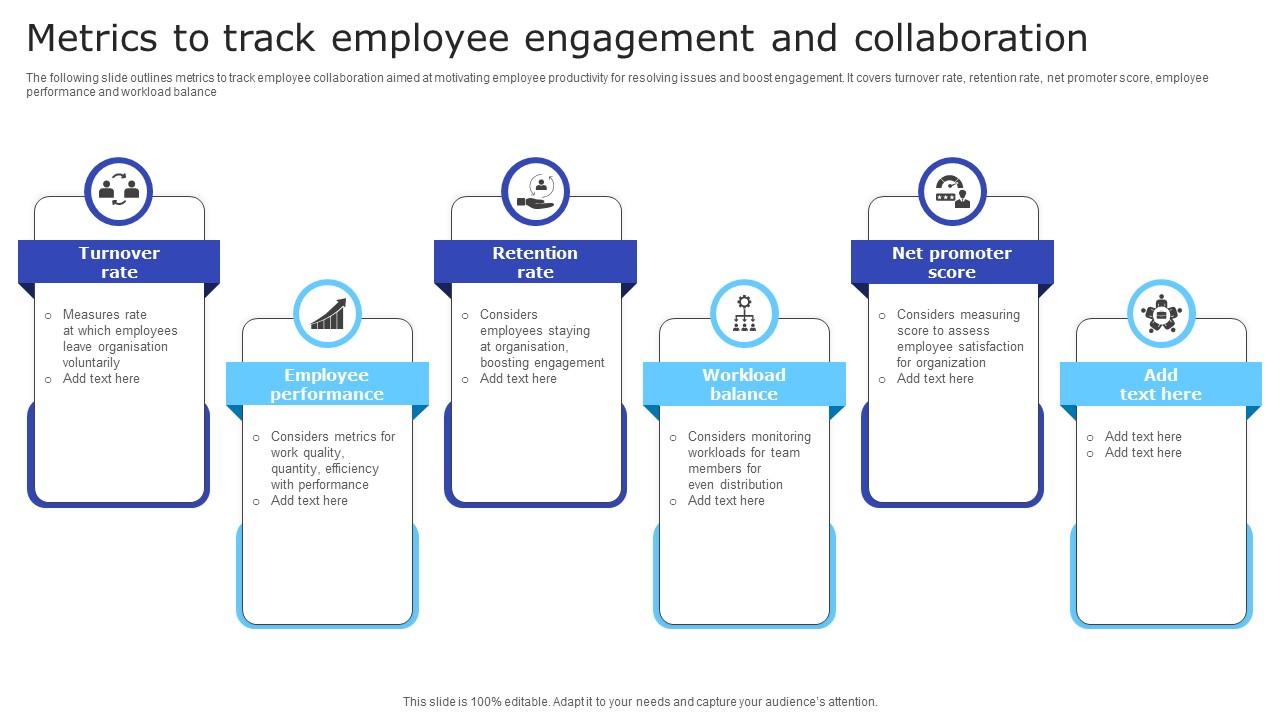
The following slide outlines metrics to track employee collaboration aimed at motivating employee productivity for resolving issues and boost engagement. It covers turnover rate, retention rate, net promoter score, employee performance and workload balance
People who downloaded this PowerPoint presentation also viewed the following :
Metrics To Track Employee Engagement And Collaboration with all 6 slides:
Use our Metrics To Track Employee Engagement And Collaboration to effectively help you save your valuable time. They are readymade to fit into any presentation structure.
FAQs for Metrics To Track Employee
**INPUT**: What are the most effective employee engagement metrics to measure in the workplace? **OUTPUT**: Effective employee engagement metrics include employee satisfaction scores, retention rates, productivity indicators, absenteeism levels, and participation in company initiatives. These measurements enable organizations to identify engagement gaps, enhance workplace culture, and streamline talent management strategies, with many companies finding that tracking these metrics ultimately delivers improved performance and competitive advantage.
Employee engagement metrics identify improvement areas by analyzing feedback scores, participation rates, productivity levels, and retention data across different team segments. Through survey responses and performance indicators, managers can pinpoint specific challenges like communication gaps or workload imbalances, while tracking trends reveals whether leadership changes or process adjustments enhance team satisfaction and ultimately deliver stronger collaboration and reduced turnover.
Employee turnover rate serves as a critical indicator of engagement levels, reflecting job satisfaction, workplace culture, compensation adequacy, career development opportunities, and management effectiveness. High turnover often signals disengagement issues, while low turnover typically indicates strong engagement, with many organizations finding that engaged employees are significantly more likely to remain, ultimately reducing recruitment costs and preserving institutional knowledge.
Pulse surveys enhance employee engagement metrics by providing real-time feedback, identifying trending issues, and capturing sentiment changes between annual reviews. These frequent, targeted questionnaires enable organizations to monitor engagement levels continuously, address concerns proactively, and measure the impact of workplace initiatives, with many companies finding that monthly or quarterly pulse surveys deliver more actionable insights than traditional annual engagement assessments.
Strong correlation exists between employee engagement and business performance, with engaged employees delivering higher productivity, reduced turnover, improved customer satisfaction, and increased profitability. Companies with highly engaged workforces demonstrate 23% higher profitability and 18% higher productivity, while organizations across retail, healthcare, and financial services find that engaged teams consistently outperform competitors through enhanced innovation, quality, and operational efficiency.
Qualitative feedback enhances quantitative engagement metrics by providing context, uncovering root causes, and revealing nuanced employee experiences that numbers alone cannot capture. Through surveys, focus groups, and one-on-one conversations, organizations gain deeper insights into engagement drivers, identify specific pain points, and develop targeted solutions, ultimately creating more comprehensive engagement strategies.
Employee NPS measures how likely employees are to recommend their organization as a workplace, providing insights into loyalty, satisfaction, and overall engagement levels that traditional surveys might miss. This metric enables companies to identify engagement drivers, predict turnover risks, and benchmark against industry standards, with many organizations finding that higher employee NPS correlates with improved productivity, customer satisfaction, and ultimately competitive advantage.
**INPUT**: How can we effectively benchmark our employee engagement metrics against industry standards? **OUTPUT**: Effective benchmarking involves comparing your metrics against industry-specific databases, peer organizations, and annual surveys from firms like Gallup, Deloitte, and SHRM. These resources enable organizations to identify performance gaps, establish realistic targets, and track competitive positioning, with many companies finding that sector-specific comparisons deliver more actionable insights than broad averages, ultimately enhancing strategic workforce planning. **Word count: 60 words**
Employee engagement tracking tools include pulse survey platforms like Glint and Culture Amp, analytics dashboards such as Workday and BambooHR, real-time feedback systems, sentiment analysis software, and performance management platforms. These technologies streamline data collection through automated surveys, predictive analytics, and integration capabilities, enabling organizations across sectors like retail and healthcare to enhance workforce satisfaction, reduce turnover costs, and ultimately deliver improved operational efficiency and competitive advantage.
Organizations should evaluate employee engagement metrics quarterly for strategic insights, with pulse surveys conducted monthly or bi-weekly for real-time feedback. This balanced approach enables companies to track meaningful trends while capturing immediate concerns, with many successful enterprises finding that regular monitoring combined with annual comprehensive assessments delivers actionable data and sustained improvements.
Common pitfalls include focusing solely on scores without context, ignoring demographic breakdowns, over-surveying employees, and failing to act on findings. Organizations often misinterpret correlation as causation, neglect qualitative feedback alongside quantitative data, and compare results across different survey tools, ultimately undermining trust and missing opportunities to enhance workplace culture and retention.
Leadership influences employee engagement scores through regular one-on-one meetings, transparent communication about departmental goals, recognition programs, and professional development opportunities. By actively listening to employee concerns, providing clear feedback, and creating psychological safety, leaders in sectors like healthcare, technology, and manufacturing find that engagement scores improve significantly, ultimately delivering higher productivity and lower turnover rates.
Strategies include targeted professional development programs, flexible work arrangements, enhanced recognition systems, improved manager training, and cross-functional collaboration opportunities based on specific metric gaps. Organizations finding low engagement in career growth can implement mentorship programs and clear advancement pathways, while those with communication issues benefit from regular feedback sessions and transparent leadership practices, ultimately delivering higher retention and productivity.
Demographic factors significantly influence employee engagement metrics through generational preferences, cultural backgrounds, career stages, and communication styles, requiring segmented analysis for accurate interpretation. Different demographics may value work-life balance versus advancement opportunities differently, with younger employees often prioritizing flexibility while experienced workers focus on recognition, ultimately requiring tailored engagement strategies rather than one-size-fits-all approaches.
Consistently monitoring employee engagement metrics delivers reduced turnover, improved productivity, enhanced customer satisfaction, better financial performance, and stronger organizational culture. These measurements enable leaders to identify emerging issues, recognize high-performing teams, and implement targeted interventions, with many organizations finding that sustained engagement tracking ultimately creates competitive advantages through higher retention and innovation.
-
A fantastic collection of templates. I'll likely use this as my go-to resource for future templates and support.
-
What a stunning collection of customizable templates! Really a time-saver..Â