


Mitigating Risks And Building Trust Through Effective Corporate Compliance Strategy Complete Deck Strategy Cd




Try Before you Buy Download Free Sample Product
 Impress Your
 Audience
 100%
100% Editable
 Save Hours
 of Time


A compliance strategy is a plan of action that organizations use to ensure they abide by all applicable laws, rules, and industry standards. Grab our Mitigating Risks And Building Trust Through Effective Corporate Compliance Strategy template. It includes a strategic plan to reduce the risks of non-compliance and to uphold the organizations good name and credibility. Our Compliance Program deck suggests strategies for managing organizational compliance requirements by identifying current issues faced by the enterprise. It further develops a compliance plan including steps, setting compliance goals, aligning business compliance with corporate culture, defining functional scope, etc. Additionally, our Risk Mitigation PPT provides information about various compliance management strategies addressing areas, complying with regulatory compliance, establishing organizational values, risk assessment, and management. These areas further include strategies such as regulatory compliance, data protection, workplace health and safety, environment safety, HR compliance, corporate governance, ethical behavior, risk management process, process risks, and quality standards. At last, our Regulatory Compliance module includes the implementation, budget, impact analysis, and dashboard tracking to measure the performance of essential compliance metrics. Get instant access.
People who downloaded this PowerPoint presentation also viewed the following :
Content of this Powerpoint Presentation
Slide 1: This slide introduces Mitigating Risks and Building Trust Through Effective Corporate Compliance Strategy. Commence by stating Your Company Name.
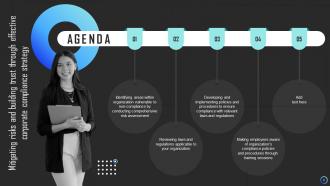
Slide 2: This slide depicts the Agenda of the presentation.
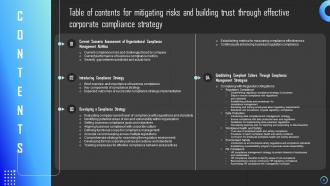
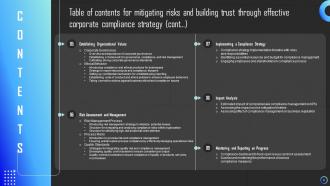
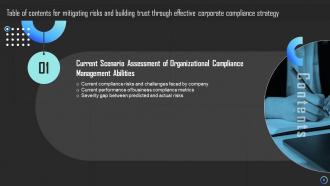
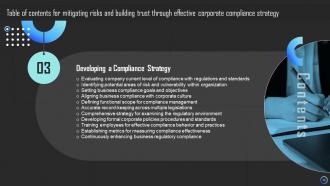
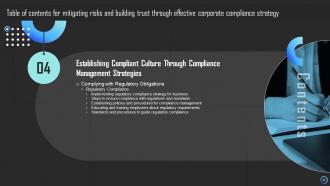
Slide 3: This slide includes the Table of contents.
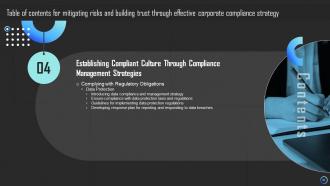
Slide 4: This slide further includes the Table of contents.
Slide 5: This slide highlights the Title for the Topics to be covered further.
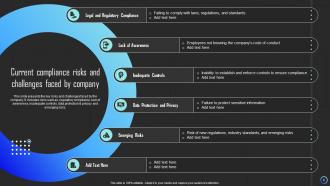
Slide 6: This slide presents the key risks and challenges faced by the company.
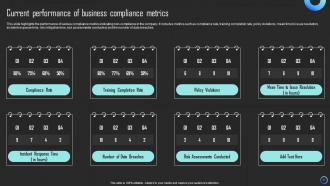
Slide 7: This slide highlights the performance of various compliance metrics indicating non-compliance in the company.
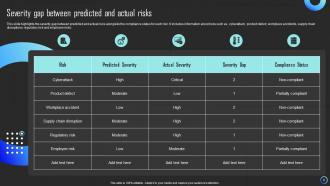
Slide 8: This slide shows the severity gap between predicted and actual risks alongside the compliance status for each risk.
Slide 9: This slide includes the Heading for the Contents to be discussed next.
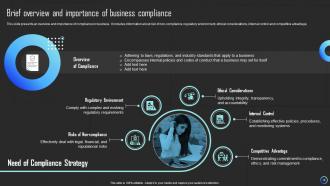
Slide 10: This slide presents an overview and importance of compliance in business.
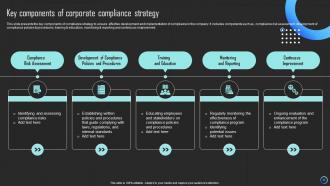
Slide 11: This slide portrays the key components of compliance strategy to ensure effective development and implementation of compliance in the company.
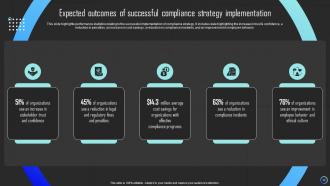
Slide 12: This slide highlights performance statistics relating to the successful implementation of compliance strategy.
Slide 13: This slide indicates the Title for the Ideas to be covered further.
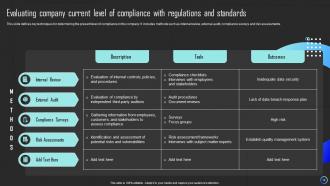
Slide 14: This slide defines key techniques for determining the present level of compliance in the company.
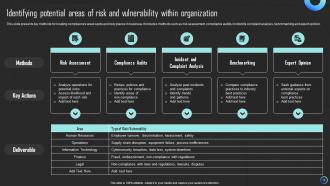
Slide 15: This slide presents key methods for locating compliance's weak spots and risky places in business.
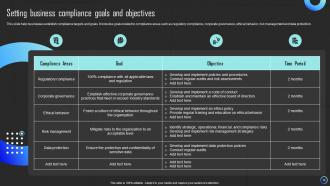
Slide 16: This slide helps businesses establish compliance targets and goals.
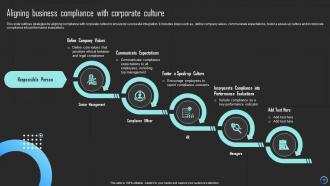
Slide 17: This slide outlines strategies for aligning compliance with corporate culture to ensure its successful integration.
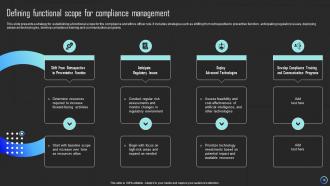
Slide 18: This slide shows a strategy for establishing a functional scope for the compliance and ethics officer role.
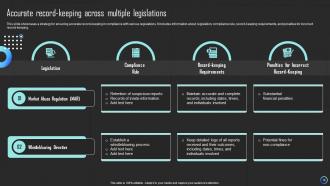
Slide 19: This slide includes a strategy for ensuring accurate record-keeping in compliance with various legislations.
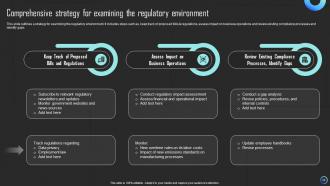
Slide 20: This slide outlines a strategy for examining the regulatory environment.
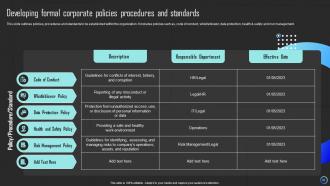
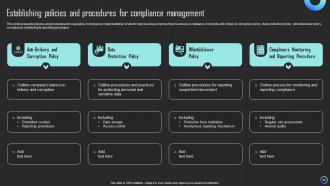
Slide 21: This slide portrays policies, procedures and standards to be established within the organization.
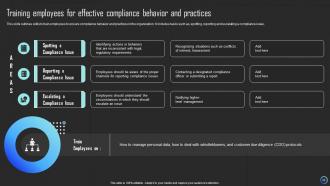
Slide 22: This slide outlines skills to train employees to ensure compliance behavior and practices in the organization.
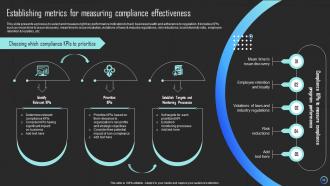
Slide 23: This slide presents a process to select and measure right key performance indicators to track business health and adherence to regulation.
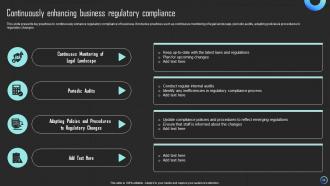
Slide 24: This slide contains key practices to continuously enhance regulatory compliance of business.
Slide 25: This slide shows the Heading for the Ideas to be discussed next.
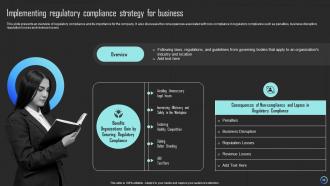
Slide 26: This slide presents an overview of regulatory compliance and its importance for the company.
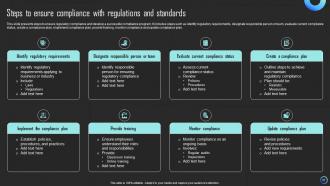
Slide 27: This slide illustrates steps to ensure regulatory compliance and develop a successful compliance program.
Slide 28: This slide presents policies and procedures for regulatory compliance implementation of which help business improve their business compliance.
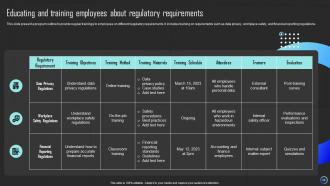
Slide 29: This slide shows a program outline to provide regular trainings to employees on different regulatory requirements.
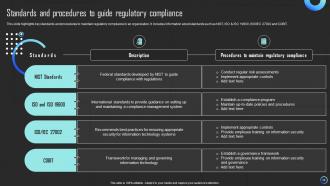
Slide 30: This slide highlights key standards and procedures to maintain regulatory compliance in an organization.
Slide 31: This slide indicates the Title for the Contents to be covered further.
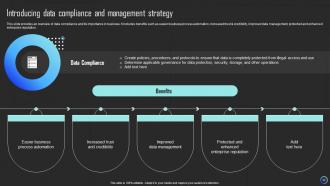
Slide 32: This slide provides an overview of data compliance and its importance in business.
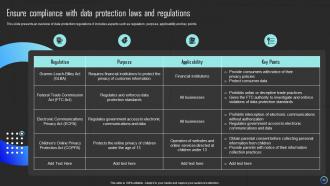
Slide 33: This slide presents an overview of data protection regulations.
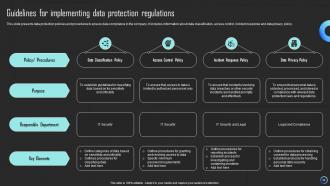
Slide 34: This slide reveals data protection policies and procedures to ensure data compliance in the company.
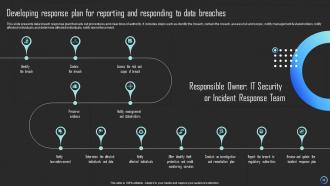
Slide 35: This slide depicts data breach response plan that sets out procedures and clear lines of authority.
Slide 36: This slide indicates the Heading for the Topics to be discussed next.
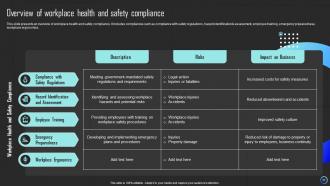
Slide 37: This slide presents an overview of workplace health and safety compliance.
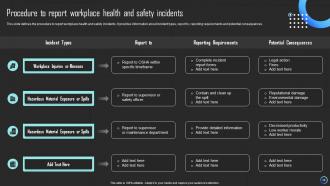
Slide 38: This slide defines the procedure to report workplace health and safety incidents.
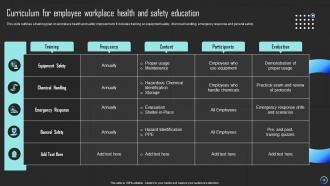
Slide 39: This slide outlines a training plan on workplace health and safety improvement.
Slide 40: This slide represents the Title for the Topics to be covered in the following template.
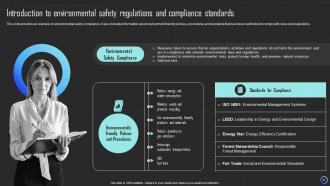
Slide 41: This slide provides an overview of environmental safety compliance.
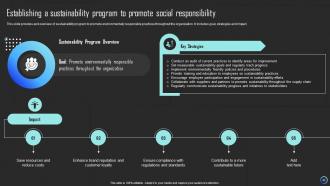
Slide 42: This slide shows the sustainability program to promote environmentally responsible practices throughout the organization.
Slide 43: This slide indicates the Heading for the Contents to be discussed further.
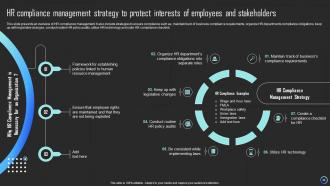
Slide 44: This slide presents an overview of HR compliance management.
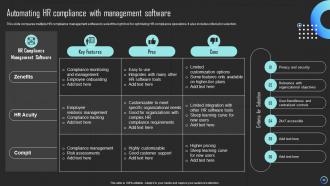
Slide 45: This slide compares multiple HR compliance management software to select the right tool for optimizing HR compliance operations.
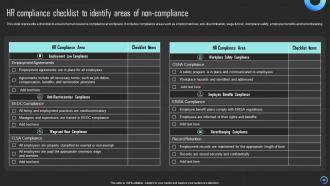
Slide 46: This slide represents a checklist to ensure human resource compliance at workplace.
Slide 47: This slide exhibits best practices to ensure effective HR compliance management in the company.
Slide 48: This slide includes the Title for the Ideas to be covered next.
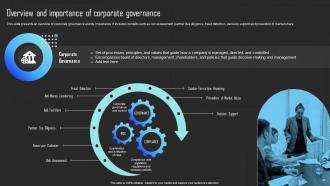
Slide 49: This slide presents an overview of corporate governance and its importance.
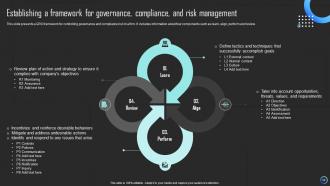
Slide 50: This slide shows a GRC framework for controlling governance and compliance risk in a firm.
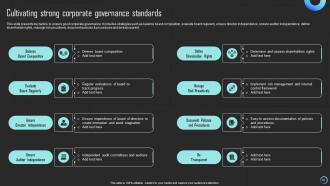
Slide 51: This slide portrays key tactics to ensure good corporate governance.
Slide 52: This slide highlights the Heading for the Ideas to be discussed further.
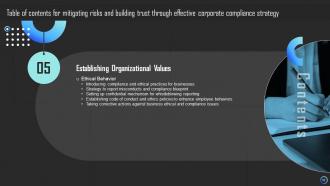
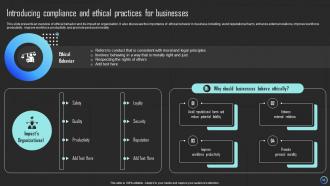
Slide 53: This slide presents an overview of ethical behavior and its impact on organization.
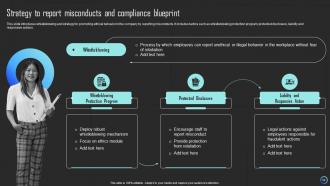
Slide 54: This slide introduces whistleblowing and strategy for promoting ethical behavior in the company by reporting misconducts.
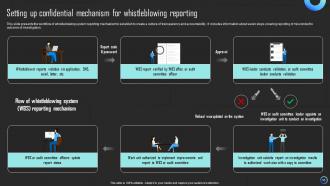
Slide 55: This slide shows the workflow of whistleblowing system reporting mechanism to establish to create a culture of transparency and accountability.
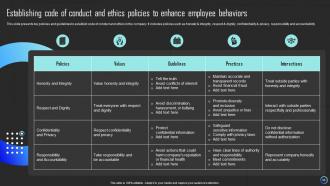
Slide 56: This slide presents key policies and guidelines to establish code of conduct and ethics in the company.
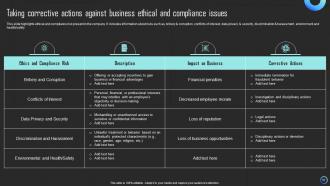
Slide 57: This slide highlights ethical and compliance risk present in the company.
Slide 58: This slide contains the Title for the Contents to be discussed next.
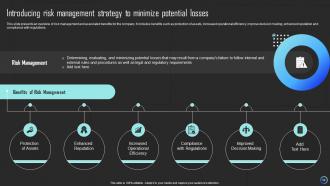
Slide 59: This slide presents an overview of risk management and associated benefits for the company.
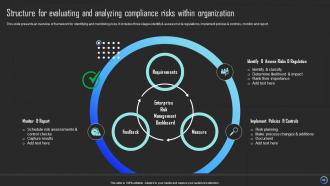
Slide 60: This slide depicts the Overview of framework for identifying and monitoring risks.
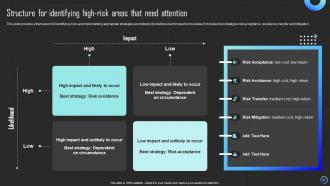
Slide 61: This slide provides a framework for identifying risks and implementing appropriate strategies according to its likelihood and impact on business.
Slide 62: This slide shows the Heading for the Topics to be covered further.
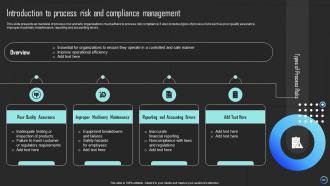
Slide 63: This slide presents an overview of process risk and why organizations must adhere to process risk compliance.
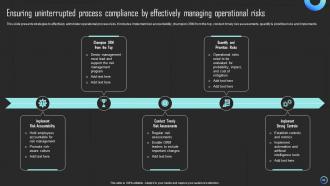
Slide 64: This slide presents strategies to effectively administer operational process risks.
Slide 65: This slide indicates the Title for the Topics to be discussed next.
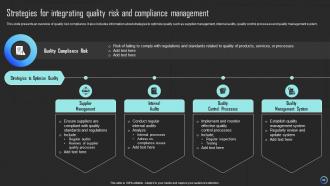
Slide 66: This slide presents an overview of quality risk compliance.
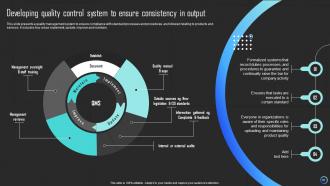
Slide 67: This slide portrays Quality management system to ensure compliance with standard processes and procedures.
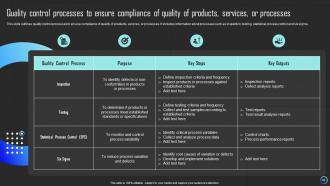
Slide 68: This slide outlines quality control processes to ensure compliance of quality of products, services, or processes.
Slide 69: This slide exhibits the Heading for the Contents to be covered in the next template.
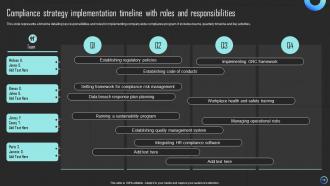
Slide 70: This slide represents a timeline detailing key responsibilities and roles for implementing company wide compliance program.
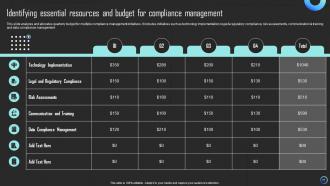
Slide 71: This slide analyzes and allocates quarterly budget for multiple compliance management initiatives.
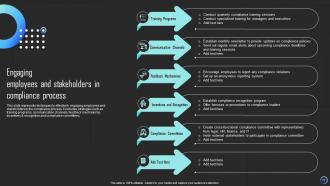
Slide 72: This slide represents techniques to effectively engaging employees and stakeholders in the compliance process.
Slide 73: This slide shows the Title for the Ideas to be covered further.
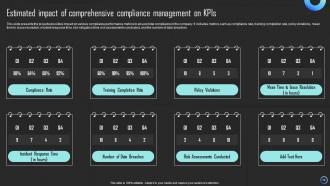
Slide 74: This slide presents the projected positive impact on various compliance performance metrics to ensure total compliance in the company.
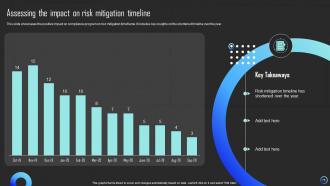
Slide 75: This slide showcases the positive impact on compliance program on risk mitigation timeframe.
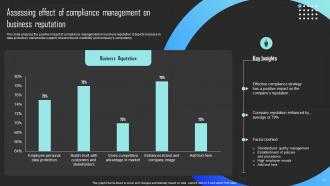
Slide 76: This slide analyzes the positive impact of compliance management on business reputation.
Slide 77: This slide depicts the Heading for the Ideas to be further discussed.
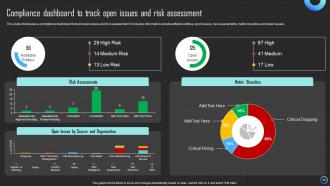
Slide 78: This slide showcases a compliance dashboard to track open issues and risk assessment.
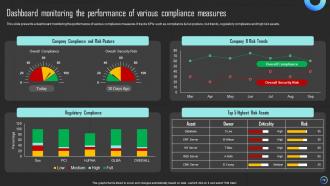
Slide 79: This slide reveals the dashboard for monitoring the performance of various compliance measures.
Slide 80: This is the Icons slide containing all the Icons used in the plan.
Slide 81: This slide is used for showcasing some Additional infomration.
Slide 82: This slide incorporates the company's mission, vision, and goals.
Slide 83: This is the About us slide. State your organization-related information here.
Slide 84: This is Meet our team slide.
Slide 85: This slide shows the goals of the firm.
Slide 86: This slide contains the Post it notes for reminders and deadlines.
Slide 87: This is the Venn diagram slide.
Slide 88: This is the Puzzle slide with related imagery.
Slide 89: This slide displays the SWOT analysis.
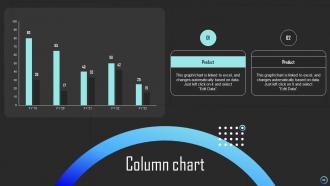
Slide 90: This slide shows the Column chart.
Slide 91: This slide displays the Line chart.
Slide 92: This slide reveals the timeline.
Slide 93: This is the roadmap slide.
Slide 94: This is the Thank You slide for acknowledgement.
Mitigating Risks And Building Trust Through Effective Corporate Compliance Strategy Complete Deck Strategy Cd with all 99 slides:
Use our Mitigating Risks And Building Trust Through Effective Corporate Compliance Strategy Complete Deck Strategy Cd to effectively help you save your valuable time. They are readymade to fit into any presentation structure.













FAQs for Mitigating Risks And Building Trust Through Effective Corporate Compliance Strategy Complete
Effective corporate compliance strategies include comprehensive risk assessment frameworks, robust policy development systems, regular training programs, continuous monitoring mechanisms, and clear reporting structures. These components work together by identifying potential violations early, educating employees on regulatory requirements, and ensuring swift corrective actions, with many organizations finding that integrated compliance systems significantly reduce legal risks while enhancing operational efficiency.
Companies can assess compliance risks through comprehensive audits, regulatory mapping, stakeholder interviews, data analysis, and gap assessments against current standards. These evaluations enable organizations to identify vulnerabilities across departments, prioritize high-impact areas, and develop targeted mitigation strategies, with many financial services and healthcare institutions finding that systematic risk assessment ultimately delivers enhanced regulatory preparedness and operational efficiency.
Leadership drives compliance culture by setting clear expectations, modeling ethical behavior, allocating adequate resources for compliance programs, and consistently communicating the importance of regulatory adherence throughout all organizational levels. Through visible commitment and accountability measures, executives in sectors like financial services, healthcare, and manufacturing create environments where compliance becomes integral to operations, ultimately reducing regulatory risks, enhancing stakeholder trust, and delivering sustainable competitive advantage.
Technology enhances corporate compliance efforts by automating monitoring processes, streamlining reporting workflows, and providing real-time risk assessments across organizational operations. Through AI-powered analytics and integrated compliance platforms, companies in sectors like banking and healthcare can detect violations earlier, reduce manual oversight costs, and maintain consistent regulatory adherence, ultimately delivering operational efficiency and competitive advantage.
Common pitfalls include inadequate risk assessment, siloed departmental approaches, outdated regulatory tracking, insufficient employee training, and reactive rather than proactive frameworks. These challenges often stem from viewing compliance as a checkbox exercise rather than strategic integration, with many organizations finding that fragmented approaches lead to costly oversights, regulatory penalties, and missed competitive advantages in regulated industries.
Organizations should prioritize compliance training by focusing on high-risk roles, regulatory requirements, incident history, and employee tenure levels. Training programs work best when tailored to specific departments like finance, healthcare, or manufacturing, with new employees receiving comprehensive foundational training while experienced staff get targeted updates on evolving regulations, ultimately reducing violations and enhancing organizational reputation.
Compliance program effectiveness metrics include audit findings frequency, regulatory violation rates, employee training completion percentages, incident response times, and cost of compliance per revenue dollar. These measurements enable organizations to track risk reduction, regulatory adherence, and operational efficiency, with many financial services and healthcare institutions finding that comprehensive metrics ultimately deliver enhanced transparency and competitive advantage.
Companies can stay updated by establishing regulatory monitoring systems, subscribing to industry publications, participating in professional associations, engaging compliance consultants, and implementing automated compliance software. These approaches enable organizations to track regulatory changes proactively, with many financial services and healthcare institutions finding that dedicated compliance teams combined with technology solutions ultimately deliver faster adaptation to new requirements and reduced regulatory risk.
Organizations can encourage compliance violation reporting through anonymous hotlines, whistleblower protection programs, regular training sessions, clear reporting procedures, and non-retaliation policies. These strategies work by building employee trust, streamlining communication channels, and creating psychological safety, with many financial services and healthcare institutions finding that transparent reporting cultures ultimately deliver faster issue resolution and stronger regulatory relationships.
Corporate compliance relates to CSR by establishing the foundational framework for ethical business operations, while CSR extends beyond legal requirements to demonstrate proactive social impact. Through integrated governance structures, organizations streamline regulatory adherence and sustainability initiatives simultaneously, with many financial institutions and healthcare companies finding that aligned compliance-CSR strategies enhance stakeholder trust, reduce operational risks, and ultimately deliver competitive advantage in increasingly conscious markets.
Integrating compliance into daily operations involves embedding automated monitoring systems, establishing clear policy workflows, training employees regularly, creating accountability frameworks, and implementing real-time reporting mechanisms. Through digital compliance platforms, organizations streamline audit processes, reduce manual oversight costs, and enhance regulatory transparency, with many financial services and healthcare institutions finding that proactive integration ultimately delivers operational efficiency and competitive advantage.
Organizations effectively communicate compliance policies through multi-channel approaches including executive presentations, employee training programs, stakeholder newsletters, digital dashboards, and regular board reporting. These communication strategies streamline policy understanding by providing clear guidelines, consistent messaging, and accessible documentation, with many companies finding that transparent, regular communication ultimately enhances stakeholder trust and regulatory confidence.
Legal implications of non-compliance include hefty financial penalties, criminal charges against executives, license revocations, operational shutdowns, and reputational damage that impacts customer trust. These consequences can devastate businesses through regulatory investigations, class-action lawsuits, and market exclusion, with many organizations finding that proactive compliance investments ultimately cost significantly less than post-violation remediation.
A risk-based approach enhances compliance strategy efficiency by prioritizing high-risk areas, allocating resources strategically, and focusing monitoring efforts where violations are most likely or impactful. This targeted methodology enables organizations to streamline auditing processes, reduce unnecessary oversight costs, and accelerate response times, while maintaining comprehensive coverage, ultimately delivering stronger compliance outcomes with optimized resource utilization.
Best practices for compliance audits include establishing standardized audit protocols, maintaining comprehensive documentation systems, conducting risk-based assessments, implementing continuous monitoring technologies, and ensuring independent oversight. These approaches streamline compliance verification by automating data collection, identifying vulnerabilities proactively, and creating audit trails, with many organizations finding that regular systematic reviews ultimately deliver reduced regulatory risks and enhanced operational transparency.
-
Great work on designing the presentation. I just loved it!
-
The service is fast, and I could access any presentation after buying the subscription. I don’t think I’ll ever have to worry about a presentation in my life.