


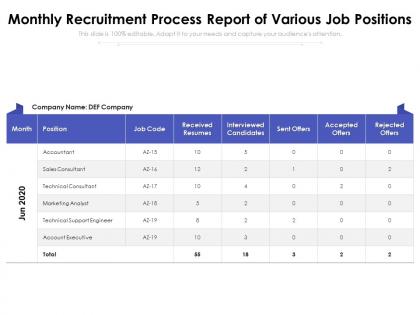
Monthly recruitment process report of various job positions




Try Before you Buy Download Free Sample Product
 Impress Your
 Audience
 100%
100% Editable
 Save Hours
 of Time


Our Monthly Recruitment Process Report Of Various Job Positions are explicit and effective. They combine clarity and concise expression.
People who downloaded this PowerPoint presentation also viewed the following :
Monthly recruitment process report of various job positions with all 2 slides:
Give your audience a fulfilling experience. They will find our Monthly Recruitment Process Report Of Various Job Positions elevating.

FAQs for Monthly recruitment process report of
Honestly, start with the basics - time-to-fill, cost-per-hire, and offer acceptance rates. Quality of hire matters way more than people think though. Track how new hires perform at 6 and 12 months because what's the point if they're gone in three months? Source effectiveness tells you which channels actually deliver (spoiler alert: employee referrals almost always crush job boards). Candidate experience scores are clutch too. Oh, and don't sleep on hiring manager satisfaction - grumpy managers will make your life hell. If diversity's on your radar, track those numbers separately. You can always get fancier with metrics later, but these will give you a solid foundation to work from.
So basically, those recruitment reports are like X-rays for your hiring process - they show you exactly where things are getting stuck. Maybe candidates are sitting around forever between interviews, or that one hiring manager takes weeks to respond (we all know the type). Time-to-hire numbers don't lie. Check which stages are taking way too long or where you're hemorrhaging good people. I've seen companies lose amazing candidates just because their process dragged on. Once you find the problem spots, you can actually fix them and keep people interested instead of watching them walk away.
Bar charts work best for comparing stuff like time-to-hire between departments. Line graphs are your go-to for tracking trends over time. Don't go crazy with colors - those rainbow charts are honestly the worst. Always label your axes clearly (people will get confused otherwise). Funnel charts are solid for showing how candidates move through hiring stages. Pie charts work well for source-of-hire breakdowns, though some people hate them for whatever reason. The main thing? Someone should look at your chart and instantly get what you're trying to show them. Lead with your biggest metric first.
So recruitment reports basically show you who's applying - age, gender, race, education, where they're from, all that stuff. You'll start noticing patterns real quick, like maybe everyone's coming from the same three schools or you're missing entire groups of people. Honestly, it's kind of eye-opening when you see the data laid out like that. The cool part is you can actually do something about it - switch up where you're posting jobs, team up with different organizations, maybe tweak how you write job descriptions. It's not just numbers sitting there, you know?
Honestly, recruitment reports are like having a roadmap for your hiring game. They'll show you how long different roles actually take to fill and where candidates are dropping off in your process. Seasonal trends become super obvious too - like how everyone ghosts you in December. You can catch patterns early, like if engineering always needs more people or if certain skills are becoming impossible to find (spoiler: they probably are). Plus the time-to-hire data from last year? That's gold for setting realistic expectations and budgets going forward. Way better than just winging it every time.
Recruitment reports are gold for figuring out where you're losing candidates. Check where people bail out most - that's your biggest red flag. Look at your timeline too, because if you're taking forever compared to other companies, good people will jump ship. Most places honestly suck at this, so fixing even basic stuff helps you win. Pay attention to offer declines and why people ghost you mid-process. That feedback tells you everything. Then clean up whatever's broken - maybe it's slow communication or too many interview rounds. Small changes make candidates actually want to recommend you to friends.
Honestly, tracking where your hires come from is a game changer. You'll see which job boards actually work versus which ones just flood you with garbage applications. Like, LinkedIn might send you 100 resumes but your employee referrals could have way better success rates - that stuff really surprised me when I first started paying attention. Then you can put more money into what's actually working and stop throwing budget at dead-end sources. Oh, and definitely break it down by department since engineers and sales people come from totally different places usually.
Monthly reports work best for most teams - gives you solid data without drowning in noise. If you're hiring like crazy, weekly might make sense. Daily though? Total overkill unless your boss is losing their mind over open roles. Whatever schedule you pick, just stick with it. Hiring managers hate surprises and love knowing when updates are coming. Plus you'll actually be able to compare performance month-to-month and figure out what's working (or what isn't). I learned this the hard way after flip-flopping between schedules and confusing everyone.
Check out Greenhouse or Workday first - their built-in reporting is pretty decent and saves you from spreadsheet hell. Trust me on that one. If you need fancier stuff, Tableau makes gorgeous dashboards but it's pricey. Power BI's cheaper and does the job. Google Data Studio works too if budget's tight. The main thing? Make sure whatever you pick talks to your current systems. Double data entry is the worst. Honestly though, start with what your ATS already does - might surprise you how much is already there.
Here's what I'd do - set up a section in your recruitment report just for hiring managers' feedback. Copy their actual quotes instead of summarizing, it hits different when stakeholders see the real words. Group everything into themes like "time-to-hire issues" or "missing skills" so trends jump out at you. Honestly, timing matters more than people think. Grab this feedback right after each hire or rejection while everyone still remembers the details. Structure it enough that busy execs can scan quickly, but don't overthink it. The goal is spotting patterns that'll actually help you improve the process next time around.
Honestly, recruitment reports are like your insurance policy against discrimination lawsuits. They track all your diversity stats and prove you're not filtering out protected groups at weird stages. When auditors show up (and trust me, they love surprise visits), you'll have everything documented. The reports help catch red flags early - like if women keep getting rejected after phone screens or something sketchy like that. I'd run them monthly at least. Yeah, it's extra paperwork, but way better than explaining to a lawyer why your hiring process looks biased. Plus the data actually helps you spot where your process might be broken anyway.
Don't just stare at the average numbers - they're pretty much useless. Break things down by department and role type first. Senior engineer positions? Yeah, those will always drag on forever. But if your normal 2-week roles suddenly hit 6 weeks, something's broken. I'd map out each stage of your process to find where things get stuck. The real gold is in spotting patterns and outliers - that's what'll help you have actual conversations with hiring managers about bottlenecks. Way better than just saying "everything's slow" in your next meeting.
Honestly, recruitment reports are treasure troves for figuring out retention. Look at which hiring channels brought in people who stayed versus those who left after a few months. What did candidates actually care about during interviews? Growth opportunities, flexible schedules, whatever - that's your roadmap for what to keep delivering. Most companies (and I've seen this way too often) just shove these reports in a folder somewhere and forget about them. Such a missed opportunity! Use that data to double-check your onboarding process. Are you actually following through on what you promised during recruitment? Those insights will tell you everything.
Ugh, inconsistent data is going to be your worst enemy. Your ATS tracks stuff one way, hiring managers do it completely different, and nobody updates anything properly. Global hiring? Time zones will make you want to scream. Also, you'll spend forever arguing about basic definitions - like does "time to hire" start from the job post or first interview? And don't get me started on teams who keep everything in random Excel files instead of the actual system. Honestly, just define your metrics clearly from day one and automate whatever you can. Manual data entry is where dreams go to die.
Honestly, these reports are game-changers because they translate your work into numbers that executives actually understand. No more awkward conversations about "hiring being tough" - you're showing real data like time-to-fill and cost-per-hire. Management eats this stuff up. You can spot problems early and prove why you need more budget or resources. When you present quarterly metrics, suddenly HR looks strategic instead of just... administrative busy work. Figure out what numbers your leadership team cares about most first. That's where you start building from. Trust me, it'll change how they see your whole department.
No Reviews