Multiple hypothesis testing ppt powerpoint presentation gallery tips cpb

Rating:
80%
Multiple hypothesis testing ppt powerpoint presentation gallery tips cpb
Slide 1 of 6
Favourites Favourites

Try Before you Buy Download Free Sample Product

Audience Impress Your
Audience
Editable 100%
Editable
Time Save Hours
of Time
The Biggest Sale is ending soon in
0
0
:
0
0
:
0
0
Rating:
80%
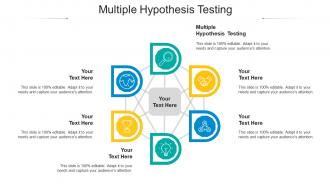
Presenting Multiple Hypothesis Testing Ppt Powerpoint Presentation Gallery Tips Cpb slide which is completely adaptable. The graphics in this PowerPoint slide showcase six stages that will help you succinctly convey the information. In addition, you can alternate the color, font size, font type, and shapes of this PPT layout according to your content. This PPT presentation can be accessed with Google Slides and is available in both standard screen and widescreen aspect ratios. It is also a useful set to elucidate topics like Multiple Hypothesis Testing. This well-structured design can be downloaded in different formats like PDF, JPG, and PNG. So, without any delay, click on the download button now.

People who downloaded this PowerPoint presentation also viewed the following :

FAQs for Multiple hypothesis testing ppt powerpoint presentation

Multiple hypothesis testing occurs when researchers simultaneously evaluate several statistical hypotheses within a single study, requiring special procedures to control the increased risk of false discoveries that naturally accompanies multiple comparisons. This approach is crucial in fields like genomics, clinical trials, and market research, where analyzing hundreds or thousands of variables simultaneously can lead to misleading conclusions without proper statistical adjustments, ultimately ensuring more reliable and actionable insights.

FWER controls the probability of making at least one Type I error across all tests, maintaining strict overall significance levels, while FDR controls the expected proportion of false discoveries among rejected hypotheses. FWER methods like Bonferroni are highly conservative, whereas FDR approaches like Benjamini-Hochberg offer greater power for exploratory research, with many analysts finding FDR delivers better balance between discovery and precision.

Common methods for controlling FWER include Bonferroni correction, Holm-Bonferroni procedure, Šidák correction, and Hochberg's step-up method, each offering different balances between statistical rigor and detection power. While Bonferroni is most conservative but easiest to implement, Holm-Bonferroni and Hochberg methods provide greater power for detecting true effects, with many research organizations finding that step-wise procedures deliver optimal outcomes.

The Benjamini-Hochberg procedure controls false discovery rate by ranking p-values from smallest to largest, then identifying the largest p-value satisfying p ≤ (i/m) × α, where i represents rank position, m equals total tests, and α sets desired FDR level. This method enables researchers in genomics, clinical trials, and marketing analytics to maintain statistical rigor while testing thousands of hypotheses simultaneously, ultimately delivering more reliable insights and reducing costly false discoveries across large-scale comparative studies.

The Bonferroni correction mitigates Type I errors by dividing the desired significance level by the number of tests performed, creating a more stringent threshold for each individual test. This statistical approach helps researchers in pharmaceutical trials, financial risk assessments, and quality control processes maintain overall experiment reliability, while ensuring that false discoveries are minimized across multiple comparisons, ultimately delivering more credible results.

Ignoring correlation between tests in multiple hypothesis testing leads to incorrect Type I error rates, reduced statistical power, and unreliable p-value adjustments. This oversight particularly affects pharmaceutical research, clinical trials, and financial risk assessments, where dependent variables are common, ultimately delivering flawed conclusions and potentially costly decision-making errors across organizations.

Bayesian approaches incorporate prior knowledge and treat hypotheses as probability distributions, while frequentist methods rely on p-value adjustments like Bonferroni corrections without prior information. Through Bayesian hierarchical modeling, researchers can simultaneously estimate multiple parameters while controlling false discovery rates more flexibly, with many pharmaceutical companies and clinical research organizations finding that this approach delivers more nuanced insights and better decision-making frameworks.

Sample size significantly influences test power in multiple hypothesis testing by affecting the ability to detect true effects while controlling family-wise error rates through correction methods like Bonferroni or FDR. Larger samples enhance statistical power across all tests simultaneously, enabling researchers in clinical trials, genomics studies, and market research to identify meaningful differences more reliably, ultimately delivering more robust findings and reducing false negative rates in comprehensive analytical frameworks.

Researchers should consider using permutation tests in multiple hypothesis testing when dealing with non-normal data distributions, small sample sizes, or when parametric assumptions are violated. These tests provide robust control of family-wise error rates by generating exact p-values through data resampling, with many statisticians finding that permutation methods deliver more reliable results than traditional parametric approaches, ultimately enhancing research validity.

Determining significance thresholds in multiple hypothesis testing presents challenges including balancing Type I and Type II error rates, selecting appropriate correction methods like Bonferroni or FDR, and accounting for test dependencies. These statistical considerations require careful evaluation of study objectives, sample sizes, and acceptable risk levels, with many researchers finding that overly conservative thresholds can reduce power while liberal approaches inflate false discovery rates.

Visualization techniques for multiple hypothesis testing include heat maps showing p-value distributions, volcano plots highlighting significant results, forest plots displaying effect sizes, and interactive dashboards enabling filtering by significance levels. These approaches streamline complex statistical communication by transforming dense numerical outputs into intuitive visual narratives, with research institutions and pharmaceutical companies finding that stakeholders grasp findings faster, ultimately enhancing decision-making processes.

Genomics exemplifies multiple hypothesis testing challenges through genome-wide association studies that simultaneously test thousands of genetic variants, creating massive false discovery risks without proper correction methods. Modern genomic research addresses these challenges using sophisticated statistical approaches like Bonferroni correction and false discovery rate control, enabling researchers to identify genuine genetic associations while minimizing spurious findings, ultimately delivering more reliable insights for personalized medicine and drug development.

Machine learning models address multiple hypothesis testing through regularization techniques like LASSO and Ridge regression, cross-validation methods, and feature selection algorithms that control for false discovery rates. These approaches automatically penalize overfitting and spurious correlations, with financial institutions and healthcare organizations finding that ensemble methods and bootstrapping techniques ultimately deliver more robust predictive accuracy while minimizing statistical errors.

P-value adjustment methods in clinical trials and public health research control false discovery rates when testing multiple endpoints, preventing inflated Type I errors that could lead to incorrect conclusions about treatment efficacy or safety. These statistical safeguards enable researchers to maintain scientific rigor while evaluating complex interventions across diverse populations, with pharmaceutical companies and health agencies finding that proper adjustments ultimately deliver more reliable evidence for regulatory approvals and treatment guidelines.

Empirical Bayes methods enhance multiple hypothesis testing by leveraging shared information across all hypotheses to improve individual test statistics, reducing false discovery rates while maintaining statistical power. Through adaptive shrinkage and data-driven prior estimation, researchers in genomics, finance, and clinical trials achieve more accurate signal detection, better error control, and ultimately more reliable scientific discoveries in large-scale testing scenarios.

Ratings and Reviews

80% of 100
Write a review
Most Relevant Reviews
  1. 80%

    by Duncan Berry

    Use of icon with content is very relateable, informative and appealing.
  2. 80%

    by Douglass Riley

    Great quality slides in rapid time.

2 Item(s)

per page: