


Nanotechnology Revolution Transforming Modern Industry TC CD
Here is a competently designed Nanotechnology Revolution Transforming Modern Industry PPT. This Nanoscience Template provides businesses with opportunities for innovation, differentiation, cost-efficiency, and market expansion. Furthermore, this Nanotech presentation enables enterprises to stay ahead of the competition and meet the demands of a rapidly evolving market. This Nanotechnology Engineering Deck introduces the concept of nanotechnology, covering details about an overview, historical evolution, key stats on adoption, and significance. Also, this PowerPoint examines the market outlook by analyzing global market size and emerging trends in nanotechnology. Moreover, this Nano Material Science presentation covers the fundamentals of nanotechnology, including- size, types, and nanosensor technology. Our presentation also covers the real-world applications of nanotechnology across various industries. Additionally, this PPT addresses the key challenges of adopting nanotechnology in business and strategies for scaling it further. Further, this presentation measures the impact of adopting nanotechnology across industries and its integration ROI. Lastly, this Applications of Nanoparticles module provides insights into future technological advancements in nanotechnology. This guide helps you understand the transformative world of nanotechnology. Invest in knowledge and become a pioneer of change today.



























































You must be logged in to download this presentation.


Do you want to remove this product from your favourites?
PowerPoint presentation slides
Deliver this complete deck to your team members and other collaborators. Encompassed with stylized slides presenting various concepts, this Nanotechnology Revolution Transforming Modern Industry TC CD is the best tool you can utilize. Personalize its content and graphics to make it unique and thought-provoking. All the eighty one slides are editable and modifiable, so feel free to adjust them to your business setting. The font, color, and other components also come in an editable format making this PPT design the best choice for your next presentation. So, download now.

People who downloaded this PowerPoint presentation also viewed the following :
Content of this Powerpoint Presentation
Slide 1: The slide introduces Nanotechnology Revolution: Transforming Modern Industry. State your Company Name and begin.
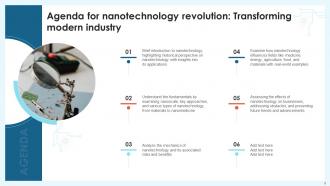
Slide 2: This is an Agenda slide. State your agendas here.
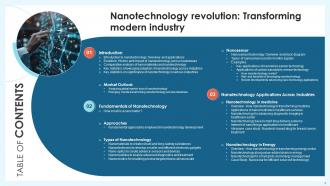
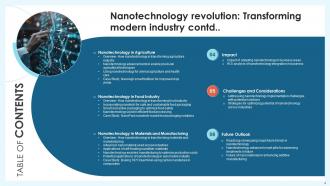
Slide 3: The slide displays Table of contents for the presentation.
Slide 4: The slide again renders Table of contents.
Slide 5: The slide also shows Table of contents.
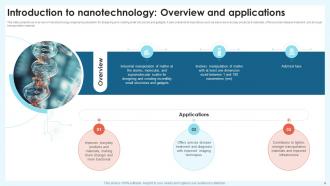
Slide 6: This slide presents an overview of nanotechnology engineering discipline for designing and creating small structures and gadgets.
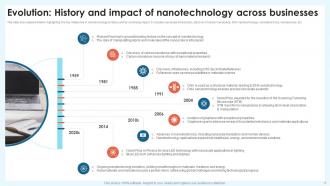
Slide 7: This slide showcases a timeline highlighting the key milestones in nanotechnology's history and its continuing impact.
Slide 8: This slide demonstrates the key difference between nanomaterials and nanotechnology.
Slide 9: This slide shows key statistics associated with nanotechnology across industry.
Slide 10: This slide presents key statistics showcasing the significance of nanotechnology in various industries.
Slide 11: This slide showcases the growth of global nanotechnology market size.
Slide 12: This slide highlights emerging trends in nanotechnology transforming various industries.
Slide 13: The slide shows Title of contents further.
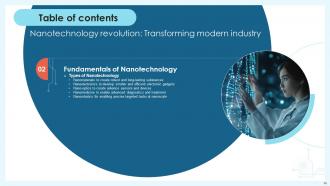
Slide 14: This slide help analyses the nanometer scale which enables to understand nanotechnology an evolving field.
Slide 15: This slide presents various approaches and techniques employed in nanotechnology.
Slide 16: The slide renders Title of contents further.
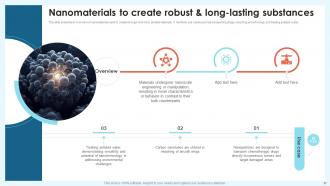
Slide 17: This slide presents an overview of nanomaterials used to create stronger and more durable materials.
Slide 18: This slide highlights an overview of nanoelectronics which enables the creation of smaller and more efficient electronic devices.
Slide 19: This slide showcases the various applications of nano-optics across industries.
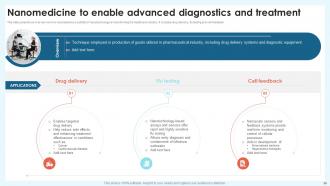
Slide 20: This slide provides an overview on how nanomedicine a subfield of nanotechnology is transforming the healthcare industry.
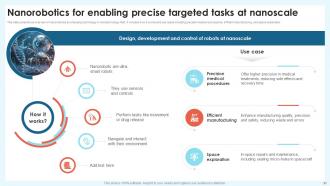
Slide 21: This slide presents an overview of nanorobotics an emerging technology in nanotechnology field.
Slide 22: The slide shows another Title of contents.
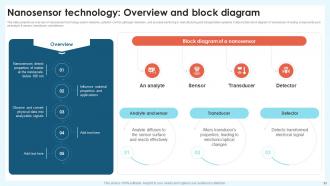
Slide 23: This slide presents an overview of nanosensor technology used in medicine, pollution control, pathogen detection, and process monitoring in manufacturing.
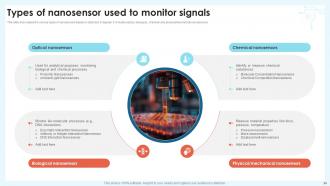
Slide 24: This slide showcases the various types of nanosensors based on detection of signals.
Slide 25: This slide presents an overview of nanowire sensors used to make ultrasensitive nanosensors for sensing applications.
Slide 26: This slide provides an overview of carbon nanotube sensors utilized to detect a variety of substances.
Slide 27: The slide displays another Title of contents.
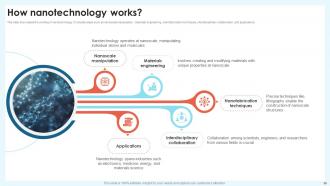
Slide 28: This slide showcases the working of nanotechnology.
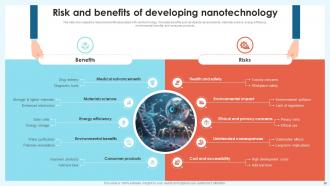
Slide 29: This slide showcases the risks and benefits associated with nanotechnology.
Slide 30: This slide showcases the recent developments in nanotechnology that is transforming various industries.
Slide 31: The slide depicts Title of contents further.
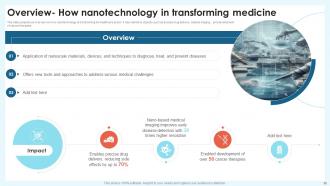
Slide 32: This slide presents an overview on how nanotechnology is transforming the healthcare sector.
Slide 33: This slide showcases the advanced applications of nanomedicine in healthcare services.
Slide 34: This slide renders how nanotechnology is helping in advancing diagnostic imaging in healthcare sector.
Slide 35: This slide displays how nanotechnology based drug delivery system helps in targeting precise cells and tissues.
Slide 36: This slide presents a framework showcasing nanodevices.
Slide 37: This slide presents a case-study analysis of how nanotechnology is being used in healthcare industry for improving the effectiveness of treatments.
Slide 38: The slide depicts Title of contents which is to be discussed further.
Slide 39: This slide provides an overview of how nanotechnology is transforming the energy and utilities sector.
Slide 40: This slide showcases the applications of nanotechnology along the value-added chain in the energy sector.
Slide 41: This slide highlights the application of nanotechnology in optimizing smart grids and energy management.
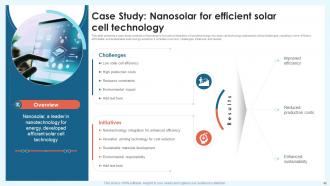
Slide 42: This slide presents a case-study analysis of Nanosolar's innovative integration of nanotechnology into solar cell technology.
Slide 43: The slide displays Title of contents further.
Slide 44: This slide presents an overview on how nanotechnology is transforming the agriculture sector.
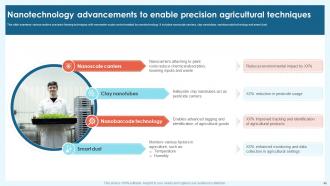
Slide 45: This slide examines various modern precision farming techniques with nanometer-scale control enabled by nanotechnology.
Slide 46: This slide presents how nanotechnology works in improving animal agriculture and healthcare.
Slide 47: This slide represents a case-study analysis of NanoAgri which utilized smart fertilizer for enhancing crop yields.
Slide 48: The slide demonstrates Title of contents further.
Slide 49: This slide presents an overview on how nanotechnology is transforming the food industry.
Slide 50: This slide showcases the application of nanotechnology in efficiently packaging food to ensure its safety and sustainability.
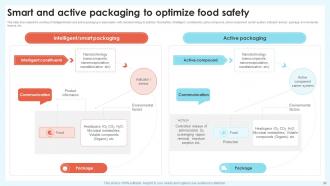
Slide 51: This slide renders the working of intelligent/smart and active packaging in association with nanotechnology to optimize food safety.
Slide 52: This slide showcases the types of nanotechnology used to optimize food processing.
Slide 53: This slide highlights a case-study analysis examining the key aspects of NanoPack's technology, its significance in the food industry, and its impact.
Slide 54: The slide again shows Title of contents which is to be discussed further.
Slide 55: This slide presents an overview of how nanotechnology help optimize materials and manufacturing.
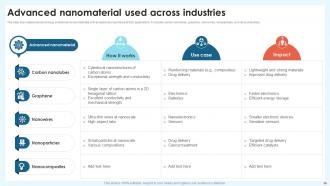
Slide 56: This slide showcases nanotechnology enabled advanced materials with exceptional properties and their applications.
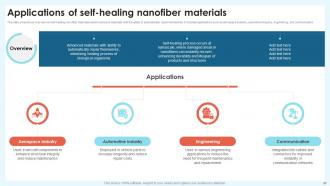
Slide 57: This slide provides an overview on self-healing nanofiber materials used to advance materials with the ability to automatically repair themselves.
Slide 58: This slide showcases the use of nanotechnology enables manufacturing industry to create goods with enhanced capabilities or lower production costs.
Slide 59: This slide showcases the applications of nanotechnologies in automobiles offering lighter but stronger materials.
Slide 60: This slide presents a case-study analysis of use of carbon nanotubes in composites.
Slide 61: The slide displays another Title of contents.
Slide 62: This slide showcases the impact of nanotechnology in various business areas.
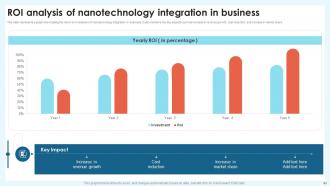
Slide 63: This slide represents a graph showcasing the return on investment of nanotechnology integration in business.
Slide 64: The slide again shows Title of contents.
Slide 65: This slide addresses various challenges related to nanotechnology and their impact on business.
Slide 66: This slide presents strategies for advancing nanotechnology field and unlocking its potential across various industries.
Slide 67: The slide represents Title of contents which is to be discussed further.
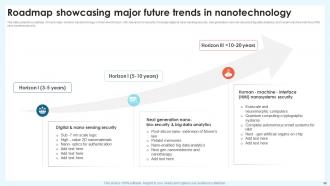
Slide 68: This slide presents a roadmap of future major trends in nanotechnology in three-level horizon, with relevance for security.
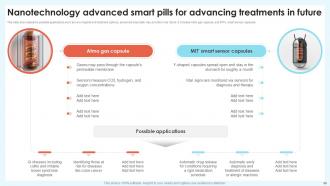
Slide 69: This slide showcases the possible applications such as new insights and treatment options, advanced smart pills may provide in the future.
Slide 70: This slide renders the impact of nanomaterials in additive manufacturing (3D printing).
Slide 71: This slide shows all the icons included in the presentation.
Slide 72: This slide is titled as Additional Slides for moving forward.
Slide 73: This is Our Vision, Mission and Goal slide with related imagery and text.
Slide 74: This is Our Team slide with names and designation.
Slide 75: This slide contains Puzzle with related icons and text.
Slide 76: This slide presents Roadmap with additional textboxes.
Slide 77: This slide depicts Venn diagram with text boxes.
Slide 78: This slide showcases Magnifying Glass to highlight information, specifications etc.
Slide 79: This slide shows Post It Notes. Post your important notes here.
Slide 80: This is a Timeline slide. Show data related to time intervals here.
Slide 81: This is a Thank You slide with address, contact numbers and email address.
Nanotechnology Revolution Transforming Modern Industry TC CD with all 90 slides:
Use our Nanotechnology Revolution Transforming Modern Industry TC CD to effectively help you save your valuable time. They are readymade to fit into any presentation structure.
-
Out of the box and creative design.
-
Very unique and reliable designs.
