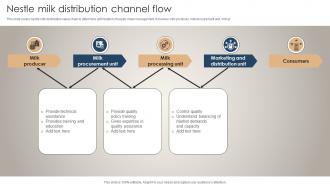
Nestle Milk Distribution Channel Flow
Try Before you Buy Download Free Sample Product
Audience
Editable
of Time
This slide covers nestle milk distribution value chain to determine optimization of supply chain management. It involves milk producer, milk procurement unit, milk pr.
People who downloaded this PowerPoint presentation also viewed the following :
Nestle Milk Distribution Channel Flow with all 9 slides:
Use our Nestle Milk Distribution Channel Flow to effectively help you save your valuable time. They are readymade to fit into any presentation structure.
FAQs for Nestle Milk
**INPUT**: What are the key stages in the Nestlé milk distribution channel? **OUTPUT**: Nestlé's milk distribution channel includes procurement from dairy farms, processing at manufacturing facilities, quality control testing, regional warehousing, and retail distribution through supermarkets, convenience stores, and specialty outlets. This multi-tiered system enables consistent product availability, maintains freshness through temperature-controlled logistics, and delivers competitive pricing while ensuring quality standards, with many retailers finding that Nestlé's streamlined approach enhances inventory management and customer satisfaction.
Nestlé ensures quality control through rigorous supplier audits, cold chain monitoring systems, real-time temperature tracking, and standardized processing protocols at collection centers. These comprehensive measures enable consistent quality from farm to consumer by maintaining optimal storage conditions, conducting regular testing, and implementing traceability systems, ultimately delivering safer products and enhanced brand reliability across their global distribution network.
Local dairy farmers serve as Nestlé's primary milk suppliers, providing fresh raw milk through established procurement networks, quality partnerships, and direct farm-to-facility collection systems. These farmers enable Nestlé's supply chain by meeting strict quality standards, maintaining consistent production volumes, and participating in training programs, ultimately delivering cost-effective sourcing while supporting rural agricultural communities.
Technology revolutionizes Nestlé's milk distribution through IoT sensors for temperature monitoring, GPS tracking for route optimization, automated inventory management systems, and predictive analytics for demand forecasting. These digital solutions streamline cold chain operations, minimize spoilage, and enhance delivery precision, with many dairy companies finding that integrated technology platforms ultimately deliver faster distribution cycles and significantly improved product quality control.
Nestlé utilizes refrigerated trucks for regional distribution, temperature-controlled rail transport for long-distance shipments, cold storage warehouses for inventory management, and specialized tanker vehicles for raw milk collection from farms. These integrated logistics methods streamline supply chain efficiency by maintaining product quality, reducing transportation costs, and ensuring faster delivery times, with many dairy operations finding that strategic cold-chain management ultimately delivers competitive advantage in perishable goods markets.
Nestlé addresses sustainability concerns through renewable energy adoption in processing facilities, sustainable packaging innovations, carbon footprint reduction initiatives, and ethical sourcing partnerships with dairy farmers. These efforts streamline environmental compliance while enhancing operational efficiency, with many food manufacturers finding that sustainable distribution practices ultimately deliver cost savings, improved brand reputation, and competitive advantage in increasingly eco-conscious markets.
Nestlé faces challenges including seasonal milk production variations, quality control across diverse supplier networks, transportation logistics in remote areas, and price volatility from market fluctuations. These supply chain complexities require strategic partnerships with local farmers, advanced cold storage infrastructure, and quality monitoring systems, ultimately enabling consistent product availability while maintaining cost efficiency and brand standards across global markets.
Nestlé leverages retail partnerships by establishing strategic alliances with supermarket chains, convenience stores, and local distributors, ensuring widespread product availability and optimized supply chain efficiency. These partnerships enable streamlined inventory management, coordinated promotional campaigns, and enhanced customer accessibility across diverse markets, with many retailers finding that Nestlé's collaborative approach delivers improved margins and faster inventory turnover.
**INPUT**: What are the metrics used to evaluate the performance of Nestlé's milk distribution channel? **OUTPUT**: Performance metrics for Nestlé's milk distribution include delivery time efficiency, inventory turnover rates, cost per unit delivered, customer satisfaction scores, and channel partner profitability margins. These measurements enable streamlined operations by identifying bottlenecks, optimizing route planning, and enhancing supplier relationships, with many dairy companies finding that comprehensive tracking ultimately delivers reduced operational costs and improved market responsiveness. [Word count: 58 words]
Seasonal variations significantly impact Nestlé's milk product demand through holiday baking surges, back-to-school periods, and summer beverage consumption patterns, requiring strategic inventory adjustments and flexible distribution networks. Through predictive analytics and diversified product portfolios, Nestlé anticipates these fluctuations by scaling production capacity, optimizing cold chain logistics, and partnering with retailers to ensure consistent availability, ultimately delivering enhanced customer satisfaction and competitive market positioning.
Nestlé implements integrated marketing strategies including trade promotions with retailers, point-of-sale displays, cooperative advertising programs, digital marketing campaigns, and strategic partnerships with distributors. These approaches enhance brand visibility across supermarkets, convenience stores, and specialty retailers, while enabling targeted consumer engagement, streamlined inventory management, and competitive shelf positioning, ultimately delivering increased market penetration and stronger distributor relationships.
Nestlé's global distribution model emphasizes standardized supply chain technologies, centralized procurement strategies, and unified quality protocols, while regional approaches adapt to local infrastructure, consumer preferences, and regulatory requirements. Through strategic localization, regional markets leverage specialized cold chain networks, partnerships with local dairy cooperatives, and culturally-specific packaging formats, ultimately delivering enhanced market penetration and customer satisfaction.
Nestlé has introduced ultra-high temperature (UHT) processing, aseptic packaging technology, modified atmosphere packaging, cold chain optimization systems, and smart packaging with freshness indicators. These innovations streamline distribution by eliminating refrigeration requirements, extending shelf life up to six months, and reducing spoilage costs, with many retailers finding that UHT milk delivers greater inventory flexibility and operational efficiency across global markets.
Consumer feedback influences Nestlé's milk distribution through direct customer surveys, social media monitoring, retailer sales data analysis, and focus group insights that identify demand patterns and preferences. This feedback enables Nestlé to optimize delivery routes, adjust product formulations, introduce new varieties like organic or lactose-free options, and enhance packaging designs, ultimately delivering improved customer satisfaction and competitive market positioning.
Distribution centers serve as strategic hubs that streamline Nestlé's milk supply chain by consolidating products, optimizing inventory levels, enabling faster order fulfillment, and reducing transportation costs through efficient routing. These facilities enhance operational efficiency by minimizing product handling, accelerating delivery times to retailers, and maintaining quality standards, ultimately delivering improved customer satisfaction and competitive advantage in the dairy market.
-
“As you have innovative ideas and they are all customizable, this saves a huge chunk of your time to prepare well-read presentations.”
-
The ease of modifying templates is just superb! Also, the vast collection offers plenty of options to choose from.