New Product Management Value Proposition Canvas For Product Positioning

Rating:
100%
New Product Management Value Proposition Canvas For Product Positioning
Slide 1 of 6

or

Favourites Favourites

Try Before you Buy Download Free Sample Product

Audience Impress Your
Audience
Editable 100%
Editable
Time Save Hours
of Time
The Biggest Sale is ending soon in
0
0
:
0
0
:
0
0
Rating:
100%
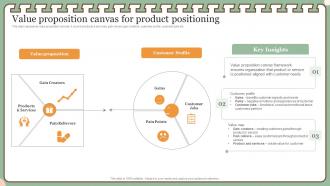
This slide represents value proposition canvas. It covers products and services, pain relivers gain creators, customer profile, customer jobs etc. Deliver an outstanding presentation on the topic using this New Product Management Value Proposition Canvas For Product Positioning. Dispense information and present a thorough explanation of Customer Profile, Value Proposition, Customer Profile using the slides given. This template can be altered and personalized to fit your needs. It is also available for immediate download. So grab it now.

FAQs for New Product Management Value Proposition Canvas

The Value Proposition Canvas serves to systematically align products or services with customer needs by mapping value propositions against customer segments, jobs, pains, and gains. This strategic tool enables businesses to identify market gaps, refine offerings, and enhance customer-product fit, with many organizations finding that it streamlines product development while ultimately delivering stronger market positioning and competitive advantage.

The Value Proposition Canvas helps identify customer needs and frustrations by systematically mapping customer jobs, pains, and gains against your value proposition's pain relievers and gain creators. Through structured customer interviews, surveys, and behavioral analysis, organizations can uncover hidden pain points, unmet needs, and desired outcomes, with many businesses finding that this framework reveals critical gaps between perceived and actual customer priorities, ultimately enabling more targeted product development and enhanced customer experiences.

The Value Proposition Canvas comprises the Customer Profile and Value Map, which work together to achieve product-market fit. The Customer Profile identifies customer jobs, pains, and gains, while the Value Map outlines pain relievers, gain creators, and products or services, with successful businesses finding that systematic alignment between these components delivers enhanced customer experiences and competitive advantage.

Businesses can utilize the Value Proposition Canvas to identify customer pain points, map product features to specific needs, validate assumptions through customer feedback, and prioritize development resources effectively. Through systematic analysis of jobs-to-be-done and gain creators, companies in sectors like healthcare and fintech streamline product-market fit, ultimately delivering more targeted solutions and enhanced customer satisfaction.

The Value Proposition Canvas enhances customer engagement by systematically aligning products with specific customer needs, pain points, and desired outcomes through detailed mapping and analysis. This strategic approach enables organizations to deliver more targeted solutions, personalized experiences, and relevant messaging, with many companies finding that structured value alignment significantly improves customer satisfaction and long-term loyalty.

Companies can gather Value Proposition Canvas data through customer interviews, surveys, focus groups, behavioral analytics, and direct observation of user interactions. These methods enable businesses to understand pain points, desired outcomes, and job-to-be-done insights across different customer segments, with many organizations finding that combining qualitative feedback with quantitative usage data delivers the most comprehensive and actionable customer profiles.

The Value Proposition Canvas focuses specifically on customer-product fit rather than entire business operations, unlike comprehensive frameworks such as Business Model Canvas or Lean Canvas. This targeted approach enables organizations to deeply analyze customer pain points, desired gains, and specific jobs-to-be-done, with many companies finding that this granular focus streamlines product development and enhances market positioning strategies.

Empathy mapping enhances the Value Proposition Canvas by providing deeper customer insights into emotions, thoughts, and behaviors that inform the customer profile section. While empathy maps explore psychological motivations and pain points through detailed emotional analysis, the Value Proposition Canvas translates these insights into structured jobs, gains, and pains, with many organizations finding that combining both approaches delivers more compelling, customer-centered value propositions.

Yes, the Value Proposition Canvas effectively analyzes competition by mapping competitors' customer jobs, pains, and gains against their value propositions, revealing gaps and differentiation opportunities. This comparative analysis enables businesses to identify underserved customer needs, benchmark their pain relievers and gain creators against competitors, and discover strategic positioning advantages, ultimately delivering clearer market differentiation and enhanced competitive intelligence.

Startups benefit from the Value Proposition Canvas by systematically identifying customer pain points, desired gains, and essential jobs-to-be-done before developing products or services. This structured approach enables early-stage companies to validate assumptions, minimize development costs, and create targeted solutions that directly address market needs, ultimately reducing the risk of product-market misfit while accelerating time-to-market success.

Common pitfalls include making assumptions without customer validation, creating overly complex value propositions, focusing solely on product features rather than customer outcomes, and neglecting to prioritize pain points effectively. These missteps often result from insufficient market research and internal bias, with many organizations finding that regular customer interviews and iterative canvas refinements ultimately deliver more compelling value propositions and stronger market positioning.

Businesses should revisit their Value Proposition Canvas quarterly during regular strategic reviews, after major market shifts, product launches, or customer feedback cycles. This iterative approach ensures alignment with evolving customer needs and competitive landscapes, with many organizations finding that regular updates enhance product-market fit, streamline messaging, and ultimately deliver stronger customer relationships and sustained competitive advantage.

Visual design elements that enhance Value Proposition Canvas presentations include clear color coding for different segments, consistent iconography, readable typography with hierarchical sizing, strategic white space, and logical flow arrows connecting customer jobs to value propositions. These elements streamline audience comprehension by creating visual distinction between pain points and gains, while enabling presenters to guide viewers through complex value mapping processes, ultimately delivering clearer strategic insights and faster stakeholder alignment.

The Value Proposition Canvas influences marketing strategies by aligning messaging with specific customer jobs, pains, and gains, ensuring communications resonate with target audiences' actual needs and priorities. This strategic alignment enables marketers to craft compelling campaigns, develop precise positioning statements, and create customer-centric content that addresses real pain points, ultimately delivering higher engagement rates and improved conversion performance across channels.

Teams can leverage the Value Proposition Canvas collaboratively by facilitating cross-functional workshops, conducting joint customer research, and creating shared visual mapping sessions that align diverse perspectives on customer needs and solutions. Through structured collaboration, teams from marketing, product development, and sales can identify innovation opportunities, validate assumptions together, and develop customer-centric solutions more effectively, ultimately delivering stronger value propositions and competitive advantage.

Ratings and Reviews

100% of 100
Review Form
Write a review
Most Relevant Reviews
  1. 100%

    by Chase Howard

    Easy to use and customize templates. Helped me give a last minute presentation.
  2. 100%

    by Williams Morales

    Happy to incorporate such stunning templates in my presentation. Made my presentation look professional and engaging. 

2 Item(s)

per page: