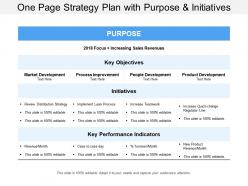
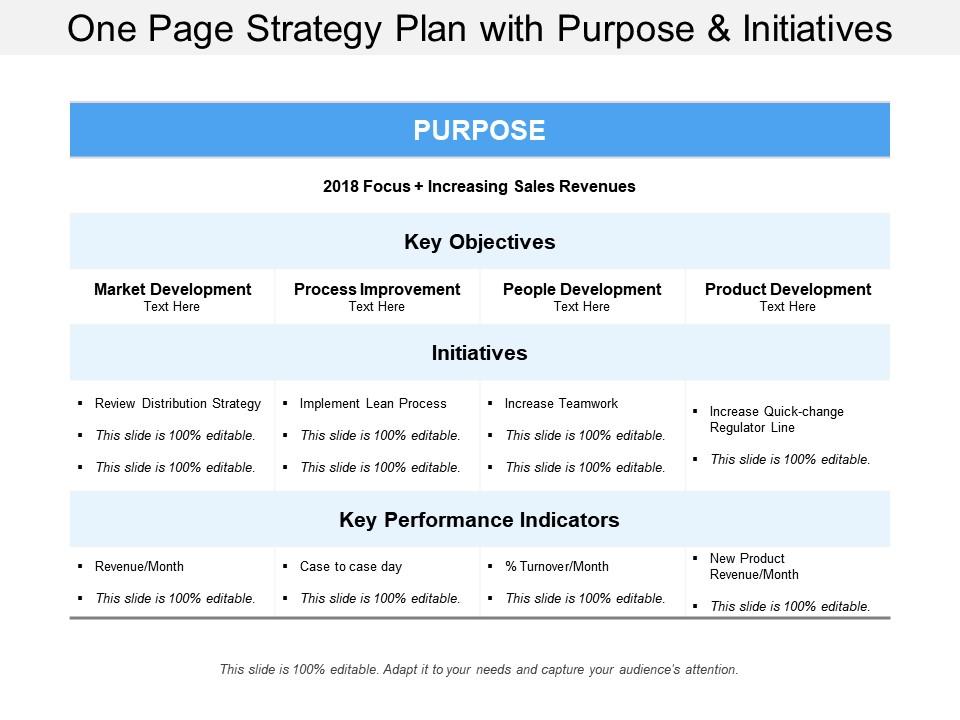
One page strategy plan with purpose and initiatives
Try Before you Buy Download Free Sample Product
Audience
Editable
of Time
Get the courage to continue fighting with our One Page Strategy Plan With Purpose And Initiatives.They ensure you don't ever lose heart.
People who downloaded this PowerPoint presentation also viewed the following :
One page strategy plan with purpose and initiatives with all 5 slides:
Forge agreements with our One Page Strategy Plan With Purpose And Initiatives.
FAQs for One page strategy plan with
You'll want your vision statement up top, then 3-5 strategic objectives underneath. Add key metrics so you can actually track if you're making progress. Don't forget major initiatives - the stuff you'll actually DO to get there. Include your target audience and what makes you different from competitors. That's honestly where most people screw up because they get way too vague about it. Keep everything to just a few bullet points per section, otherwise you'll lose focus. The whole idea is forcing yourself to cut out the fluff and focus on what really matters. Should take under 5 minutes to explain to someone else.
Dude, here's the thing - when you cram everything onto one page, nobody can misinterpret what you're trying to do. Those massive strategy documents? People just skim them differently and end up confused. With one page, everyone's literally looking at the same priorities. Decisions happen way faster because there's no digging through chapters to figure out if something matters. Honestly, I've seen teams waste months on stuff that wasn't even aligned with goals. Short sentences work better anyway. People actually read it when it fits on their phone screen, and meetings don't turn into those endless "wait, what are we even doing here" discussions.
Don't try cramming everything onto one page - you'll just end up with microscopic text that nobody reads. Focus on what actually moves the needle. Also, cut the vague corporate speak like "improve customer experience." What does that even mean? How will you measure it? Get your team involved from day one. Solo strategies usually crash and burn (learned this the hard way). Pick your top 3-5 priorities max, attach clear metrics to each one, and assign owners. Oh, and treat it like a living document - not something that collects dust in a filing cabinet.
Look, a one-page strategy forces you to cut the BS and focus on what actually matters. Those massive 20+ page strategy docs? Nobody reads them after the first meeting (guilty as charged). You've got limited space, so you can't hide behind fancy corporate speak or endless analysis. Short. Ruthless prioritization becomes your best friend. Your goals, key moves, and how you'll measure success - it all has to fit. Honestly, I think most strategy sessions are just elaborate procrastination anyway. But when everything's crammed onto one page, your team can actually understand it, remember it, and - here's the wild part - they'll execute on it too.
Honestly, design can make or break your strategy plan. Nobody reads walls of text anymore. Use clean headings and tons of white space - cramped pages get ignored instantly. Pick fonts that don't suck and colors that actually mean something. I'm talking infographic style, not some boring corporate memo your boss would write. Replace chunks of text with simple icons or graphics when you can. The whole point? Someone should glance at it and immediately get what you're trying to do. Oh, and test it on a friend first - they'll spot confusing parts you missed.
Honestly, that one-page strategy thing is clutch during sprints. When you're drowning in standups and ticket reviews, it's like your "wait, why are we building this again?" lifeline. Agile moves so fast that priorities get messy quick - having your main goals and metrics on one page means you can actually tell if that shiny new feature fits your strategy or if it's just feature creep. I always peek at ours during sprint planning. Sounds nerdy but it stops you from shipping random stuff instead of the stuff that actually matters. Game changer, trust me.
Stick with 3-5 metrics that actually connect to your main goals - stuff like revenue growth, customer acquisition costs, retention rates. I've watched companies try tracking 20+ KPIs and it's a disaster, nobody looks at them after month two. Pick things you can realistically measure monthly or quarterly. Each metric should map back to one of your strategic priorities. The beauty of a one-page strategy is keeping it simple, so choose the numbers that'll actually tell you if you're crushing it or not. Oh, and start tracking from day one - don't wait.
Honestly, get everyone in a room first - doesn't matter if it's Zoom or whatever. Before you even think about that one-pager, have each team spell out what winning actually looks like to them. Marketing vs product vs ops - they're all gonna have different ideas, so hash that out upfront. I've watched teams skip this part and end up with total garbage nobody cares about. Here's the good part though: rotate who writes different sections. Finance explains customer stuff, product defends marketing metrics. Sounds backwards but that's exactly why it works. You get real buy-in instead of everyone just protecting their turf.
Honestly, Canva's probably your best bet if you want something that looks decent without spending forever on design. They've got solid business templates. Miro's amazing too - I use it all the time and the boards just look so clean. Way better for team collaboration if that's what you need. PowerPoint's SmartArt is surprisingly not terrible if you're going super basic. Mural and Lucidchart are good options too, though Lucidchart's better when you've got lots of processes to map out. I'd go Canva for quick and polished, Miro if people need to jump in and edit together. Oh, and Cascade has some structured strategy templates if you want something more formal.
Check it quarterly for sure, but honestly when things get crazy I've seen teams look at it monthly. Major stuff like market changes or your competitors doing something wild? Review it right away - don't wait. Quick tip though - set up a recurring calendar reminder now because you'll totally forget otherwise (I always do). Also worth a quick look after big wins or major failures to see if you're still on track. The whole thing's supposed to change with you, not just sit there collecting digital dust. Trust me, making it automatic saves so much headache later.
Stories stick way better than bullet points, trust me. Frame your strategy like "here's where we started, this is what went wrong, here's how we fix it." People's brains are wired for narrative - we'll remember a customer's struggle over data points every single time. You could follow someone's journey through your product, or just set it up as problem-meets-solution. Honestly, I'd start with something concrete that makes people go "oh yeah, I've seen that before." One clear storyline threads everything together without feeling like you're just checking boxes.
Look up Amazon's original one-pager - just customer obsession, long-term thinking, and invention. Simple but it drove everything. Southwest Airlines? "Low cost, fun, point-to-point flights." That's it. They never wavered from that. Tesla's early strategy was probably scribbled on whatever Musk had handy, but it worked: accelerate sustainable transport. Notice how none of these sound like corporate BS? They kept it to 3-4 core things max. Honestly, search "lean canvas examples" - that format works great for strategy plans and you'll find real company samples all over. The best ones read like actual humans wrote them, not some consultant charging $500/hour.
Honestly, get them involved from the start - don't just show up with a finished plan. I learned this the hard way when leadership torpedoed what I thought was a brilliant strategy doc. Bring key people into your planning sessions so they actually feel like they helped create it. Different groups care about different stuff too - finance wants numbers, ops wants to know if it'll actually work. Run rough drafts by the big players first. And skip the email blast when you're done. Sit down with people face-to-face instead.
Tech startups and consulting firms get the most out of these - makes sense since they're always pivoting. Retail too, obviously. Healthcare's another big one because you've got doctors, admin, and like five different departments that need to actually talk to each other. Manufacturing works well, same with professional services. The weird thing is, messier industries actually do better with one-pagers. Forces you to strip away all the corporate BS and figure out what you're really doing. Short sentences hit harder than long rambling strategic documents nobody reads anyway. Just try it - worst case you waste an hour and realize it's not for you.
You know what's crazy? When you put everything on one page, suddenly nobody can pretend they didn't know what the priorities were. Marketing stops doing their own thing while sales chases random targets - everyone actually sees how their work fits together. Those massive strategy documents just sit in folders gathering digital dust anyway. Short sentences work better. Your team can glance at it during meetings and go "oh wait, are we still focused on the right stuff?" Post it somewhere people actually look (not buried in some shared drive) and watch how much less confusion you get. It's weirdly effective.
-
Good research work and creative work done on every template.
-
Great designs, Easily Editable.