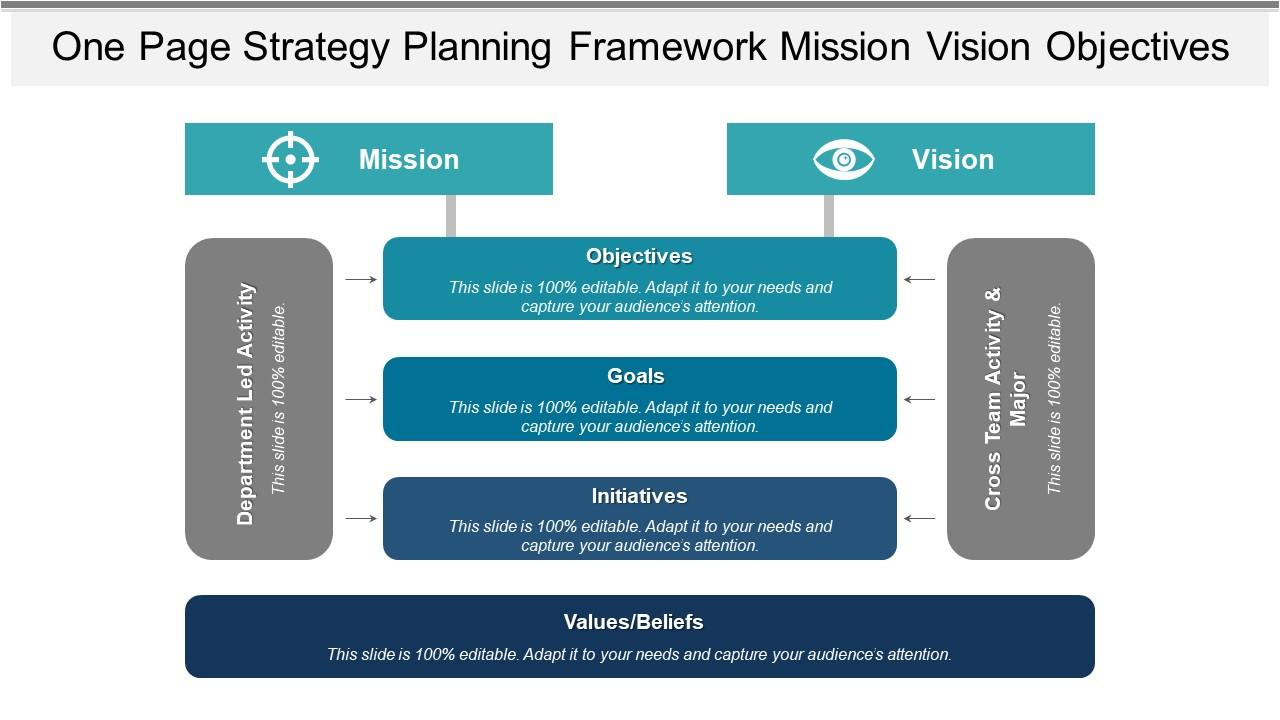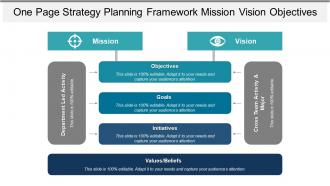
Objectifs de la vision de la mission du cadre de planification stratégique d'une page

Rating:
100%
Slide 1 of 5
Favourites Favourites

Try Before you Buy Download Free Sample Product

Audience Impress Your
Audience
Editable 100%
Editable
Time Save Hours
of Time
The Biggest Sale is ending soon in
0
0
:
0
0
:
0
0
Rating:
100%

Caractéristiques de ces diapositives de présentation PowerPoint :

Présentation des objectifs de vision de la mission du cadre de planification stratégique d'une page. Il s'agit d'un cadre de planification stratégique d'une page et d'objectifs de vision de mission. Il s'agit d'un processus en trois étapes. Les étapes de ce processus sont une stratégie d'une page, un plan de page, une idée de page.

FAQs for One page strategy planning framework

Start with your objectives first - everything else builds from there. Then map out where you currently stand (situational analysis), what paths you could take, and how you'll actually execute it. Oh, and don't forget success metrics! I swear, half the strategies I've seen fall apart because nobody bothered measuring anything. Resource allocation is huge too - sounds boring but you need to know what you're working with. Stakeholder buy-in can't be an afterthought either, trust me on that one. Those five pieces should give you a solid foundation to work from.

Honestly, visuals just work better for strategy stuff. Your brain can actually make sense of abstract concepts when they're mapped out instead of buried in paragraphs. People see connections between ideas way faster with charts or diagrams - like, it's night and day compared to dense text blocks. Most folks check out mentally when you hit them with walls of words anyway (I know I do). Flowcharts are clutch for this. Plus you'll remember the key parts later instead of forgetting everything five minutes after the meeting ends.

Don't overcomplicate it - that's the main thing. Complex frameworks just confuse people instead of helping them. Also, resist copying what worked at other companies because their situation isn't yours. Get input from stakeholders early or you'll build something nobody wants to use (learned this the hard way). Oh, and forget about making it look pretty at first - nail the logic first. I'd rather see a rough framework that actually gets used than some polished thing sitting in a drawer. Test it with your team, be ready to change stuff. Simple beats perfect every time.

Look, first figure out what actually matters in your specific industry. Tech? Focus on fast iteration and platform effects. Manufacturing gets messy with supply chains - that's where you put your energy. Healthcare is honestly brutal with all the compliance stuff, so build those approval timelines right into whatever framework you pick. The trick is matching your industry's make-or-break factors to the framework pieces. Porter's Five Forces, OKRs, whatever you're using. Just don't grab some random template and call it a day - I've seen that backfire so many times.

You absolutely have to figure out who needs to be on board with your strategy first. Like, does your CEO actually care more about hitting growth targets or protecting margins? That stuff totally changes everything. Map out everyone who'll either influence your strategy or get hit by it - customers, executives, whoever. Then use what matters to them to decide which parts of your framework to focus on. I swear I've watched amazing strategies completely tank because someone overlooked a crucial group. Oh and do this mapping early, not halfway through when you're already committed to a direction.

So basically, having a strategy framework means you're not reinventing the wheel every single time a decision comes up. Your team already knows what matters most and can just run options through those filters instead of having endless meetings about it. Honestly, it's like having a cheat sheet for tough calls. Plus your front-line people can make quicker decisions without always asking permission first - which is huge. I'd start simple though, maybe pick 3 or 4 things that really drive your business and test those out on whatever decisions are coming up next. Way better than winging it every time.

Honestly, you've gotta figure out how your company actually works before picking any framework. Like, who really makes decisions? What gets people promoted? If you skip this step, you'll just be fighting uphill the whole time. Pick something that fits your culture - don't try forcing consensus-driven people into a top-down system (learned that one the hard way). Get your team involved in choosing the framework so they buy into it. And seriously, test it with just one team first. Rolling out company-wide without a pilot is asking for trouble.

Look, metrics are basically how you know if your strategy is actually working or if you're just wasting time. Build them into your plan from day one - don't slap them on later. I've watched so many good strategies crash because teams weren't measuring the right things (or anything at all, honestly). Connect each metric straight to what you're trying to achieve. That way you'll catch problems early and fix them fast. Stick to 3-5 metrics that actually matter. Review them regularly with your team and you'll be golden.

Honestly, start with SWOT analysis - it'll show you where you actually stand right now. Porter's Five Forces is solid for checking out your competition, and OKRs help you set goals you can actually measure. Scenario planning is my personal favorite though, because it makes you think past the "everything will go perfectly" mindset. Business Model Canvas or Strategy Canvas work great for mapping everything out visually. But here's the thing - don't go overboard with tools. Sometimes just writing down your strengths and weaknesses on a napkin gets you most of the way there. Pick one or two that click with your situation first.

Think of scenario planning as your strategy's reality check. Build out different futures that could happen - maybe the economy tanks, a competitor comes out of nowhere, or some new tech shakes everything up. Then test how your current plan would actually survive each situation. Honestly, most companies just cross their fingers and hope for the best, which is wild to me. The smart move? Figure out which strategies work no matter what gets thrown at you. It's basically having multiple backup plans so you're not scrambling when things inevitably go sideways.

Look, feedback stops your strategy from turning into some useless document everyone forgets about. Your team, customers, and market conditions will tell you what's actually working vs what just sounded smart in meetings. Monthly check-ins are clutch here - honestly, I've seen too many companies skip this step and then wonder why they're behind competitors. Without regular input, you're basically guessing. Track your key metrics so you can shift direction when something isn't hitting right. It's like having a GPS that actually updates instead of sending you into a lake.

Honestly, strategy frameworks are game-changers for breaking down those stupid department silos. Get marketing, product, and sales all speaking the same language instead of everyone doing their own thing. You know how it is - without a shared playbook, you're constantly playing telephone with priorities and nothing gets done. The framework basically forces teams to collaborate at natural points, like when product roadmaps need to match up with launch plans. My advice? Get your key people to buy into the framework first - that's the hard part. Then just use it in every cross-team meeting going forward.

Honestly, just start small - run a pilot first to see what actually breaks. Track the stuff that matters early on, like how many people are actually using it, not just the end results. The people doing the work will tell you way more than any spreadsheet about what's not working. Oh and definitely compare your results to other companies or your past performance so you're not just guessing. Here's the thing though - you've got to pick your success metrics before you start, then track them religiously for like 6-12 months. That's the only way you'll know if this thing actually works or if you're just fooling yourself.

Honestly, you've got to nail down who owns what first. Pick specific people for each initiative and give them real deadlines - none of that "we'll circle back" nonsense. Monthly check-ins are clutch, but make them report actual numbers, not just "things are going well." I'd set up some kind of dashboard so everyone can see what's happening. Too many strategies die because people assume someone else is handling it. Oh, and don't be stubborn about pivoting when stuff isn't working. You'll want that accountability rhythm to feel automatic eventually.

Here's what I'm seeing: agile frameworks are crushing the old rigid planning models. ESG stuff isn't optional anymore - companies are basically forced into it now. Data tools for strategy are finally getting good (took long enough). Digital transformation frameworks are literally everywhere though. Honestly getting a bit tired of hearing about them. The smarter approach? Mixing traditional strategy with quick testing cycles. Customer focus and stakeholder capitalism are changing how everything gets built. My take: find one framework that actually works for your space and stick with it. Don't chase every shiny new methodology that pops up.

Ratings and Reviews

100% of 100
Review Form
Write a review
Most Relevant Reviews
  1. 100%

    by Colin Barnes

    Editable templates with innovative design and color combination.
  2. 100%

    by Eduardo Greene

    Content of slide is easy to understand and edit.

2 Item(s)

per page: