

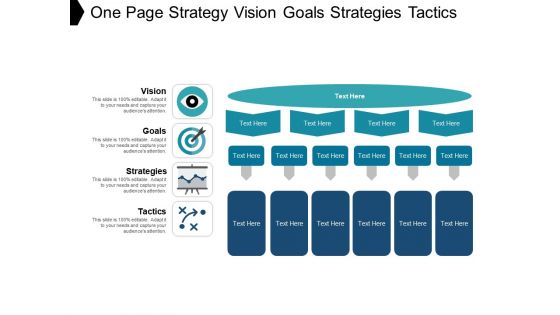
One page strategy vision goals strategies tactics





Try Before you Buy Download Free Sample Product
 Impress Your
 Audience
 100%
100% Editable
 Save Hours
 of Time


Get folks involved in combined effort with our One Page Strategy Vision Goals Strategies Tactics. Give them an incentive to join forces.
People who downloaded this PowerPoint presentation also viewed the following :
One page strategy vision goals strategies tactics with all 5 slides:
Convey your intentions with our One Page Strategy Vision Goals Strategies Tactics. Acquaint folks with the course you will follow.



FAQs for One page strategy vision
Look, you need four main things: vision, goals, action steps, and some way to measure if it's working. Start with where you want to end up, then set specific goals that get you there. Break everything down into actual tasks with real deadlines and assign them to people - this is honestly where most plans die because everyone stays too wishy-washy. Budget for what you'll need. Keep it simple or your team won't touch it after week one. Oh, and review it every quarter! Don't just write it and shove it in a drawer somewhere.
Honestly, you've gotta stop treating strategy like this once-a-year thing. Monthly competitor checks and customer feedback should be happening automatically - I can't tell you how many businesses I've watched get completely caught off guard because they only did their "looking around" during budget season. Pick 3-4 key indicators for your industry and actually watch them. When those start shifting, that's your cue to pivot before everyone else catches on. Quarterly adjustments beat those rigid 5-year plans every time. It's way better to catch changes early than scramble to react later.
Dude, you absolutely need to get your stakeholders involved early. They're basically your reality check - they'll tell you what actually works versus what sounds good on paper. I've watched so many smart strategies completely bomb because leadership thought they could figure it out alone. Your people know where the real problems are hiding. They understand what resources you can actually get your hands on, not just what's theoretically available. Plus they'll tell you what's politically possible (which honestly matters more than we'd like to admit). Map out who matters most and start having regular conversations with them now.
You know how you're always second-guessing business decisions? Data analytics basically turns those gut feelings into actual proof by revealing patterns you'd miss completely. Instead of wondering what customers want or where things are breaking down, you'll see the real story. Predictive stuff is wild too - like spotting problems weeks before they blow up. Just don't get caught up tracking every metric under the sun. Pick one area where your data isn't a mess, show it works there first. Then roll it out to bigger strategic calls.
Honestly, psychological safety is where I'd start - people need to feel safe throwing out crazy ideas without getting shut down. Maybe give everyone like 10% of their time just to mess around with experiments? The magic really happens when you mix different departments together, so definitely push for that cross-functional stuff. Here's the hard part though - you actually have to celebrate when things fail and call it "learning." Hackathons are pretty fun for building momentum too. But real talk, if leadership isn't genuinely participating and just talks about innovation in meetings, forget it. That kills everything faster than anything else.
Track leading and lagging indicators - you need both. Set up quarterly reviews for the usual suspects: revenue growth, market share, profitability. But honestly? I've watched too many teams obsess over metrics that look impressive but mean nothing. Forward-looking stuff matters more sometimes - customer acquisition, employee engagement, hitting those strategic milestones. The trick is nailing down these benchmarks when you're setting strategy, not hunting for them later when things go sideways. Oh, and schedule regular check-ins with leadership. Course corrections happen whether you plan for them or not.
Honestly, most strategies crash because of terrible communication and nobody actually buying into the plan. Don't try tackling everything at once - I've seen that disaster too many times. Break it into smaller chunks instead. Get your main people on board first, then keep everyone updated as you go. Also, someone needs to actually own each piece or it'll just sit there while everyone assumes someone else is handling it. Oh, and make sure you've got the budget locked down before you start anything. Sounds obvious but... yeah, learned that one the hard way.
Figure out what actually sets you apart first - better prices, cool tech, amazing service, whatever it is. Build everything around that one thing. Seriously, don't spread yourself thin trying to compete everywhere (I've watched so many businesses tank doing this). Focus hard on your strength and make it bulletproof. Create barriers so competitors can't just waltz in and copy you - patents work, exclusive deals help, or sometimes you just get so damn good that nobody can touch you. The whole point is making sure your edge sticks around long-term.
Honestly, culture is everything when it comes to pulling off strategy. Your team will either help you execute or they'll drag their feet the whole way - there's not much middle ground. People need to actually believe in what you're doing, not just follow orders. Otherwise you're fighting an uphill battle where everyone's just checking boxes. The smart move? Figure out where your culture clashes with your strategy before you roll anything out. Then you can either fix those gaps first or - and this is key - tweak your approach so it actually works with how your people think and operate.
Honestly, you've got to translate that vision into stuff people actually give a damn about - like how it affects their job or helps them grow. Skip the corporate BS and use words normal humans understand. Hit them from all angles: town halls, team meetings, those awkward one-on-ones. Show specific examples of how Sarah in accounting or Mike in sales fits into the big picture. Here's the thing though - don't just talk at people. Let them ask questions and push back a little. That back-and-forth conversation? Way more powerful than some fancy presentation deck.
Dude, digital strategy is wild right now. You're not just fighting competitors anymore - it's whole platform ecosystems coming at you. Most companies have tons of data but honestly? They're terrible at actually doing anything useful with it. Markets move so fast that you need to pivot strategies constantly, which is exhausting but necessary. Forget the old vertical integration playbook - now it's all about orchestrating these complex ecosystems. Oh and your strategic planning cycles need to be way shorter. If I had to pick one thing to focus on, dump money into your analytics team yesterday. They'll make or break everything else.
So basically you create 3-4 different futures that could realistically happen to your business, then test how your current plan would hold up in each one. Best case, worst case, plus a couple in-between scenarios. Here's the thing though - you can't be vague about it. Instead of "economy tanks," get specific: "main competitor slashes prices 30% while our supply costs jump 15%." That kind of detail actually helps. Once you've got these mapped out, you'll see which moves work across multiple scenarios and which ones would totally screw you over. Start with whatever's keeping you up at night - your biggest unknown - and build from there.
Markets shift way faster than most people expect - your brilliant strategy today could be totally irrelevant in six months. COVID proved this hardcore. Companies that survived were the ones who could completely flip their approach overnight, not the ones married to some rigid five-year plan. Build flexibility into your strategy from day one. Don't wait for quarterly reviews either - check in monthly or even weekly when things get crazy. Sometimes you gotta throw the playbook out and just react to what's happening right now.
Look, the trick is making sure your day-to-day stuff actually builds toward your bigger goals instead of just being random busy work. Most teams I've seen completely whiff on this part - they'll crush their monthly targets but then wonder why they're not getting anywhere long-term. What works is having a simple gut check: "will this thing I'm doing today help us get where we want to be in 3 years?" Sounds basic but it's crazy how often the answer is no. Short wins should ladder up, not just exist in a vacuum. Check in on this every few months so you don't drift off course.
Look, tech pretty much runs everything in business now. Your customer outreach, operations, competitive edge - all of it. Data analytics help you figure out market positioning. Automation cuts costs and makes things run smoother. Honestly, I'm trying to think of one area it doesn't impact and I'm coming up blank. New business models pop up constantly and flip entire industries on their head. The trick is getting ahead of whatever trends are happening in your space instead of scrambling to catch up after your competitors already beat you to it.
-
Topic best represented with attractive design.
-
Very unique and reliable designs.