Organizational Team Structure For Manufacturing Department Smart Production Technology Implementation

Rating:
80%
Organizational Team Structure For Manufacturing Department Smart Production Technology Implementation
Slide 1 of 6
Favourites Favourites

Try Before you Buy Download Free Sample Product

Audience Impress Your
Audience
Editable 100%
Editable
Time Save Hours
of Time
The Biggest Sale is ending soon in
0
0
:
0
0
:
0
0
Rating:
80%
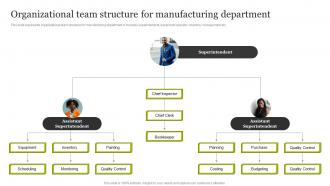
This slide represents organizational team structure for manufacturing department. It includes superintendent, equipment operator, inventory management etc. Increase audience engagement and knowledge by dispensing information using Organizational Team Structure For Manufacturing Department Smart Production Technology Implementation. This template helps you present information on threestages. You can also present information on Chief Inspector, Chief Clerk, Bookkeeper using this PPT design. This layout is completely editable so personaize it now to meet your audiences expectations.

FAQs for Organizational Team Structure For Manufacturing Department Smart

Key manufacturing team roles include production managers, quality control inspectors, machine operators, maintenance technicians, supply chain coordinators, safety officers, and process engineers. These roles work collaboratively to streamline operations, minimize downtime, and ensure product quality, with many manufacturing organizations finding that well-defined team structures enhance operational efficiency and ultimately deliver faster production cycles and improved competitive positioning.

Manufacturing team size significantly impacts efficiency through span of control, communication complexity, coordination requirements, and resource allocation dynamics. Smaller teams often deliver faster decision-making and clearer accountability, while larger teams enable specialized roles and comprehensive coverage, with many manufacturers finding that optimal sizing depends on production complexity, technology integration, and operational goals, ultimately balancing agility with capability.

Centralized manufacturing consolidates decision-making authority at headquarters, ensuring consistent processes, standardized quality control, and coordinated resource allocation across facilities. Decentralized structures empower local teams with operational autonomy, enabling faster responses to regional market demands, customized production schedules, and enhanced flexibility, with many organizations finding that hybrid approaches deliver both strategic oversight and operational agility.

Cross-functional teams enhance manufacturing communication by bringing together diverse expertise from production, quality, engineering, and supply chain departments, creating shared accountability and real-time problem-solving capabilities. These collaborative structures streamline decision-making processes, reduce information silos, and accelerate issue resolution, with many manufacturing organizations finding that integrated teams deliver faster production cycles and improved operational efficiency.

Essential skills for manufacturing team leaders include technical expertise in production processes, safety management, quality control, effective communication, and problem-solving capabilities. These competencies enable leaders to streamline operations, ensure compliance with industry standards, and motivate cross-functional teams, with many manufacturing organizations finding that strong leadership ultimately delivers improved productivity, reduced downtime, and enhanced workplace safety.

Manufacturing team effectiveness is measured through key performance indicators including production output, quality metrics, equipment downtime, safety incidents, and cost per unit. These metrics enable organizations to track operational efficiency, identify bottlenecks, and optimize resource allocation, with many manufacturers finding that balanced scorecards combining productivity and quality measures deliver the most comprehensive performance insights.

Technology fundamentally reshapes manufacturing team structures by enabling cross-functional collaboration, automating routine tasks, and creating data-driven decision-making hierarchies. Through IoT sensors, AI analytics, and cloud platforms, manufacturers streamline operations with flatter organizational structures, enhanced communication between production and quality teams, and ultimately faster response times to market demands.

Lean manufacturing principles can be integrated into team organization by creating cross-functional cells, implementing continuous improvement groups, establishing visual management systems, and empowering frontline decision-making. These organizational structures streamline operations by eliminating waste, reducing handoffs, and accelerating problem resolution, with many manufacturers finding that autonomous teams deliver faster production cycles, improved quality, and enhanced operational efficiency.

Agile methodologies in manufacturing teams deliver enhanced flexibility, faster product development cycles, improved quality control, reduced waste, and stronger cross-functional collaboration. These approaches streamline operations by enabling rapid response to market changes, continuous improvement processes, and real-time problem-solving, with many manufacturers finding that agile practices ultimately reduce time-to-market and increase competitive advantage.

Cultural and geographical factors significantly influence global manufacturing team structures through communication preferences, hierarchical expectations, regulatory compliance requirements, and operational timezone considerations. Organizations adapt by implementing regional management layers, localized decision-making processes, and cross-cultural training programs, with many multinational manufacturers finding that flexible hybrid structures ultimately deliver better coordination, employee engagement, and market responsiveness.

Effective training strategies for manufacturing teams include hands-on technical skills development, safety protocol education, lean manufacturing principles, cross-functional competency building, and continuous improvement methodologies. These approaches enhance operational efficiency by reducing errors, minimizing downtime, and improving quality control, with many manufacturing organizations finding that comprehensive training programs ultimately deliver higher productivity, better safety records, and increased employee retention across production facilities.

A strong team structure enhances quality control through clear accountability chains, specialized role definitions, cross-functional collaboration, and systematic feedback loops. Manufacturing organizations with well-defined hierarchies and communication protocols can quickly identify defects, implement corrective measures, and maintain consistent standards, ultimately delivering higher product reliability and reduced waste costs while strengthening competitive market positioning.

Manufacturing teams face challenges including workforce retraining, integration complexities, initial capital investments, resistance to change, and maintaining quality during transitions. While automation streamlines production and reduces costs, organizations must address employee concerns, ensure seamless technology integration, and balance efficiency gains with workforce development, ultimately delivering competitive advantage through enhanced operational capabilities.

Collaboration between design and production teams can be optimized through cross-functional workshops, shared digital platforms, regular feedback loops, and integrated project management systems. Manufacturing companies increasingly find that co-locating teams, implementing design-for-manufacturing protocols, and establishing joint performance metrics streamlines product development cycles, reduces costly revisions, and ultimately delivers faster time-to-market with enhanced product quality.

Employee engagement significantly impacts manufacturing team dynamics by enhancing communication, improving collaboration across shifts, boosting problem-solving capabilities, and reducing workplace conflicts. Engaged manufacturing workers demonstrate higher safety compliance, participate more actively in continuous improvement initiatives, and support knowledge transfer between departments, while organizations with strong engagement report faster production cycles, reduced turnover costs, and ultimately stronger operational efficiency in increasingly competitive manufacturing environments.

Ratings and Reviews

80% of 100
Review Form
Write a review
Most Relevant Reviews
  1. 80%

    by Claudio Alvarez

    Wow! The design and quality of templates on SlideTeam are simply the best. 
  2. 80%

    by Dennis Stone

    Easily Editable.

2 Item(s)

per page: