Other customer focus areas ppt examples professional

Rating:
90%
Other customer focus areas ppt examples professional
Slide 1 of 5
Favourites Favourites

Try Before you Buy Download Free Sample Product

Audience Impress Your
Audience
Editable 100%
Editable
Time Save Hours
of Time
The Biggest Sale is ending soon in
0
0
:
0
0
:
0
0
AI-Ready
Upload this template to AI and ask it to make any changes to content or color
100% editable Powerpoint Template for AI-assisted presentations. Finish your work in less time. ​
Works with
Microsoft PowerPoint
Microsoft 365
Claude for PowerPoint
ChatGPT
Google Slides
Microsoft Copilot
Rating:
90%
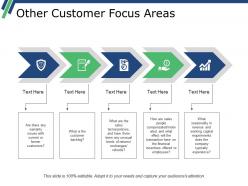
Presenting this set of slides with name - Other Customer Focus Areas Ppt Examples Professional. This is a five stage process. The stages in this process are Business, Icons, Marketing, Process, Strategy.

Content of this Powerpoint Presentation

Description:

This image appears to be a PowerPoint slide with the title "Other Customer Focus Areas." It contains a diagram with four arrows, each with space for text and associated subtext questions aimed at focusing on different areas of customer service and sales within a business. The arrows are color-coded and include symbols signifying protection/warranty, an order or document, monetary transactions, and sales trends or analysis.

From left to right, the first arrow prompts discussion about warranty issues with current or former customers. The second is concerning backlog, examining the efficiency of order processing and customer waiting times. The third arrow focuses on the company's sales terms/policies, returns, exchanges, and refunds - important details of a sales policy that affect customer satisfaction. The last arrow confronts the issue of sales compensation and motivation, posing questions about the impact of financial transactions on employee incentives. Additionally, there is a part about seasonal impacts on revenue and capital requirements, which suggests analyzing financial trends and planning accordingly.

Use Cases:

Here are seven industries where such slides might be commonly used:

1. Retail:

Use: To train staff on customer service guidelines and policies

Presenter: Customer Service Manager

Audience: New and existing customer service representatives

2. Manufacturing:

Use: To discuss warranty service with distribution partners

Presenter: After-Sales Support Manager

Audience: Distributors and retailers

3. E-commerce:

Use: To strategize on improving order fulfillment and returns processing

Presenter: E-commerce Operations Manager

Audience: E-commerce team and logistics personnel

4. Automotive:

Use: To present warranty policies and customer service improvement plans

Presenter: Warranty and Service Manager

Audience: Dealership managers and customer service teams

5. Telecommunications:

Use: To review policies around customer contract terms and billing issues

Presenter: Customer Relations Supervisor

Audience: Customer service agents and support staff

6. Financial Services:

Use: To align compensation strategy with customer acquisition and retention goals

Presenter: Head of Sales

Audience: Sales associates and financial consultants

7. Technology Software:

Use: To address support backlog and enhancement of customer technical support

Presenter: Technical Support Lead

Audience: Customer support technicians and IT staff

FAQs for Other customer focus areas

Key elements defining positive customer experience include seamless interactions, personalized service, quick problem resolution, consistent quality across touchpoints, and proactive communication. These components work together by reducing friction, anticipating customer needs, and building trust, with many retail and financial services organizations finding that strategic focus on these elements ultimately delivers higher satisfaction rates and stronger customer loyalty.

Businesses can measure customer experience through Net Promoter Score (NPS), Customer Satisfaction (CSAT) surveys, Customer Effort Score (CES), retention rates, and journey analytics. These metrics enable organizations to identify pain points, streamline touchpoints, and enhance satisfaction across retail, banking, and healthcare sectors, ultimately delivering improved loyalty and competitive advantage.

User feedback serves as a critical foundation for customer experience enhancement by identifying pain points, revealing service gaps, and uncovering improvement opportunities across touchpoints. Organizations leverage this feedback through systematic analysis, targeted solutions, and continuous refinements, with many retail and hospitality companies finding that responsive feedback integration ultimately delivers higher satisfaction rates and stronger customer loyalty.

Personalization enhances customer engagement by delivering tailored content, customized product recommendations, targeted messaging, and individualized user experiences based on behavioral data and preferences. Through AI-driven analytics and segmentation tools, retailers, streaming services, and e-commerce platforms create relevant interactions that increase conversion rates, build customer loyalty, and drive repeat purchases, ultimately delivering competitive advantage in increasingly crowded markets.

Employee training significantly enhances customer experience by improving service quality, reducing response times, increasing problem-solving capabilities, and ensuring consistent brand interactions across all touchpoints. Well-trained employees in retail, hospitality, and financial services deliver more personalized solutions, handle complaints more effectively, and create positive memorable interactions, ultimately driving customer loyalty and competitive advantage.

Cultural differences significantly affect customer expectations through varying communication styles, service preferences, decision-making processes, and relationship approaches. For example, customers in collectivist cultures often prioritize group consensus and long-term relationships, while individualistic markets emphasize personal choice and efficiency, with many global retailers finding that localized experiences deliver higher satisfaction and competitive advantage.

**INPUT**: What technologies are transforming customer experience in today's market? **OUTPUT**: Customer experience transformation technologies include artificial intelligence, chatbots, predictive analytics, omnichannel platforms, and personalization engines. These technologies streamline interactions by delivering instant support, anticipating customer needs, and creating seamless experiences across touchpoints, with many retailers and financial services finding that personalized, data-driven approaches ultimately enhance satisfaction while reducing operational costs. *[Word count: 56 words]*

Businesses use data analytics to anticipate customer needs by analyzing purchase histories, browsing patterns, seasonal trends, and demographic preferences to predict future behaviors. Through predictive modeling and machine learning algorithms, companies like Netflix and Amazon deliver personalized recommendations, targeted promotions, and proactive service offerings, ultimately enhancing customer satisfaction while driving revenue growth.

Companies can implement strategies including swift acknowledgment and apology, immediate problem resolution, compensation or goodwill gestures, follow-up communication, and process improvements to prevent recurrence. These recovery approaches enhance customer retention by demonstrating accountability, building trust, and often creating stronger loyalty than before the incident, with many organizations finding that effective service recovery transforms dissatisfied customers into brand advocates.

Omnichannel support enhances the customer journey by providing seamless interactions across all touchpoints, maintaining conversation history between channels, and enabling consistent service quality regardless of contact method. This integrated approach allows customers to start conversations via chat, continue through email, and resolve issues by phone, with representatives accessing complete interaction histories, ultimately delivering faster resolutions and significantly improved satisfaction rates.

Common customer experience pitfalls include inconsistent messaging across channels, inadequate staff training, poor data integration, reactive rather than proactive service approaches, and insufficient feedback collection systems. These challenges often result from siloed departments and limited customer journey mapping, with many organizations finding that addressing these issues through strategic coordination and technology integration ultimately delivers improved satisfaction rates and stronger customer retention.

Social media influences customer perceptions through real-time feedback, peer reviews, brand interactions, and community engagement, creating powerful touchpoints that shape purchasing decisions. Companies leverage these platforms to deliver personalized customer service, showcase testimonials, and build brand loyalty, with businesses in retail, hospitality, and financial services finding that strategic social media engagement significantly enhances customer satisfaction and drives competitive advantage.

Customer experience directly drives customer loyalty through consistent, positive interactions that build emotional connections and trust over time. Organizations delivering exceptional experiences across touchpoints, from retail interactions to service resolution, see significantly higher retention rates, increased repeat purchases, and stronger brand advocacy, with many companies finding that improved customer experience reduces churn while enhancing lifetime value.

Visual elements in presentations significantly influence customer service perceptions by enhancing credibility, professionalism, and message clarity through consistent branding, compelling data visualizations, and polished design aesthetics. Well-crafted visuals streamline communication, reduce misunderstandings, and build trust with clients, with many service organizations finding that strategic presentation design ultimately delivers stronger customer relationships and competitive advantage in increasingly visual business environments.

Emerging customer experience trends include AI-powered personalization, omnichannel integration, predictive analytics, voice-enabled interfaces, and real-time feedback systems. These technologies streamline interactions by anticipating customer needs, delivering seamless cross-platform experiences, and enabling instant service resolution, with retailers, banks, and healthcare providers finding that proactive, data-driven approaches significantly enhance satisfaction and loyalty.

Ratings and Reviews

90% of 100
Review Form
Write a review
Most Relevant Reviews
  1. 80%

    by Delbert Palmer

    Helpful product design for delivering presentation.
  2. 100%

    by Dirk Kelley

    Really like the color and design of the presentation.

2 Item(s)

per page: