

Overview Of Active And Passive Attacks In Cybersecurity Training PPT




Try Before you Buy Download Free Sample Product
 Impress Your
 Audience
 100%
100% Editable
 Save Hours
 of Time


This set of slides covers active and passive attacks in cybersecurity in detail. An active attack entails intercepting a communication or message and modifying it for malicious effect. A passive attack involves a hacker monitoring a system and illicitly copying data without changing it.
People who downloaded this PowerPoint presentation also viewed the following :
Content of this Powerpoint Presentation
Slide 2
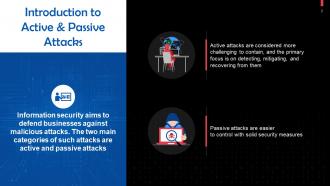
This slide introduces the concept of active and passive attacks in Information Security. Information security aims to defend businesses against malicious attacks. The two main categories of such attacks are active and passive attacks.
Slide 3
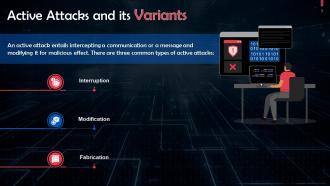
This slide provides information on active attacks and its variants. There are three common types of active attack. These are interruption, modification, and fabrication.
Instructor’s Notes:
- Interruption: The attacker interrupts the original communication and creates new, malicious messages, posing as one of the communicating parties
- Modification: The attacker uses existing communications and replays them to deceive one of the communicating parties or modifies the communication to gain an advantage
- Fabrication: Creates fake or synthetic communications, typically to achieve Denial of Service (DoS). This prevents users from accessing systems or performing routine operations
Slide 4
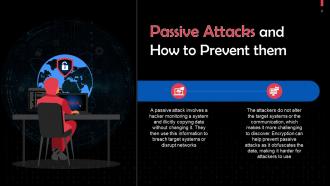
This slide gives us information about passive attacks. A passive attack involves a hacker monitoring a system and illicitly copying data without changing it. They then employ this information to breach target systems or disrupt networks.
Slide 5
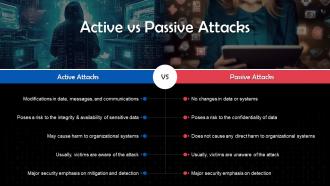
This slide tabulates differences between active and passive attacks.
Overview Of Active And Passive Attacks In Cybersecurity Training PPT with all 24 slides:
Use our Overview Of Active And Passive Attacks In Cybersecurity Training PPT to effectively help you save your valuable time. They are readymade to fit into any presentation structure.










FAQs for Overview Of Active And Passive Attacks In
So basically, passive attacks are like someone secretly listening to your conversations - they're just watching and collecting info without you knowing. Network sniffing, traffic monitoring, that kind of stuff. Active attacks? Way more obvious since they're actually messing with your systems - malware, DDoS, unauthorized changes. Honestly, passive ones freak me out more because you might never realize it happened. Both can totally wreck you though. Active attacks can destroy your whole setup, while passive ones lead to data breaches. Your best bet is monitoring network traffic regularly and getting intrusion detection systems that catch both types.
Get yourself some solid monitoring tools - SIEM systems, network analyzers, that kind of stuff. They'll catch weird patterns like random data transfers or login failures going crazy. Honestly, behavioral analytics are pretty clutch for spotting when users start acting strange. You've gotta establish what "normal" looks like first though, otherwise everything triggers false alarms. Real-time alerts are non-negotiable since attacks happen fast and do damage immediately. I'd start with network monitoring and user behavior tracking - catches most active threats before they blow up into disasters.
So basically there's network sniffing where hackers grab your data packets while they're traveling, plus traffic analysis - they study your communication patterns even when they can't actually read what you're saying. Wireless eavesdropping is huge too, especially on those sketchy coffee shop networks (honestly, who thought free WiFi was ever truly "free"?). The scary part? You'll never know it's happening. They can steal login info, personal stuff, or even spy on your work messages. VPNs are clutch for public networks, and always check that little lock icon for encrypted sites.
Honestly, encryption is your best bet here. When attackers intercept your data, they'll just see scrambled nonsense without the keys to decode it. HTTPS and VPNs are solid choices since they encrypt everything while it's moving around. Network segmentation works too - it limits how much damage someone can do if they actually break in. I always think of it like this: someone's probably watching, so you might as well make your data useless to them. Math really is pretty wild when you think about it.
So IDSs are basically your digital security guards - they watch network traffic and catch sketchy stuff as it's happening. Really good at spotting DoS attacks, malware, unauthorized logins, that kind of thing. The patterns these attacks create are pretty obvious once you know what to look for. Best part? You get alerts right away so you can actually do something about it before everything goes to hell. Just make sure you configure them properly or you'll get bombarded with useless alerts all day. Trust me, false positives are the worst.
Ditch the PowerPoint death march - you need hands-on stuff that actually matters. Set up fake phishing emails and sketchy phone calls so people can practice in real time. Those end-of-video quizzes are basically useless at this point. Monthly mini-sessions work way better, especially if you're pulling examples from actual recent breaches. Role-play different scenarios too - like active attacks versus the sneaky data theft that happens quietly in the background. Oh, and make sure everyone knows exactly who to call when something feels weird. Clear escalation procedures are honestly half the battle.
So threat modeling basically maps out how hackers might come after your system - both the sneaky stuff (like listening in) and the aggressive attacks where they're actively messing with things. You gotta think like the bad guy, which is weirdly entertaining once you get the hang of it. Different attack styles need totally different defenses, so figure out both types early. I'd start with what you're protecting, then just brainstorm all the ways someone could steal or break it. Honestly beats trying to secure everything blindly.
Dude, social engineering is terrifying because attackers go straight for your people instead of trying to hack systems. They'll send fake emails, call pretending to be IT, or leave infected USB drives around - whatever gets employees to hand over passwords or click sketchy links. Honestly, I've seen smart people fall for this stuff all the time. Your team becomes part of the attack without even knowing it. That's what makes it so much more dangerous than someone just scanning your network for weaknesses. You really need to train everyone regularly because they're gonna be your biggest vulnerability and strongest protection at the same time.
Watch for weird traffic spikes and random processes you didn't start. Failed logins followed by successful ones are a dead giveaway, especially from sketchy IP addresses. Your system might slow to a crawl too - hackers are resource hogs when they're actively messing with your stuff. Database queries running on their own? Red flag. Files popping up where they don't belong? Another bad sign. Oh, and keep an eye on outbound connections you didn't make. It's honestly like watching someone trash your digital house in real-time. Set up alerts for this stuff so you're not finding out about attacks three weeks later like an idiot.
Passive attacks don't actually mess with your data directly - they're more like digital stalking. Someone's just watching and collecting info about your network traffic, passwords, communication patterns, that sort of thing. The scary part? They use all that intel later for the real attacks that'll actually damage your stuff. It's basically like someone scoping out your house for weeks before they rob it. Honestly, I'd just assume someone's always watching your network and check your traffic logs pretty regularly. Short-term they're harmless, but long-term you're screwed.
Dude, attackers today have insane tools compared to even five years ago. AI helps them craft better phishing emails, and automated scanners find vulnerabilities faster than we can patch them. Cloud botnets can hit you from everywhere at once. Don't get me started on IoT devices - your smart doorbell might be part of someone's botnet right now. Machine learning lets them adjust their attacks based on how you defend. It's wild how sophisticated this stuff has gotten. Bottom line: assume they've got access to the same advanced tech you do, so plan accordingly.
You definitely want to layer your defenses since attackers come at you different ways. Strong encryption is your baseline - protects data whether it's sitting around or moving. Network segmentation is clutch because it boxes them in if they break through. Passive attacks are sneaky, so monitoring and anomaly detection catch the weird stuff. Active attacks? More obvious - firewalls, intrusion prevention, and patch everything religiously. User training gets overlooked but honestly your employees mess up more than the tech does. Oh, and if you're starting somewhere, encryption plus good monitoring covers most bases.
So GDPR, SOX, and HIPAA basically force companies to have proper security stuff in place - encryption, network monitoring, access controls. The fines are brutal if you mess up, like millions of dollars brutal. They also want regular security checks and incident response plans ready to go. Honestly, the smartest thing is mapping what you currently have against whatever rules hit your industry. Find those gaps before some auditor does it for you. Oh, and the breach notification requirements are super strict too - you can't just sweep incidents under the rug anymore.
AI is basically giving hackers superpowers on both ends. They can churn through intercepted data way faster than before, finding patterns in your network traffic that would've taken forever to spot manually. Then there's the active stuff - phishing emails that actually sound convincing, automated vulnerability scans, deepfakes for social engineering. Honestly, some of these attacks are getting pretty wild. What really sucks is that AI tools are becoming accessible to everyone, so you don't need to be some elite hacker anymore. Your average script kiddie can launch pretty sophisticated attacks now. Best defense? Get some AI-powered security tools and keep your awareness training updated.
Yeah, pen testing is clutch for catching active attack vulnerabilities. Basically your testers act like real hackers - they'll try SQL injections, buffer overflows, social engineering, all that nasty stuff attackers actually use. You get to see exactly how someone would break into your systems before it happens for real. Honestly, it's pretty wild watching ethical hackers work. Make sure you test both external and internal attack paths, and don't skip the phishing tests either. Those usually catch people off guard but they're super common in real attacks.
-
Attractive design and informative presentation.
-
I have just started downloading templates for my presentations and I must say this is a great design. It helped accelerate my presentation design process and made it more visually appealing.