Overview Of Crystal Methodology In Agile Methodology IT Ppt Diagram Templates
Try Before you Buy Download Free Sample Product
Audience
Editable
of Time
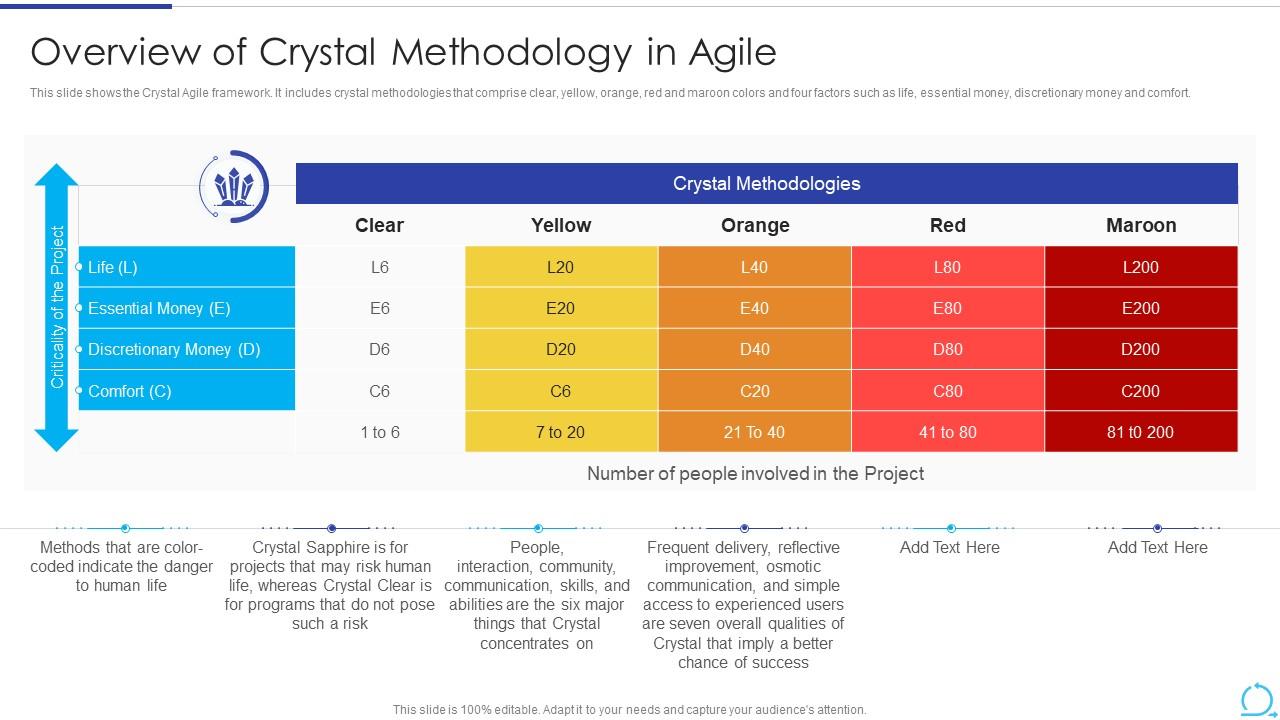
This slide shows the Crystal Agile framework. It includes crystal methodologies that comprise clear, yellow, orange, red and maroon colors and four factors such as life, essential money, discretionary money and comfort.
People who downloaded this PowerPoint presentation also viewed the following :
Overview Of Crystal Methodology In Agile Methodology IT Ppt Diagram Templates with all 6 slides:
Use our Overview Of Crystal Methodology In Agile Methodology IT Ppt Diagram Templates to effectively help you save your valuable time. They are readymade to fit into any presentation structure.
FAQs for Overview Of Crystal Methodology In Agile Methodology IT
Crystal Methodology's core principles include frequent delivery, close communication, reflective improvement, personal safety, focus, and easy access to expert users. These principles streamline software development by promoting adaptive processes, encouraging team collaboration, and minimizing documentation overhead, with many development teams finding that this flexibility enables faster delivery cycles and enhanced product quality in increasingly dynamic project environments.
Crystal Methodology adapts through its family of color-coded variants, ranging from Crystal Clear for small teams to Crystal Red for larger projects, each tailored to specific team sizes and criticality levels. This scalable approach enables organizations to match methodology weight to project complexity, with software development teams finding that lighter processes work for smaller projects while heavier governance suits enterprise-scale implementations, ultimately delivering appropriate oversight without unnecessary bureaucracy.
Crystal Methodology includes Crystal Clear, Crystal Yellow, Crystal Orange, Crystal Red, Crystal Maroon, and Crystal Blue, with each color representing increasing project size and complexity requirements. These frameworks enable organizations to scale agile practices appropriately, with smaller teams leveraging Crystal Clear for enhanced collaboration, while larger enterprises utilize Crystal Red or Maroon for complex initiatives, ultimately delivering optimized project outcomes across diverse organizational structures.
Crystal Methodology emphasizes communication through frequent face-to-face interactions, collaborative workspaces, and regular reflection sessions that foster continuous dialogue among team members. This approach enables teams to rapidly identify issues, share knowledge seamlessly, and adapt project direction quickly, with many software development organizations finding that enhanced communication ultimately delivers faster problem resolution and stronger project outcomes.
Crystal Methodology promotes flexibility through adaptive team sizes, customizable processes based on project criticality, frequent delivery cycles, and emphasis on people over rigid procedures. This approach enables organizations to scale methodologies according to project complexity, team expertise, and business requirements, with many software development teams finding that Crystal's color-coded framework delivers faster iterations and improved stakeholder collaboration.
Crystal teams typically include roles such as sponsor, senior designer, programmer, business expert, and coordinator, with responsibilities varying by project size and methodology variant. These roles enhance collaboration by ensuring clear accountability, streamlined communication, and balanced expertise distribution, with many agile organizations finding that Crystal's flexible role definitions ultimately deliver faster development cycles and improved stakeholder alignment.
Crystal Methodology approaches risk management through continuous risk assessment, frequent stakeholder communication, and adaptive planning cycles, emphasizing early detection over extensive documentation. Unlike rigid methodologies that rely on formal risk registers, Crystal integrates risk mitigation into daily workflows through osmotic communication and reflective workshops, enabling teams to address issues immediately while maintaining project momentum and delivering incremental value to stakeholders.
Crystal employs frequent incremental delivery cycles, regular retrospectives for process refinement, close customer collaboration, and adaptive planning based on project size and criticality. These techniques enable teams to deliver working software regularly while maintaining quality, with many software development organizations finding that Crystal's flexible approach accelerates time-to-market and enhances customer satisfaction through continuous value streams.
Crystal encourages stakeholder involvement through regular reflection workshops, frequent deliveries for feedback, and osmotic communication practices that keep stakeholders informed throughout development cycles. This methodology emphasizes close collaboration between business users, developers, and project sponsors, with many software teams finding that consistent stakeholder engagement reduces project risks, accelerates decision-making, and ultimately delivers solutions that better align with business objectives.
Common challenges include adapting Crystal's flexible framework to rigid organizational structures, selecting the appropriate Crystal variant for team size, managing reduced documentation requirements, and balancing frequent communication with productivity demands. Many software development teams find that transitioning from traditional methodologies requires significant cultural shifts, while organizations struggle with maintaining quality standards amid Crystal's emphasis on people over processes, ultimately requiring strategic change management.
Crystal Methodology integrates testing and quality assurance through continuous testing cycles, embedded quality checkpoints, and collaborative feedback loops between developers and testers. This approach enables teams to identify defects early, streamline bug resolution, and maintain code quality throughout development phases, with many software organizations finding that integrated QA practices ultimately deliver faster releases and enhanced product reliability.
Crystal Methodology works best for small, co-located teams with frequent stakeholder communication needs, particularly in environments requiring high adaptability and minimal documentation overhead. Unlike rigid Agile frameworks, Crystal's family of methodologies scales based on project criticality and team size, making it ideal for startups, creative agencies, and research projects where collaboration flexibility, rapid iteration, and reduced process burden ultimately deliver faster innovation and stronger stakeholder alignment.
Teams measure Crystal Methodology success through frequent deliveries of working software, stakeholder feedback quality, team communication effectiveness, and adaptability to changing requirements. These metrics focus on delivering business value rather than rigid adherence to processes, with many software development teams finding that regular reflection sessions and customer satisfaction scores provide clearer project health indicators than traditional milestone tracking.
**INPUT**: What tools and technologies are commonly used to support the implementation of Crystal? **OUTPUT**: Crystal methodology leverages collaborative tools like Slack, Microsoft Teams, JIRA for project tracking, Git for version control, and automated testing frameworks to enhance team communication and streamline development processes. These technologies enable organizations, particularly in software development and IT services, to maintain Crystal's emphasis on frequent delivery, osmotic communication, and reflective improvement, ultimately delivering faster project cycles and enhanced team productivity. **Word count: 60**
Crystal Methodology emphasizes documentation that directly serves the team's needs, focusing on essential artifacts like user stories, architectural diagrams, and key decisions rather than comprehensive documentation. This approach streamlines project management by reducing administrative overhead, enabling faster iterations, and allowing teams to concentrate on delivering value, with many software development organizations finding that selective documentation enhances both productivity and project outcomes.
-
My team has been relying on SlideTeam’s professional PPT designs for a while now. It has greatly sped up quality work at my organization. So thanks!
-
SlideTeam is a great place for PPT templates. They have many templates on a single topic. It has made my life a lot easier.