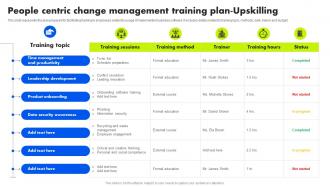
People Centric Change Management Training Plan Upskilling Organizational Change Management
Try Before you Buy Download Free Sample Product
Audience
Editable
of Time
This slide represents the plan prepared for facilitating training to employees related to usage of implemented business software. It includes details related to training topic, methods, date, trainer and budget.
People who downloaded this PowerPoint presentation also viewed the following :
People Centric Change Management Training Plan Upskilling Organizational Change Management with all 6 slides:
Use our People Centric Change Management Training Plan Upskilling Organizational Change Management to effectively help you save your valuable time. They are readymade to fit into any presentation structure.
FAQs for People Centric Change Management Training Plan Upskilling
Effective change management principles include clear communication, stakeholder engagement, leadership commitment, structured planning, and continuous feedback mechanisms. These approaches streamline organizational transitions by building employee buy-in, minimizing resistance, and maintaining operational continuity, with many companies finding that strategic change implementation ultimately delivers improved efficiency, enhanced adaptability, and sustained competitive advantage.
Organizations assess change readiness through stakeholder surveys, leadership commitment evaluations, resource availability analysis, cultural assessments, and communication effectiveness reviews. These comprehensive evaluations enable companies to identify potential resistance points, skill gaps, and infrastructure limitations, while many businesses finding that proactive readiness assessments ultimately streamline implementation timelines and enhance employee adoption rates.
Communication serves as the foundation of successful change management by building trust, reducing resistance, providing clarity on objectives, and ensuring stakeholder alignment throughout transformation processes. Through transparent messaging, regular updates, and feedback mechanisms, organizations streamline adoption rates, minimize confusion, and enhance employee engagement, with many companies finding that strategic communication ultimately delivers faster implementation and sustainable organizational change.
Common change management pitfalls include inadequate stakeholder communication, insufficient leadership commitment, poor timing, resistance underestimation, and lack of training resources. These challenges often derail transformation initiatives across industries, with many organizations finding that addressing communication gaps and securing visible executive support significantly improves adoption rates, ultimately delivering smoother transitions and sustained competitive advantage.
Leaders cultivate change-embracing cultures by establishing open communication channels, recognizing adaptive behaviors, providing continuous learning opportunities, and modeling flexibility themselves. Through transparent decision-making processes and regular feedback loops, organizations like tech companies and healthcare systems build psychological safety, empower employee innovation, and create resilience, ultimately delivering competitive advantage in dynamic markets.
Change management success metrics include employee adoption rates, performance indicators, timeline adherence, budget variance, and stakeholder satisfaction scores. These measurements enable organizations to track progress across departments, identify implementation bottlenecks, and demonstrate ROI, with many companies finding that combining quantitative data with qualitative feedback delivers comprehensive insights into transformation effectiveness.
Employee resistance to change can be effectively addressed through transparent communication, inclusive participation in planning processes, comprehensive training programs, and strong leadership support throughout transitions. Organizations in sectors like healthcare, manufacturing, and financial services find that involving employees in decision-making, providing clear rationales for changes, and offering skill development opportunities significantly reduces resistance while enhancing adoption rates and operational efficiency.
Strategies include regular communication updates, celebrating quick wins, involving employees in implementation decisions, providing continuous training support, and establishing feedback loops for course corrections. These approaches maintain engagement by demonstrating progress, addressing resistance proactively, and ensuring stakeholders remain invested throughout the transformation, with many organizations finding that consistent momentum prevents change fatigue and accelerates adoption.
Remote change management requires enhanced digital communication strategies, virtual engagement techniques, and technology-driven feedback systems, while in-office settings rely more on face-to-face interactions, physical presence, and traditional meeting structures. Organizations increasingly find that remote environments demand more structured documentation and frequent check-ins, yet ultimately deliver greater flexibility and scalability across distributed teams.
Effective stakeholder engagement practices include early involvement, transparent communication, regular feedback sessions, role-specific messaging, and continuous support systems. These approaches streamline adoption by building trust, addressing concerns proactively, and ensuring alignment across organizational levels, with many companies finding that engaged stakeholders become change champions, ultimately delivering faster implementation and sustained transformation success.
Technology tools enhance change management efforts by providing real-time communication platforms, data analytics for tracking adoption rates, automated workflow systems, and digital training modules. Through project management software and collaboration tools, organizations streamline change processes, reduce resistance through transparent communication, and accelerate implementation timelines, with many companies finding that integrated digital approaches deliver faster adoption and measurable outcomes.
Poorly managed change creates lasting organizational damage through decreased employee trust, reduced productivity, increased turnover, cultural fragmentation, and weakened competitive positioning. These impacts compound over time, with many organizations finding that recovery requires significant investment in rebuilding morale, restructuring processes, and regaining market confidence, ultimately costing far more than proper change management.
Feedback loops can be integrated through regular employee surveys, structured review meetings, performance metrics tracking, and open communication channels that capture real-time insights. These mechanisms enable organizations to identify resistance early, adjust implementation strategies dynamically, and measure adoption rates across departments, with many companies finding that continuous feedback cycles significantly improve change success rates and employee buy-in.
Interactive workshops, scenario-based simulations, mentorship programs, cross-functional training, and continuous feedback sessions are most effective for preparing employees for change. These approaches enhance adaptability by building practical skills, fostering collaboration, and creating support networks, with many organizations finding that hands-on learning delivers higher engagement and smoother transitions.
Organizations ensure change sustainability through continuous reinforcement strategies, embedding new practices into daily workflows, and establishing robust feedback mechanisms to monitor progress. These approaches work by creating accountability systems, providing ongoing training support, and aligning incentives with desired behaviors, with many companies finding that regular communication and celebrating small wins ultimately delivers lasting transformation and competitive advantage.
-
Amazing variety of PowerPoint slides. Really helpful in designing professional presentations.Â
-
I was confident and well prepared for my presentation for the first time ever. With SlideTeam’s templates, I could deliver one of my best presentations. Will be coming back for more!