


Performance coaching improvement plan and major strategies powerpoint presentation slides




Try Before you Buy Download Free Sample Product
 Impress Your
 Audience
 100%
100% Editable
 Save Hours
 of Time


Performance coaching is an ongoing process that aids in the development and maintenance of productive employee and supervisory relationships. Performance coaching can assist in identifying an employees growth and planning and developing new abilities. At present, the company wants to make improvement plans and effective strategies. Check out our professionally designed template on Performance Coaching that provides the details on the companys current scenario, employee efficiency graph, critical objectives of performance coaching, major performance issues for the employees, etc. This presentation also covers details on performance coaching planning and practical strategies, eight steps model to high-performance coaching, major guidelines for performance coaching, methods used by leaders to coach their employees, etc. Additionally, this template provides information about the RACI matrix for employee responsibilities, a coaching conversation checklist for managers, performance coaching and improvement plan details, development strategies to retain employees, and a coaching plan for the sales team. Also, this presentation shows stats related to employee efficiency after performance coaching, forecasted annual production of the company, employee satisfaction rate after performance coaching, and performance coaching dashboard. Get access to it now.
People who downloaded this PowerPoint presentation also viewed the following :
Content of this Powerpoint Presentation
Slide 1: This slide introduces Performance Coaching Improvement Plan and Major Strategies. State Your Company Name and begin.
Slide 2: This slide represents Agenda for Performance Coaching Improvement Plan and Major Strategies.
Slide 3: This slide shows Table of Content for the presentation.
Slide 4: This slide presents Table of Content highlighting Current Scenario.
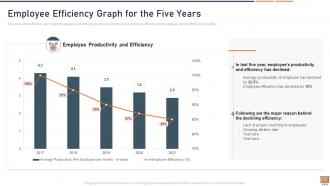
Slide 5: This slide shows the five- year graph of average production per employee (in tonne) and employee efficiency (in percentage).
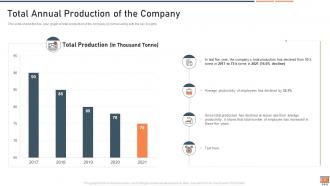
Slide 6: This slide displays the five- year graph of total production of the company (in tonne) along with the key insights.
Slide 7: This slide represents the various performance issues of the employee related technical abilities, time management, quantity and quality of the work etc.
Slide 8: This slide shows the various performance table of employees with details such as performance rating, major strengths, etc.
Slide 9: This slide presents the various objectives of performance coaching such as building new skills in employee, improve employee engagement and retention rate, etc.
Slide 10: This slide shows the key reasons for employee’s underperformance and potential solutions to improve employee performance.
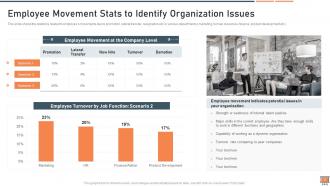
Slide 11: This slide displays the statistics related to employee’s movements due to promotion, lateral transfer, resignation etc.
Slide 12: This slide shows Table of Contents for Performance Coaching Improvement Plan and Major Strategies.
Slide 13: This slide shows the various performance coaching strategies used by the company to improve the performance of its employee.
Slide 14: This slide presents the eight-step model of a successful coaching program.
Slide 15: This slide shows the performance coaching plan for an employee that include coaching areas, desired outcome and key benefits of change
Slide 16: This slide displays the performance coaching planning worksheet with details related to Major targets, coaching topics, etc.
Slide 17: This slide represents the performance coaching guidelines such as frequent feedback to employees; build culture of team feedback; etc.
Slide 18: This slide shows various coaching methods like Democratic Coaching, Authoritarian Coaching, Holistic Coaching, etc.
Slide 19: This slide shows Table of Contents for Performance Coaching Improvement Plan and Major Strategies.
Slide 20: This slide shows the primary and other goals of the performance coaching.
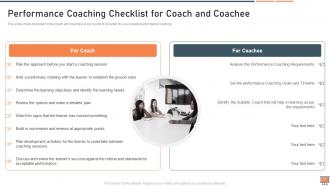
Slide 21: This slide displays Performance Coaching Checklist for Coach and Coachee.
Slide 22: This slide represents coaching Conversation Checklist for Managers under the heading such as Conversation Frame, Understand the current state, Explore the desired state etc.
Slide 23: This slide shows the Employee Performance Status (After one month, three months and 6 months) as per the set goals.
Slide 24: This slide presents Employee Feedback Regarding Performance Coaching.
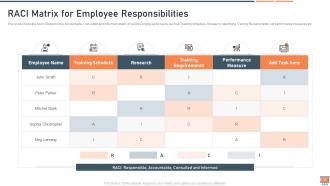
Slide 25: This slide shows RACI Matrix for Employee Responsibilities.
Slide 26: This slide shows Table of Contents for Performance Coaching Improvement Plan and Major Strategies.
Slide 27: This slide represents the Gantt chart of employee coaching plan for improving performance.
Slide 28: This slide shows the GROW model of Performance Coaching that shows the Goal, Reality, Opportunity, etc.
Slide 29: This slide presents the various employee development methods used to improve the employee performance.
Slide 30: This slide shows the Employee Performance Status (After one month, three months and 6 months) as per the set goals.
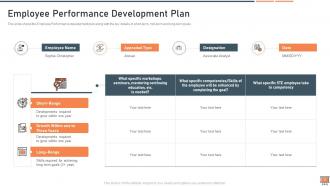
Slide 31: This slide displays the Employee Performance development plan along with the key details of short-term, mid-term and long-term goals.
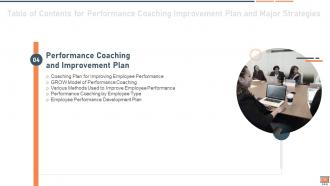
Slide 32: This slide shows Table of Contents for Performance Coaching Improvement Plan and Major Strategies.
Slide 33: This slide shows the key strategies used by the company to retain its employee.
Slide 34: This slide presents the key topics like project management, portfolio management, time management, advance excel, etc.
Slide 35: This slide shows the coaching schedule of members in marketing team.
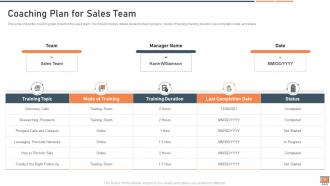
Slide 36: This slide displays the coaching plan sheet for the sales team.
Slide 37: This slide shows Table of Contents for Performance Coaching Improvement Plan and Major Strategies.
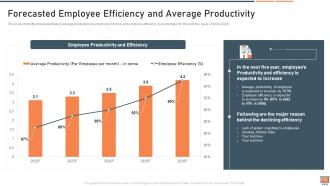
Slide 38: This slide shows Forecasted Employee Efficiency and Average Productivity.
Slide 39: This slide presents the graph forecasted total production of the company (in tonne) for the next five years.
Slide 40: This slide shows the graph of employee satisfaction rate from the year 2017 to 2022.
Slide 41: This slide shows Table of Contents for Performance Coaching Improvement Plan and Major Strategies.
Slide 42: This slide displays Dashboard - Performance Review Status and Steps.
Slide 43: This slide represents Performance Coaching dashboard with Various Metrics.
Slide 44: This slide presents Icons for Performance Coaching Improvement Plan and Major Strategies.
Slide 45: This slide is titled as Additional Slides for moving forward.
Slide 46: This slide displays Line Chart with two products comparison.
Slide 47: This slide displays Stock Chart with two products comparison.
Slide 48: This is About Us slide to show company specifications etc.
Slide 49: This slide shows 30 60 90 Days Plan with text boxes.
Slide 50: This is a Financial slide. Show your finance related stuff here.
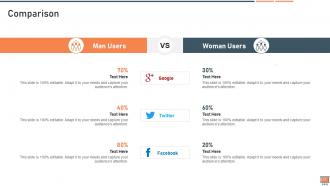
Slide 51: This is a Comparison slide to state comparison between commodities, entities etc.
Slide 52: This slide shows Venn diagram with text boxes.
Slide 53: This slide shows Magnifying Glass to highlight information, specifications etc
Slide 54: This slide shows Roadmap with additional textboxes.
Slide 55: This slide shows Post It Notes. Post your important notes here.
Slide 56: This is a Thank You slide with address, contact numbers and email address.
Performance coaching improvement plan and major strategies powerpoint presentation slides with all 56 slides:
Use our Performance Coaching Improvement Plan And Major Strategies Powerpoint Presentation Slides to effectively help you save your valuable time. They are readymade to fit into any presentation structure.


















FAQs for Performance coaching improvement plan and major strategies
Key components of an effective performance coaching strategy include clear goal-setting frameworks, regular feedback mechanisms, skill development pathways, performance measurement tools, and individualized action plans. These elements work together by establishing measurable objectives, providing continuous guidance, and tracking progress systematically, with many organizations finding that this structured approach ultimately delivers improved employee engagement, enhanced productivity, and stronger competitive advantage.
Goal-setting enhances coaching by providing clear direction, measurable milestones, accountability frameworks, and structured progress tracking for both individuals and teams. Through SMART objectives and regular check-ins, organizations streamline performance management, accelerate skill development, and improve employee engagement, with many companies finding that systematic goal-setting approaches ultimately deliver higher productivity and stronger team alignment.
Feedback serves as the cornerstone of performance coaching, enabling individuals to understand their current performance levels, identify improvement areas, and track progress toward goals. Constructive feedback should be specific, timely, and balanced, combining recognition of strengths with actionable development suggestions, ultimately fostering continuous learning and enhanced performance outcomes.
Performance data integration involves collecting metrics from assessments, feedback tools, goal-tracking systems, and behavioral observations, then analyzing trends during regular coaching sessions. Through dashboard reviews, progress scorecards, and data-driven discussions, coaches and employees can identify improvement patterns, address performance gaps, and adjust development strategies, ultimately delivering more targeted coaching outcomes and measurable professional growth.
Coaches can build rapport and trust through active listening, empathy demonstration, consistent follow-through on commitments, authentic vulnerability sharing, and creating psychologically safe environments for open dialogue. These relationship-building techniques enhance client engagement by establishing mutual respect, encouraging honest communication, and fostering accountability partnerships, with many professional coaches finding that strong initial rapport significantly accelerates performance breakthroughs and sustainable behavioral changes.
Mindfulness practices can be incorporated into performance coaching through meditation techniques, breathing exercises, present-moment awareness training, stress reduction methods, and focus enhancement activities. These approaches help athletes and professionals develop mental clarity, emotional regulation, and concentration skills, with many sports teams and corporate organizations finding that mindfulness training significantly improves decision-making under pressure and overall performance consistency.
Sustaining motivation and accountability involves setting clear milestones, regular check-ins, celebrating incremental wins, creating peer support networks, and establishing transparent progress tracking systems. Through structured feedback loops and goal reassessment sessions, organizations enhance employee engagement, accelerate skill development, and maintain momentum, with many companies finding that consistent recognition and collaborative accountability frameworks ultimately deliver higher retention rates and improved performance outcomes.
Performance coaching adapts to remote environments through virtual one-on-ones, digital goal-tracking platforms, video-based skill assessments, and cloud-based feedback systems that maintain consistent touchpoints. These approaches enable managers to deliver personalized development remotely, monitor progress through data analytics, and create structured coaching conversations, with many organizations finding that hybrid models actually enhance coaching frequency and documentation.
Common obstacles in performance coaching include resistance to feedback, unclear goal setting, lack of consistent follow-through, communication barriers, and misaligned expectations between coach and coachee. These challenges can be overcome by establishing trust through transparent communication, setting specific measurable objectives, implementing regular check-ins, and creating structured accountability frameworks, ultimately delivering improved performance outcomes and stronger professional development across organizations.
Performance coaches tailor their approach by understanding industry-specific challenges, regulatory requirements, performance metrics, cultural dynamics, and operational constraints that define each sector. In healthcare, coaches focus on patient outcomes and compliance protocols, while in manufacturing they emphasize safety standards and efficiency targets, and in financial services they prioritize risk management and client relationship skills, ultimately delivering measurable improvements aligned with each industry's strategic objectives.
Emotional intelligence enables coaches to build deeper trust, read nonverbal cues accurately, and adapt their communication style to each individual's emotional needs and motivations. Through enhanced EQ skills, coaching relationships deliver stronger engagement, more honest feedback exchanges, and sustainable behavioral changes, with many organizations finding that emotionally intelligent coaches achieve significantly higher client retention and performance outcomes.
Coaches can effectively evaluate their impact through baseline measurements, regular performance assessments, 360-degree feedback, goal achievement tracking, and behavioral observation metrics. By establishing clear KPIs before coaching begins, organizations can measure improvements in productivity, employee engagement, and skill development, with many finding that combining quantitative data with qualitative feedback delivers comprehensive insights into coaching effectiveness.
**INPUT**: What training or certification paths are available for aspiring performance coaches? **OUTPUT**: Performance coaching certification paths include ICF-accredited programs, specialized performance coaching diplomas, psychology-based certifications, corporate training qualifications, and industry-specific credentials. These comprehensive programs enhance coaching effectiveness through structured learning, practical application, and professional credibility, with many organizations finding that certified coaches deliver measurably improved employee performance and strategic outcomes. [Word count: 52 words]
Technology enhances coaching through AI-powered assessment tools, real-time performance analytics, mobile coaching apps, video analysis platforms, and progress tracking dashboards. These digital solutions streamline goal setting, automate feedback delivery, and provide data-driven insights, with many organizations finding that integrated coaching platforms ultimately deliver more personalized development experiences and measurable performance improvements.
Performance coaching enhances employee retention by providing personalized development opportunities, regular feedback, clear goal-setting, and skill-building support that demonstrates organizational investment in individual growth. Through structured coaching conversations, employees experience increased engagement, career progression clarity, and stronger manager relationships, with many organizations finding that consistent coaching reduces turnover while significantly improving job satisfaction and workplace commitment.
-
Awesome!
-
Awesome presentation, really professional and easy to edit.
-
It saves your time and decrease your efforts in half.