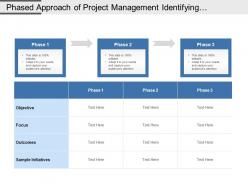
Phased approach of project management identifying objectives focus outcome and initiatives

Rating:
80%
Phased approach of project management identifying objectives focus outcome and initiatives
Slide 1 of 5
Favourites Favourites

Try Before you Buy Download Free Sample Product

Audience Impress Your
Audience
Editable 100%
Editable
Time Save Hours
of Time
The Biggest Sale is ending soon in
0
0
:
0
0
:
0
0
AI-Ready
Upload this template to AI and ask it to make any changes to content or color
100% editable Powerpoint Template for AI-assisted presentations. Finish your work in less time. ​
Works with
Microsoft PowerPoint
Microsoft 365
Claude for PowerPoint
ChatGPT
Google Slides
Microsoft Copilot
Rating:
80%
Presenting this set of slides with name - Phased Approach Of Project Management Identifying Objectives Focus Outcome And Initiatives. This is a three stage process. The stages in this process are Phased Approach, Phased Approach Plan, Phased Strategy.

People who downloaded this PowerPoint presentation also viewed the following :

FAQs for Phased approach of project management identifying objectives focus

Key phases in phased project management include initiation, planning, execution, monitoring and controlling, and closure, with each phase containing specific deliverables and approval gates. These structured phases enhance project success by establishing clear milestones, reducing risks through systematic reviews, and enabling better resource allocation, with many organizations finding that this methodology delivers improved project outcomes and stakeholder alignment.

Phased project management follows sequential, linear stages with defined deliverables and gate approvals, while agile emphasizes iterative cycles, continuous feedback, and adaptive planning. Traditional phased approaches work well for construction, manufacturing, and regulatory projects requiring predictable timelines, whereas agile excels in software development and innovation projects, ultimately delivering faster responsiveness to changing requirements.

Phased project management offers enhanced risk management, improved resource allocation, better quality control, increased stakeholder engagement, and greater flexibility in adapting to changes. This structured approach enables organizations to minimize project failures, optimize budget distribution, and deliver measurable outcomes at each stage, with many companies finding that phased execution significantly reduces costs while accelerating overall project success.

Teams effectively manage risks through systematic identification, assessment, and mitigation strategies tailored to each project phase, including regular risk registers, stakeholder communication, and contingency planning. During initiation phases, teams focus on scope and resource risks, while execution phases emphasize timeline and quality risks, with many organizations finding that proactive monitoring and adaptive response strategies ultimately deliver better project outcomes and stakeholder confidence.

Stakeholders provide essential input during planning, offer feedback during execution phases, approve deliverables at gate reviews, and ensure alignment with business objectives throughout the project lifecycle. Their involvement enables project managers to validate requirements, secure necessary resources, mitigate risks early, and maintain strategic direction, ultimately delivering outcomes that meet organizational expectations and drive competitive advantage.

Effective communication between project phases requires structured handoff protocols, comprehensive documentation transfer, and regular stakeholder alignment meetings to ensure continuity. Many organizations implement phase gate reviews, standardized reporting templates, and cross-functional team briefings, ultimately delivering seamless transitions while maintaining project momentum and stakeholder confidence throughout the implementation process.

Project management tools beneficial for phased projects include Gantt chart software, milestone tracking systems, resource allocation platforms, phase gate management tools, and integrated dashboard solutions. These technologies streamline project oversight by enabling visual timeline management, automated progress reporting, and cross-phase dependency tracking, with many organizations finding that comprehensive platforms like Microsoft Project ultimately deliver enhanced coordination and reduced project delays.

Key metrics include milestone completion rates, budget variance, resource utilization, quality indicators, and stakeholder satisfaction scores. These measurements enable project managers to assess phase performance, identify potential risks early, and make data-driven adjustments, with many organizations finding that consistent tracking across phases ultimately delivers improved project outcomes and enhanced strategic alignment.

Phase length is determined by deliverable complexity, resource availability, stakeholder requirements, risk levels, and interdependencies between tasks. Project managers analyze scope, assess team capacity, and consider external factors like regulatory approvals, with many organizations finding that breaking complex deliverables into smaller milestones enables better control and ultimately delivers more predictable timelines.

**INPUT**: What strategies can be employed to handle delays between project phases? **OUTPUT**: Strategies include buffer time allocation, resource reallocation protocols, stakeholder communication frameworks, alternative workflow development, and milestone adjustment procedures. These approaches streamline project continuity by maintaining team productivity during transitions, enabling rapid resource deployment, and preserving client relationships, with many organizations finding that proactive delay management ultimately delivers improved project outcomes and enhanced competitive positioning.

Lessons learned are documented through structured debriefs, stakeholder feedback sessions, risk assessments, and performance metrics analysis after each phase completion. These insights are integrated into updated project templates, refined processes, and enhanced risk mitigation strategies, with many organizations finding that systematic knowledge capture reduces future project timelines by 15-20% while improving overall delivery quality.

Common pitfalls in phased project management include inadequate phase gate reviews, poor stakeholder communication, scope creep between phases, insufficient resource planning, and weak dependency management across sequential deliverables. These challenges can be avoided by establishing clear phase exit criteria, maintaining consistent stakeholder engagement, implementing robust change control processes, and conducting thorough risk assessments at each transition point, ultimately delivering more predictable outcomes and enhanced project success rates.

Resource allocation optimization across project phases involves strategic workforce planning, budget reallocation based on phase requirements, skill-based team adjustments, and continuous resource monitoring. Through phased management approaches, organizations streamline personnel deployment, minimize idle time, and maximize productivity, with many project managers finding that dynamic resource shifting between initiation, execution, and closure phases ultimately delivers cost efficiency and faster project completion.

Phase completion enables strategic budget control through milestone-based funding releases, improved cost forecasting, and enhanced financial accountability across project lifecycles. This approach streamlines resource allocation by allowing organizations to adjust budgets based on actual performance, minimize financial risks through incremental investments, and secure stakeholder confidence, with many enterprises finding that phased funding ultimately delivers better cost management and project success rates.

Phased project management integrates with remote team dynamics through structured communication protocols, digital collaboration platforms, and milestone-based accountability systems. These methodologies enhance remote workflows by establishing clear deliverable timelines, facilitating virtual sprint reviews, and enabling distributed teams to maintain project momentum, ultimately delivering improved coordination and measurable outcomes across geographical boundaries.

Ratings and Reviews

80% of 100
Review Form
Write a review
Most Relevant Reviews
  1. 80%

    by Chester Kim

    Out of the box and creative design.
  2. 80%

    by Christopher Wood

    Easily Editable.

2 Item(s)

per page: