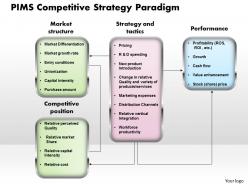
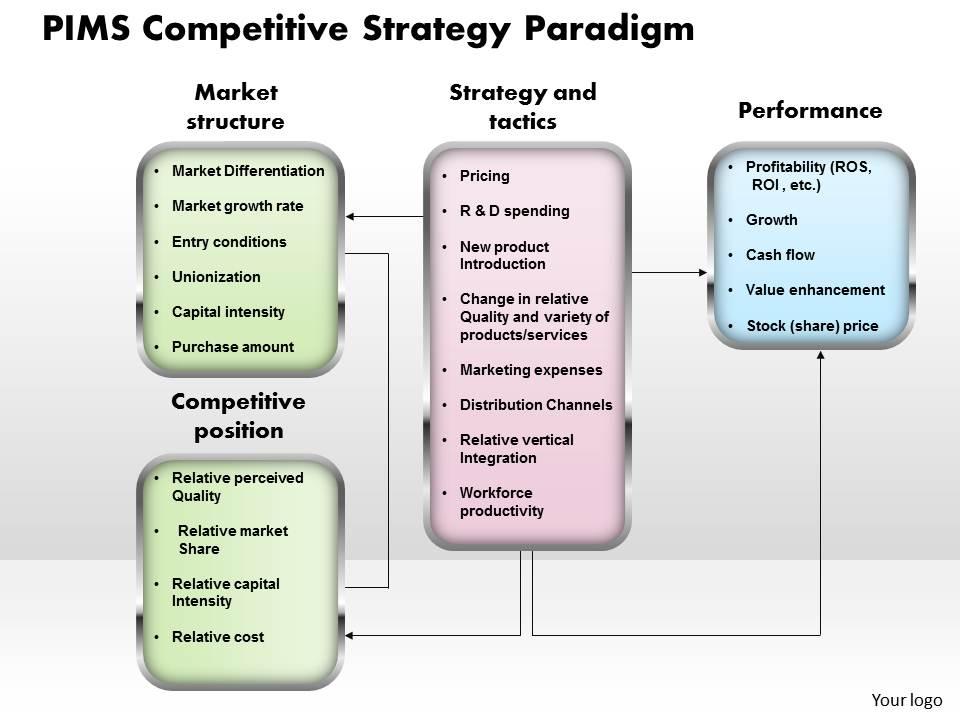
Pims competitive strategy paradigm r powerpoint presentation slide template
Try Before you Buy Download Free Sample Product
Audience
Editable
of Time
Keep time with our PIMS Competitive Strategy Paradigm R Powerpoint Presentation Slide Template. Your talk will go like clockwork.
People who downloaded this PowerPoint presentation also viewed the following :
Pims competitive strategy paradigm r powerpoint presentation slide template with all 5 slides:
Let our PIMS Competitive Strategy Paradigm R Powerpoint Presentation Slide Template accompany your words. Together they will sing a tuneful ditty.
FAQs for Pims competitive strategy paradigm r powerpoint
The PIMS framework includes market share, product quality, investment intensity, capacity utilization, and productivity measures as core components for analyzing business performance. These strategic elements enable organizations to benchmark profitability drivers, identify competitive advantages, and optimize resource allocation, with many companies finding that higher market share and superior quality ultimately deliver sustained profitability and market leadership.
PIMS helps businesses identify competitive advantages by analyzing market share, product quality, investment intensity, capacity utilization, and cost position against industry benchmarks. Through comprehensive database comparisons, companies can pinpoint performance gaps, optimize resource allocation, and discover strategic positioning opportunities, with many organizations finding that PIMS insights enable targeted improvements in profitability and sustainable competitive differentiation.
PIMS metrics enhance strategic decision-making by providing data-driven insights into market share, product quality, investment intensity, and profitability relationships across diverse business units. Through these comprehensive benchmarks, organizations streamline resource allocation, optimize pricing strategies, and identify growth opportunities, with many companies finding that PIMS analysis ultimately delivers competitive advantage and improved operational efficiency.
Market share serves as a primary determinant of profitability in PIMS methodology, with higher market share typically correlating with increased ROI through economies of scale, enhanced bargaining power, and operational efficiency gains. This strategic advantage enables companies to leverage cost leadership positions, streamline resource allocation, and ultimately deliver superior competitive positioning, with many organizations finding that market leadership directly translates into sustained financial performance.
Companies leverage PIMS data to optimize product positioning by analyzing market share relationships, profitability patterns, and competitive dynamics across similar business units. This strategic analysis enables organizations to identify optimal price points, quality levels, and market segments, with many manufacturing and retail companies finding that PIMS insights deliver enhanced competitive positioning and improved profit margins.
PIMS analysis incorporates KPIs including market share, return on investment, cash flow generation, product quality metrics, and relative cost position within competitive markets. These indicators work together by measuring market dominance, profitability trends, and operational efficiency, with many organizations finding that higher market share and superior quality ultimately deliver sustained competitive advantage and improved financial performance.
PIMS differs from frameworks like SWOT or Porter's Five Forces by focusing on empirical data analysis from thousands of businesses to identify profit drivers, rather than theoretical strategic positioning. While SWOT analyzes internal strengths and Porter examines competitive forces, PIMS uses quantitative metrics like market share, product quality, and capital intensity to predict profitability, with many organizations finding that data-driven insights enable more precise strategic decisions.
SMEs can effectively implement PIMS strategy by focusing on market share growth within niche segments, optimizing product quality relative to competitors, and leveraging data analytics to identify profitable customer segments. Through targeted investment in core competencies and strategic partnerships, these businesses streamline operations while building competitive advantages, with many SMEs finding that concentrated market focus delivers superior returns and sustainable growth.
PIMS data presents challenges including potential obsolescence due to market evolution, limited industry scope, generalized insights that may not reflect unique business contexts, and dependency on historical performance patterns. While these limitations require careful consideration, many organizations find that combining PIMS insights with current market analysis and company-specific data ultimately delivers more robust strategic planning and competitive positioning.
PIMS insights vary substantially across industries due to differing competitive dynamics, customer behaviors, market structures, and operational requirements. Manufacturing sectors emphasize quality and market share relationships, while service industries like banking and healthcare focus more on customer satisfaction metrics and operational efficiency, with many organizations finding that industry-specific factors significantly influence strategic priorities and performance outcomes.
Consumer behavior significantly impacts PIMS strategy effectiveness by influencing market share dynamics, pricing power, and quality perceptions across different segments. Organizations with deep consumer insights can better leverage PIMS principles, adapting their competitive positioning based on purchasing patterns, brand loyalty, and value expectations, ultimately delivering sustained profitability and market dominance.
Companies like General Electric successfully applied PIMS principles by focusing on market share leadership and quality improvement, achieving higher ROI in their appliance division. Similarly, Procter & Gamble leveraged PIMS insights to optimize product portfolios and market positioning strategies, while manufacturing firms used PIMS data to streamline operations and enhance competitive advantage, ultimately delivering sustained profitability and market dominance across diverse business units.
Technology and data analytics enhance PIMS by automating market share tracking, enabling real-time profitability analysis, and providing predictive insights into competitive positioning. Advanced analytics platforms streamline ROI calculations across business units while delivering faster strategic decision-making, with many organizations finding that integrated dashboards ultimately improve resource allocation and competitive advantage.
Relying solely on PIMS for competitive strategy presents limitations including outdated data from the 1970s-80s, industry-specific variations it may not capture, oversimplified relationships between variables, and limited consideration of digital transformation factors. While PIMS provides valuable market share and profitability insights, organizations increasingly combine it with modern analytics, real-time competitive intelligence, and sector-specific frameworks to develop comprehensive strategies that address today's dynamic business environment.
External market factors significantly influence PIMS-driven strategies through competitive intensity, customer demand patterns, technological disruption, and regulatory changes that can amplify or diminish market share advantages. Organizations implementing PIMS frameworks find that economic conditions, industry growth rates, and supplier dynamics directly impact their ability to achieve projected ROI and profitability outcomes, requiring continuous strategy recalibration.
-
Much better than the original! Thanks for the quick turnaround.
-
Visually stunning presentation, love the content.