PMO Optimization Maturity Process Flow

Rating:
100%
PMO Optimization Maturity Process Flow
Slide 1 of 6

or

Favourites Favourites

Try Before you Buy Download Free Sample Product

Audience Impress Your
Audience
Editable 100%
Editable
Time Save Hours
of Time
The Biggest Sale is ending soon in
0
0
:
0
0
:
0
0
Rating:
100%
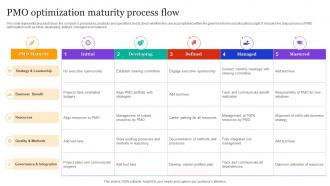
This slide represents process to track the companys procedures, practices and operations and to check whether they are accomplished within the given time frame and allocated budget. It includes five steps process of PMO optimization such as initial, developing, defined, managed and mastered. Introducing our PMO Optimization Maturity Process Flow set of slides. The topics discussed in these slides are Strategy Leadership, Business Benefit, Resources. This is an immediately available PowerPoint presentation that can be conveniently customized. Download it and convince your audience.

People who downloaded this PowerPoint presentation also viewed the following :

FAQs for PMO Optimization

Key components of a PMO Maturity Model include governance frameworks, standardized processes, performance metrics, resource management capabilities, and stakeholder alignment mechanisms. These elements work together by establishing clear project oversight, streamlining operational efficiency, and enabling data-driven decision making, with many organizations finding that mature PMOs deliver faster project completion and enhanced strategic value.

Organizations assess PMO maturity through comprehensive evaluations examining governance structures, standardized processes, resource allocation capabilities, performance metrics frameworks, and stakeholder engagement effectiveness. Through maturity assessment tools and benchmarking studies, companies identify gaps in project delivery, strategic alignment, and operational efficiency, while establishing clear roadmaps for advancing capabilities, ultimately enabling enhanced project success rates and competitive advantage.

Adopting a PMO Maturity Model delivers enhanced project success rates, standardized processes, improved resource allocation, better risk management, and increased organizational alignment. Through systematic assessment and development, organizations streamline project delivery, reduce costs, and accelerate decision-making, with many companies finding that mature PMOs significantly improve strategic outcomes and competitive advantage.

A PMO Maturity Model evolves with digital transformation by incorporating advanced analytics, artificial intelligence, cloud-based collaboration tools, and automated reporting systems that enhance decision-making, resource allocation, and project visibility. Through digital integration, organizations streamline project workflows, enable real-time performance tracking, and facilitate remote team coordination, while leveraging predictive analytics for risk management, ultimately delivering faster project delivery and competitive advantage.

Stakeholder engagement and communication serve as foundational pillars for PMO maturity, driving alignment, transparency, and organizational buy-in across all project management processes. Mature PMOs establish structured communication frameworks that enhance collaboration between departments, streamline decision-making, and deliver consistent project visibility, with many organizations finding that strategic stakeholder engagement ultimately accelerates project success rates and organizational transformation.

PMO maturity metrics include project success rates, resource utilization efficiency, stakeholder satisfaction scores, process standardization levels, and strategic alignment measurements. These indicators enable organizations to track operational improvements, cost reductions, and delivery timelines, with many enterprises finding that comprehensive metric frameworks ultimately deliver enhanced project outcomes and competitive advantage across portfolios.

Organizations transition to higher PMO maturity by establishing standardized processes, implementing robust governance frameworks, investing in project management tools and training, and creating comprehensive performance metrics. This strategic evolution typically spans 18-24 months, with many enterprises finding that phased implementation across departments delivers improved project success rates, enhanced resource allocation, and ultimately stronger competitive positioning in increasingly complex business environments.

Organizations commonly face resistance to change, lack of executive support, insufficient resources, unclear governance structures, and inadequate stakeholder buy-in when implementing PMO Maturity Models. These challenges often manifest through inconsistent project methodologies, poor communication across departments, and difficulty measuring progress, with many companies finding that gradual implementation and strong leadership commitment ultimately streamlines adoption and delivers sustainable organizational improvements.

A PMO Maturity Model aligns with organizational goals by establishing governance frameworks, standardizing project methodologies, and implementing strategic portfolio management processes that directly support business objectives. Through progressive maturity stages, organizations streamline resource allocation, enhance project success rates, and improve decision-making capabilities, with many companies finding that mature PMOs deliver measurable competitive advantage and accelerated strategic initiative execution.

**INPUT**: What frameworks (like Agile, Waterfall) influence the PMO Maturity Model's adaptability? **OUTPUT**: Agile, Waterfall, PRINCE2, Scrum, Lean, and hybrid methodologies significantly influence PMO Maturity Model adaptability by enabling flexible governance structures, scalable processes, and responsive project delivery approaches. These frameworks enhance organizational capability through iterative improvements, standardized practices, and adaptive resource allocation, with many enterprises finding that strategic framework integration ultimately delivers greater operational efficiency and competitive advantage across diverse project portfolios.

Cultural change significantly impacts PMO Maturity Model success by influencing stakeholder adoption, process acceptance, and organizational alignment with new project management practices. Organizations with strong change management capabilities, clear communication strategies, and leadership support typically achieve smoother transitions, while those experiencing cultural resistance may face implementation delays, ultimately requiring targeted culture transformation initiatives alongside their maturity enhancement efforts.

Technology enhances the PMO Maturity Model through automated project tracking, real-time analytics dashboards, integrated resource management platforms, AI-driven risk assessment tools, and centralized knowledge repositories. These solutions streamline maturity assessments by providing data-driven insights, accelerating decision-making processes, and enabling seamless collaboration across project teams, ultimately delivering enhanced operational efficiency and strategic oversight capabilities.

Standard PMO Maturity Models provide universal frameworks focusing on general project management capabilities, governance structures, and standardized processes across all sectors. Industry-specific models incorporate sector requirements, regulatory compliance, and specialized methodologies tailored to healthcare, financial services, or manufacturing environments, with many organizations finding that industry-specific approaches deliver faster implementation, better regulatory alignment, and more relevant performance metrics than generic frameworks.

Continuous improvement integrates into PMO Maturity Model frameworks through regular assessments, feedback loops, benchmarking against industry standards, and iterative capability enhancements across all maturity levels. Organizations achieve this by implementing structured review cycles, capturing lessons learned from project outcomes, and establishing metrics-driven advancement processes, with many PMOs finding that systematic improvement accelerates their progression through maturity stages while delivering measurable business value.

Best practices for sustainable PMO maturity growth include establishing clear governance frameworks, implementing continuous performance monitoring, fostering stakeholder engagement, developing standardized processes, and investing in team capabilities development. Organizations across industries find that combining regular maturity assessments with strategic alignment initiatives, knowledge management systems, and change management protocols ultimately delivers enhanced project success rates and organizational resilience.

Ratings and Reviews

100% of 100
Review Form
Write a review
Most Relevant Reviews
  1. 100%

    by Dean Dixon

    Crisp and neat slides. Makes it fun and easier to curate presentations. 
  2. 100%

    by Dean Dixon

    Understandable and informative presentation.

2 Item(s)

per page: