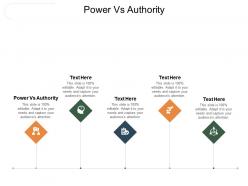
Power vs authority ppt powerpoint presentation infographic template examples cpb
Try Before you Buy Download Free Sample Product
Audience
Editable
of Time
Our Power Vs Authority Ppt Powerpoint Presentation Infographic Template Examples Cpb are explicit and effective. They combine clarity and concise expression.
People who downloaded this PowerPoint presentation also viewed the following :
Power vs authority ppt powerpoint presentation infographic template examples cpb with all 2 slides:
Give your audience a fulfilling experience. They will find our Power Vs Authority Ppt Powerpoint Presentation Infographic Template Examples Cpb elevating.
FAQs for Power vs authority ppt powerpoint presentation infographic
Power stems from personal influence, expertise, relationships, and control over resources, while authority derives from formal organizational positions, titles, and legally designated roles. While power can exist without formal recognition and operates through persuasion, charisma, and knowledge, authority provides legitimate decision-making rights within established structures, with many organizations finding that effective leaders strategically combine both elements to maximize influence and deliver sustainable results.
Power influences organizational dynamics through informal networks, personal relationships, and resource control, while authority operates through formal hierarchies, designated roles, and structured decision-making processes. Power often creates flexible coalitions and behind-the-scenes influence across departments, whereas authority streamlines operations through clear reporting structures, ultimately delivering organizational efficiency with many companies finding that balancing both enhances strategic outcomes.
Authority is earned through demonstrated expertise, consistent results, building trust, gaining stakeholder respect, and proving competence over time, while power can be inherited, assigned, or seized through position, resources, or force. Unlike power which can be immediately granted or taken, earned authority requires sustained performance and relationship-building, with many organizations finding that leaders who combine positional power with earned authority deliver significantly better engagement and long-term results.
Cultural perceptions of power and authority vary significantly through hierarchical structures, communication styles, decision-making processes, and social expectations across societies. While Western cultures often emphasize individual leadership and direct communication, many Asian and Latin American societies prioritize collective harmony, respect for age and position, ultimately creating distinct organizational dynamics and management approaches that successful global businesses must navigate strategically.
Yes, power can exist without authority through informal influence networks, expert knowledge, relationship building, and resource control. Employees often wield significant power by leveraging specialized skills, maintaining strategic connections with key stakeholders, or controlling critical information flows, with many organizations finding that informal power structures ultimately drive decision-making and operational outcomes.
Imbalances between power and authority create team dysfunction through unclear decision-making, reduced accountability, conflicting directives, and diminished trust among members. These misalignments often result in decreased productivity, higher turnover, and strategic misexecution, with many organizations finding that clearly defined roles and transparent governance structures ultimately restore team cohesion and operational effectiveness.
The relationship between power and authority significantly shapes decision-making by determining who participates, how quickly decisions are made, and implementation effectiveness. When formal authority aligns with actual power, organizations experience streamlined processes, clearer accountability, and faster execution, while misalignment creates bottlenecks, with many companies finding that distributed authority coupled with collaborative power structures ultimately enhances both decision quality and organizational agility.
Ethical leadership ensures power and authority serve organizational mission rather than personal interests, creating accountability, transparency, and trust across all levels. Through consistent decision-making frameworks, inclusive communication, and stakeholder consideration, ethical leaders demonstrate that authority enhances rather than exploits power dynamics, ultimately delivering sustainable organizational performance and employee engagement.
Understanding power versus authority enables team members to recognize legitimate decision-making channels, respect formal hierarchies while leveraging informal influence networks, and communicate more effectively across organizational levels. This clarity reduces conflicts over roles and responsibilities, streamlines project workflows, and enhances trust, with many organizations finding that teams collaborate more seamlessly when everyone understands both formal authority structures and informal power dynamics.
Leaders can responsibly wield authority through transparent communication, collaborative decision-making, regular feedback mechanisms, clear boundary setting, and empowerment-focused delegation. These strategies enable organizations to maintain trust while driving results, with many finding that combining consultative approaches with decisive leadership ultimately delivers stronger team engagement, reduced resistance to change, and sustainable competitive advantage.
Power can undermine legitimate authority when individuals bypass established hierarchies through personal connections, financial influence, or political leverage, effectively circumventing formal decision-making processes. This typically occurs in organizations where informal networks override structured governance, with many institutions finding that unchecked power dynamics ultimately erode accountability, reduce operational efficiency, and compromise strategic leadership effectiveness.
Shared authority redistributes decision-making from hierarchical leaders to cross-functional teams, subject matter experts, and frontline employees with relevant expertise. This approach flattens traditional pyramids by enabling faster responses, improving innovation through diverse perspectives, and enhancing employee engagement, with many organizations finding that distributed leadership delivers greater agility and competitive advantage.
Technology reshapes workplace power dynamics by democratizing information access, enabling remote leadership, flattening organizational hierarchies, and creating data-driven decision-making processes. Through digital collaboration platforms and real-time analytics, organizations streamline communication, enhance transparency, and distribute authority more effectively, with many companies finding that technology ultimately delivers faster decision-making and improved operational efficiency.
Individuals can navigate power struggles by maintaining transparent communication, building strategic alliances, focusing on collaborative solutions, and demonstrating consistent expertise in their domain. By leveraging emotional intelligence and diplomatic negotiation skills, professionals preserve their credibility while managing conflicts, ultimately strengthening their positional authority and fostering productive workplace relationships that enhance organizational effectiveness.
Common misconceptions about authority include believing it grants unlimited control, that it doesn't require accountability, and that position alone commands respect without earning it. These misconceptions lead organizations to experience reduced employee engagement, increased turnover, and diminished productivity, with many companies finding that sustainable leadership requires balancing authority with transparency, collaboration, and ethical responsibility to maintain competitive advantage.
No Reviews