Process Of Writing Video Script Implementing Video Marketing Strategies

Rating:
90%
Process Of Writing Video Script Implementing Video Marketing Strategies
Slide 1 of 6

or

Favourites Favourites

Try Before you Buy Download Free Sample Product

Audience Impress Your
Audience
Editable 100%
Editable
Time Save Hours
of Time
The Biggest Sale is ending soon in
0
0
:
0
0
:
0
0
Rating:
90%
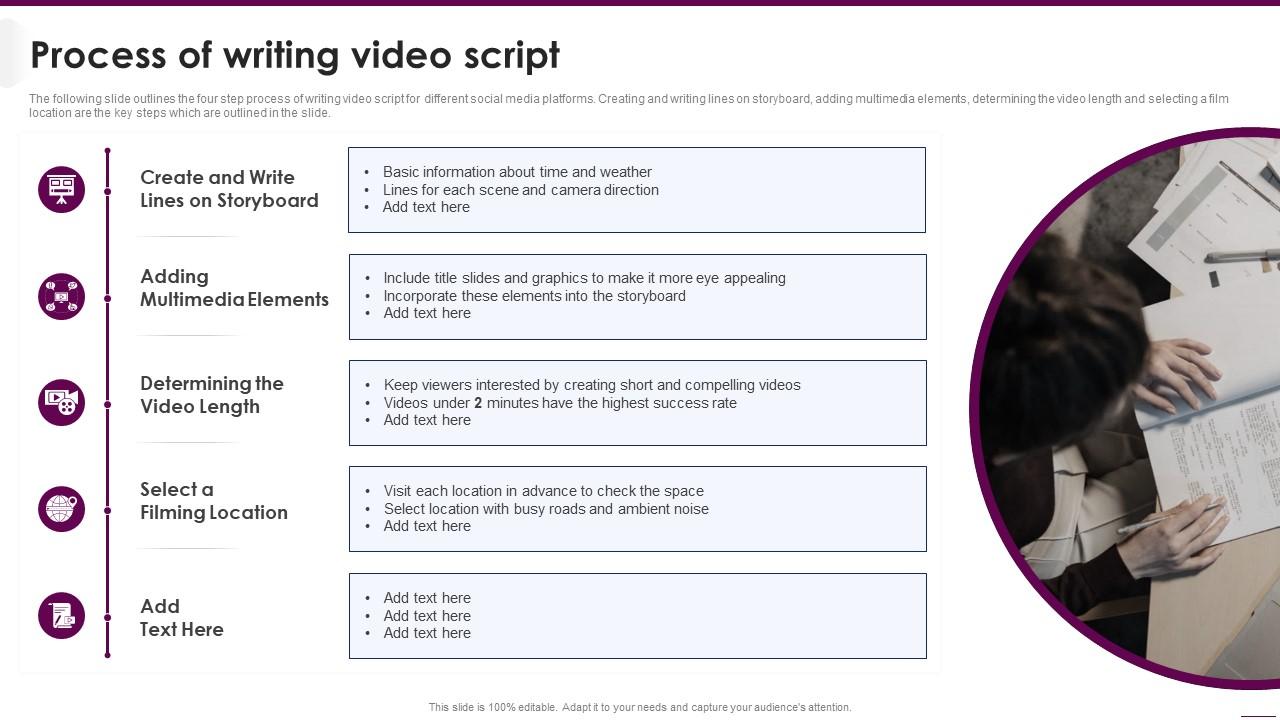
The following slide outlines the four step process of writing video script for different social media platforms. Creating and writing lines on storyboard, adding multimedia elements, determining the video length and selecting a film location are the key steps which are outlined in the slide. Increase audience engagement and knowledge by dispensing information using Process Of Writing Video Script Implementing Video Marketing Strategies. This template helps you present information on five stages. You can also present information on Storyboard, Multimedia Elements, Filming Location using this PPT design. This layout is completely editable so personaize it now to meet your audiences expectations.

FAQs for Process Of Writing Video Script Implementing

Compelling video scripts include a strong hook, clear structure, engaging dialogue, visual storytelling elements, and a compelling call-to-action. These components work together by capturing attention immediately, maintaining viewer engagement through strategic pacing, and driving desired outcomes, with many organizations finding that well-crafted scripts significantly enhance message retention and conversion rates.

Effective video scripts maximize engagement through a clear hook within the first 10 seconds, logical content flow with smooth transitions, and strategic pacing that balances information with visual elements. Scripts structured around problem-solution frameworks, compelling storytelling arcs, and clear call-to-actions deliver higher viewer retention and conversion rates, with many content creators finding that audience-centric approaches significantly enhance message clarity and business outcomes.

Storytelling serves as the foundation of effective video script writing, creating emotional connections, establishing clear narrative arcs, maintaining audience engagement, and transforming information into memorable experiences. Through compelling characters, conflict resolution, and structured narratives, organizations across industries like healthcare, education, and marketing find that storytelling-driven scripts significantly increase viewer retention, message comprehension, and ultimately deliver stronger conversion rates and brand loyalty.

Tone and voice are effectively conveyed through carefully chosen language, dialogue patterns, character interactions, and descriptive elements that reflect the intended emotional atmosphere and personality. Strategic use of pacing, word selection, and narrative style enables scriptwriters to create consistent brand voices and emotional connections, with many production teams finding that well-defined tonal guidelines streamline filming and ultimately deliver more engaging, authentic content.

Character development in video scripts utilizes dialogue patterns, behavioral quirks, backstory integration, visual storytelling cues, and consistent voice establishment. These techniques enable scriptwriters to create memorable personas by revealing motivations through actions, crafting distinctive speaking styles, and showing character growth arcs, with many production teams finding that well-developed characters significantly enhance audience engagement and retention.

Tailoring scripts for different audience segments involves adjusting language complexity, cultural references, pain points, and communication styles to match specific demographics, industries, or user personas. By analyzing audience data, creating segment-specific messaging frameworks, and testing variations across different groups, content creators can deliver more personalized experiences that resonate with distinct viewer needs, ultimately driving higher engagement and conversion rates.

Video script visual and audio cues include detailed shot descriptions, seamless transition markers, strategic audio callouts, precise timing notations, and comprehensive graphics specifications. These elements streamline production workflows by eliminating guesswork, reducing revision cycles, and ensuring creative alignment, with many production teams finding that well-documented scripts ultimately deliver faster turnarounds and more polished final content.

Call-to-action statements work within video scripts by strategically positioning clear, compelling directives at key moments, using urgent language, and connecting directly to viewer pain points or desires. These statements drive engagement by creating immediate response opportunities, guiding viewers toward specific actions like subscribing, purchasing, or sharing, ultimately converting passive viewers into active participants and measurable business outcomes.

Common video script mistakes include writing for reading rather than speaking, overloading with information, neglecting clear structure, ignoring the target audience, and failing to include compelling calls-to-action. These oversights often result in scripts that sound unnatural when spoken, confuse viewers with dense content, and miss conversion opportunities, with many businesses finding that conversational tone, focused messaging, and strategic pacing ultimately deliver higher engagement and better results.

Research enhances video script quality by providing accurate information, understanding target audience preferences, identifying compelling narratives, and ensuring content relevance across different platforms. Through thorough market analysis and audience insights, scriptwriters can craft more engaging dialogue, develop authentic characters, and structure compelling storylines, while incorporating industry-specific terminology and cultural nuances that resonate with viewers, ultimately delivering higher engagement rates.

Pacing and timing significantly influence viewer engagement, message retention, and emotional response by controlling information flow, maintaining attention spans, and creating dramatic emphasis. Through strategic rhythm variations, content creators deliver compelling narratives, enhance key messages, and sustain audience interest, with many marketing and educational videos finding that well-timed sequences ultimately improve conversion rates and learning outcomes.

Electronic video scriptwriting tools include Final Draft, WriterDuet, Celtx, StudioBinder, and Fountain for formatting and collaboration. These platforms streamline the creative process by automating industry-standard formatting, enabling real-time collaboration between writers and directors, and integrating production scheduling features, with many content creators finding that these tools significantly reduce revision cycles while enhancing overall production efficiency.

Humor can be effectively integrated through situational comedy that relates to audience experiences, character-driven jokes that feel natural to personalities, visual gags that enhance storytelling, and strategic timing that doesn't overshadow key messages. These approaches work particularly well in training videos, marketing content, and corporate communications, with many organizations finding that well-placed humor increases engagement and retention.

Cross-platform script adaptation involves adjusting length, pacing, hook placement, and visual elements to match each platform's unique audience behaviors and technical requirements. Through strategic modifications, content creators can repurpose core messages for YouTube's longer-form storytelling, Instagram's visual-first approach, and TikTok's rapid-engagement format, while maintaining brand consistency and maximizing reach across diverse digital touchpoints.

Live action scripts focus on realistic dialogue, actor performances, location constraints, and practical filming considerations like lighting and camera angles. Animated video scripts emphasize visual storytelling possibilities, character design flexibility, and creative freedom in environments and actions. While live action requires detailed scene directions for physical production, animation scripts concentrate on describing visual concepts and transitions that illustrate complex ideas, with many businesses finding animated formats more cost-effective for explaining abstract services.

Ratings and Reviews

90% of 100
Review Form
Write a review
Most Relevant Reviews
  1. 100%

    by William Martinez

    The customer care of SlideTeam is very responsive. I was having a payment issue and they fixed it for me in no time.
  2. 80%

    by Chong Richardson

    Helpful product design for delivering presentation.

2 Item(s)

per page: