

Product Development Plan Powerpoint Presentation Slides V






Try Before you Buy Download Free Sample Product
 Impress Your
Audience
 100%
Editable
 Save Hours
of Time


Product development is a process that includes the conceptualization, innovation, development, and promotion of newly created or newly rebranded goods or services. It includes the products entire journey, i.e., from initial idea generation to its after-market release. Our Product Development Plan PPT showcase statistics, trends, gap analysis, and the monthly timeline for product development along with process, proactive and reactive strategies. This PowerPoint includes product development strategies such as pricing, innovation, time-to-market strategy, customer-oriented, and platform driven, along with models including hook, kano, strategy canvas, impact vs. effort matrix, and value proposition model. It also highlights product lifecycle management stages, processes, software, and strategies brand extension, product repositioning, deletion, obsolescence, and differentiation. This deck covers the product adoption curve, strategies, and impact on the customer. Lastly, it represents the product management team, training plan, cost and financial statements, impact, dashboards, and case study. Download our 100 percent editable and customizable template, which is also compatible with Google Slides.
People who downloaded this PowerPoint presentation also viewed the following :
Content of this Powerpoint Presentation
Slide 1: This slide introduces Product Development Plan. State your company name and begin.
Slide 2: This slide states Agenda of the presentation.
Slide 3: This slide presents Table of Content for the presentation.
Slide 4: This is another slide continuing Table of Content for the presentation.
Slide 5: This slide highlights title for topics that are to be covered next in the template.
Slide 6: This slide shows Key statistics associated with product development.
Slide 7: This slide presents Key product development and management trends.
Slide 8: This slide displays Gap assessment highlighting need for product management.
Slide 9: This slide highlights title for topics that are to be covered next in the template.
Slide 10: This slide represents Monthly timeline highlighting product development.
Slide 11: This slide highlights title for topics that are to be covered next in the template.
Slide 12: This slide showcases 7 stage product development process.
Slide 13: This slide shows Major proactive product development strategies.
Slide 14: This slide presents Key reactive product development strategies.
Slide 15: This slide highlights title for topics that are to be covered next in the template.
Slide 16: This slide displays Price driven strategy in product development.
Slide 17: This slide represents Use case for product pricing strategy.
Slide 18: This slide showcases Product innovation strategy and action plan.
Slide 19: This slide shows Use case for product innovation strategy.
Slide 20: This slide represents time to market strategy for product development.
Slide 21: This slide showcases Use case for time to market strategy.
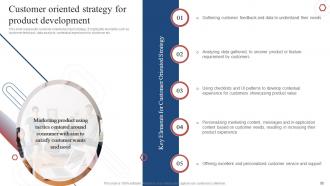
Slide 22: This slide shows Customer oriented strategy for product development.
Slide 23: This slide presents Use case for customer oriented strategy.
Slide 24: This slide displays Platform driven strategy to enhance customer experience.
Slide 25: This slide represents Use case for platform driven strategy.
Slide 26: This slide highlights title for topics that are to be covered next in the template.
Slide 27: This slide showcases Hook model in product development and management.
Slide 28: This slide shows Kano model to evaluate product performance.
Slide 29: This slide presents Strategy canvas model in product development.
Slide 30: This slide displays Impact vs. effort matrix for product management.
Slide 31: This slide represents Value proposition canvas for product positioning.
Slide 32: This slide highlights title for topics that are to be covered next in the template.
Slide 33: This slide showcases 4 stage product lifecycle management.
Slide 34: This slide shows Product development and management lifecycle.
Slide 35: This slide presents 8 phase product lifecycle management process.
Slide 36: This slide displays Software selection for product lifecycle management.
Slide 37: This slide highlights title for topics that are to be covered next in the template.
Slide 38: This slide represents Types of brand extension strategy for product launch.
Slide 39: This slide showcases Major product repositioning strategy to enhance sales.
Slide 40: This slide shows 4 phase product deletion strategy.
Slide 41: This slide presents Types of planned product obsolescence strategy.
Slide 42: This slide displays Major types product differentiation strategy.
Slide 43: This slide highlights title for topics that are to be covered next in the template.
Slide 44: This slide represents Product adoption curve to enhance lead generation.
Slide 45: This slide showcases Strategies and impact of product adoption on consumer.
Slide 46: This slide highlights title for topics that are to be covered next in the template.
Slide 47: This slide shows Product management and development team structure.
Slide 48: This slide presents Key roles and responsibilities for product team.
Slide 49: This slide displays Training plan for product development and management team.
Slide 50: This slide highlights title for topics that are to be covered next in the template.
Slide 51: This slide represents Quarterly budget plan for product development.
Slide 52: This slide showcases Cash flow statement for product manufacturing business.
Slide 53: This slide shows Consolidated income statement for product manufacturing business.
Slide 54: This slide highlights title for topics that are to be covered next in the template.
Slide 55: This slide presents Impact of product development strategies post implementation.
Slide 56: This slide highlights title for topics that are to be covered next in the template.
Slide 57: This slide displays Metric dashboard to measure product performance.
Slide 58: This slide represents Metric dashboard to track product success.
Slide 59: This slide showcases Product development and management dashboard.
Slide 60: This slide highlights title for topics that are to be covered next in the template.
Slide 61: This slide represents case study for product development strategy.
Slide 62: This slide contains all the icons used in this presentation.
Slide 63: This slide is titled as Additional Slides for moving forward.
Slide 64: This slide provides 30 60 90 Days Plan with text boxes.
Slide 65: This slide depicts Venn diagram with text boxes.
Slide 66: This is a Financial slide. Show your finance related stuff here.
Slide 67: This slide presents Roadmap with additional textboxes.
Slide 68: This slide shows Post It Notes. Post your important notes here.
Slide 69: This slide contains Puzzle with related icons and text.
Slide 70: This slide presents Bar chart with two products comparison.
Slide 71: This is Our Target slide. State your targets here.
Slide 72: This is a Thank You slide with address, contact numbers and email address.
Product Development Plan Powerpoint Presentation Slides V with all 77 slides:
Use our Product Development Plan Powerpoint Presentation Slides to effectively help you save your valuable time. They are readymade to fit into any presentation structure.









FAQs for Product Development Plan Powerpoint
Key components of an effective product development plan include market research, competitive analysis, feature specifications, timeline milestones, resource allocation, risk assessment, and success metrics. These elements work together by ensuring strategic alignment, streamlining development processes, and minimizing costly revisions, with many organizations finding that comprehensive planning reduces time-to-market while delivering products that better meet customer needs and business objectives.
Market research findings influence product development by identifying customer needs, validating demand, informing feature prioritization, and reducing development risks through data-driven insights. These insights enable companies to refine product specifications, adjust pricing strategies, and optimize go-to-market approaches, with organizations across retail, technology, and healthcare finding that research-backed development significantly reduces time-to-market while enhancing customer adoption rates.
Methods to define target audiences include market research surveys, customer interviews, demographic analysis, behavioral segmentation, and competitor audience analysis. These approaches streamline product positioning by identifying customer pain points, purchasing patterns, and preferences, with many companies finding that combining multiple methods delivers more accurate audience profiles and ultimately enhances market penetration strategies.
A product development plan incorporates agile methodology through iterative sprints, continuous customer feedback, cross-functional collaboration, and adaptive planning cycles that prioritize flexibility over rigid timelines. This approach enables teams to respond quickly to market changes, reduce development costs, and deliver customer-centric products faster, with many organizations finding that agile integration ultimately enhances innovation and competitive positioning.
Cross-functional collaboration enhances product development by integrating diverse expertise, accelerating decision-making, reducing development cycles, and minimizing costly revisions through early identification of potential issues. Teams combining engineering, marketing, design, and operations streamline communication, enable faster market validation, and deliver products that better align with customer needs, ultimately reducing time-to-market and increasing competitive advantage.
Feature prioritization in product development involves evaluating customer needs, business value, technical feasibility, resource requirements, and market timing. Through strategic frameworks like value-impact matrices and user feedback analysis, organizations streamline decision-making by focusing on high-impact features first, ultimately delivering competitive advantage and enhanced customer experiences while optimizing development resources.
**INPUT**: What metrics should be tracked to evaluate the success of a product development plan? **OUTPUT**: Key metrics include time-to-market, development costs versus budget, customer satisfaction scores, feature adoption rates, and revenue performance against projections. These indicators enable organizations to streamline future development cycles, optimize resource allocation, and enhance competitive positioning, with many companies finding that tracking these metrics ultimately delivers faster product launches and improved market responsiveness. [Word count: 56 words]
Companies ensure product development aligns with business goals by establishing clear strategic objectives, conducting regular stakeholder reviews, implementing cross-functional collaboration between teams, and using data-driven decision-making frameworks. Through integrated planning processes, organizations streamline resource allocation, accelerate time-to-market, and enhance competitive positioning, with many finding that structured alignment ultimately delivers stronger ROI and sustainable growth.
Common pitfalls include insufficient market research, unclear target audience definition, unrealistic timelines, inadequate budget allocation, and poor stakeholder communication. These challenges can derail projects by creating misaligned expectations, resource shortages, and missed opportunities, with many organizations finding that structured planning frameworks and regular milestone reviews ultimately deliver more predictable outcomes and competitive advantage.
Prototyping and testing integrate effectively through iterative cycles that begin early in development, incorporating user feedback at each stage, and establishing clear testing criteria before prototype creation. This approach enables development teams to identify design flaws quickly, reduce costly late-stage revisions, and validate functionality continuously, with many organizations finding that early integration ultimately accelerates time-to-market while enhancing product quality.
Product development management tools include Jira, Asana, Monday.com, Trello, and Microsoft Project, each offering features like task tracking, timeline management, and team collaboration. These platforms streamline project workflows by enabling real-time communication, resource allocation, and milestone tracking, with many organizations finding that integrated solutions ultimately enhance team productivity and accelerate time-to-market for new products.
Gathering feedback involves customer surveys, user testing sessions, stakeholder interviews, prototype demonstrations, and market research throughout development phases. Teams implement insights by prioritizing feature adjustments, refining user interfaces, and iterating designs based on data, with many organizations finding that continuous feedback loops accelerate time-to-market while reducing costly post-launch revisions.
Moving from idea to market-ready product involves concept validation, market research, prototype development, testing and iteration, business model creation, and launch preparation. These steps enable organizations to systematically transform innovative concepts into viable products by validating demand, refining functionality, and establishing go-to-market strategies, ultimately delivering competitive advantage and sustainable revenue growth.
Product lifecycle management significantly impacts development plans by providing structured frameworks for tracking progress, managing resources, and coordinating cross-functional teams throughout each development phase. This systematic approach enables organizations to minimize time-to-market, reduce development costs, and enhance product quality, with many technology companies and manufacturers finding that integrated PLM systems ultimately deliver better resource allocation and more predictable project outcomes.
Risk mitigation strategies in product development include thorough market research, prototype testing, phased rollouts, cross-functional team collaboration, and contingency planning. These approaches streamline development by identifying potential issues early, validating concepts with real users, and enabling rapid pivots, with many organizations finding that structured risk assessment ultimately delivers faster time-to-market and higher success rates.
-
Fantastic and innovative graphics with useful content. The templates are the best and latest in the industry.
-
Easily Understandable slides.