Project cost estimate ppt summary example introduction

Project cost estimate ppt summary example introduction
Slide 1 of 5
Favourites Favourites

Try Before you Buy Download Free Sample Product

Audience Impress Your
Audience
Editable 100%
Editable
Time Save Hours
of Time
The Biggest Sale is ending soon in
0
0
:
0
0
:
0
0
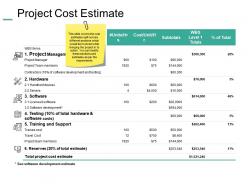
Presenting this set of slides with name - Project Cost Estimate Ppt Summary Example Introduction. This is a six stage process. The stages in this process are Project Management, Software, Hardware, Reserves, Travel Cost.

People who downloaded this PowerPoint presentation also viewed the following :

FAQs for Project cost estimate ppt

Key factors include labor costs, material expenses, equipment requirements, overhead allocation, and risk contingencies. These elements work together by establishing comprehensive budgets, enabling accurate resource planning, and minimizing cost overruns, with many organizations finding that systematic estimation ultimately delivers better project profitability and competitive advantage.

Historical data enhances project cost estimation accuracy by providing benchmarks from similar past projects, identifying recurring cost patterns, and revealing common budget overrun factors. Through analysis of previous projects in similar industries like construction or software development, organizations streamline resource allocation, minimize unexpected expenses, and deliver more reliable budgets, ultimately improving client trust and competitive positioning.

Top-down estimation uses historical data and expert judgment to estimate total project costs from a high-level perspective, while bottom-up estimation builds costs by analyzing individual work packages and activities in detail. Bottom-up methods deliver greater accuracy for detailed planning, whereas top-down approaches enable faster initial budgeting and strategic decision-making, with many organizations combining both methods for comprehensive project cost control.

Indirect costs significantly impact project budgets by adding overhead expenses like administrative salaries, utilities, facility maintenance, and management fees that aren't directly tied to specific deliverables. These costs typically represent 20-40% of total project expenses, with organizations in construction, IT development, and consulting finding that proper indirect cost allocation enables more accurate pricing, better resource planning, and ultimately stronger profit margins.

Risk assessment identifies potential cost overruns, schedule delays, resource shortages, and scope changes that could impact project budgets. This analysis enables project managers to build contingency reserves, adjust timelines, and develop mitigation strategies, with many organizations finding that proactive risk evaluation reduces unexpected expenses by 15-30%, ultimately delivering more accurate budgets and improved project success rates.

Project managers effectively communicate cost estimates by presenting clear breakdowns with contingency plans, using visual dashboards and regular updates, and contextualizing costs against business value and ROI projections. Through structured presentations and transparent reporting, stakeholders gain confidence in budget accuracy, while regular milestone reviews enable proactive adjustments, ultimately delivering enhanced project transparency and stronger stakeholder buy-in across organizations.

Project cost estimation tools include Microsoft Project, Primavera P6, Smartsheet, Asana, and specialized software like CostX and ProEst. These platforms streamline budgeting by automating calculations, tracking resource allocation, and providing real-time cost monitoring, with many organizations finding that integrated estimation software reduces planning time while enhancing accuracy and financial transparency.

Accounting for scope changes requires establishing a baseline estimate with contingency buffers, implementing change control processes, and using parametric estimation models that can adjust dynamically. Many organizations use earned value management and scope verification techniques to track deviations, enabling project managers to recalculate costs quickly while maintaining budget control and stakeholder transparency.

Contingency reserves provide crucial financial buffers in project cost estimation, accounting for identified risks, unforeseen challenges, and scope variations that could impact budgets. These reserves enable project managers to maintain financial control, respond to unexpected issues, and deliver successful outcomes, with many organizations finding that strategic contingency planning reduces overall project costs while enhancing stakeholder confidence.

Earned value management enhances cost estimation by integrating scope, schedule, and cost data to provide real-time project performance insights, enabling more accurate forecasting through variance analysis and trend identification. Through EVM metrics like Cost Performance Index and Estimate at Completion, project managers can detect cost overruns early, adjust resource allocation strategically, and deliver more reliable budget projections, ultimately improving organizational financial planning and competitive positioning.

Inflation impacts project cost estimates by increasing material costs, labor wages, equipment prices, and vendor service fees throughout the project lifecycle. While organizations can mitigate these effects through escalation clauses, fixed-price contracts, and regular estimate updates, many construction and infrastructure projects find that incorporating annual inflation rates of 2-4% into multi-year budgets ultimately delivers more accurate forecasting and better financial planning.

Common cost estimation mistakes include underestimating scope complexity, overlooking indirect costs, relying on outdated data, failing to account for risks, and neglecting stakeholder input during planning phases. These oversights often result in budget overruns and project delays, with many organizations finding that comprehensive estimation frameworks, regular reviews, and cross-functional collaboration ultimately deliver more accurate forecasts and better resource allocation.

Industry standards like ANSI and ISO significantly enhance cost estimation practices by establishing consistent methodologies, standardized metrics, and quality benchmarks that improve accuracy and reliability. These frameworks enable organizations to streamline project planning, reduce estimation errors, and ensure compliance across sectors, with many construction and manufacturing companies finding that standardized approaches ultimately deliver better cost control and competitive advantage.

Labor rates and material costs directly determine project budgeting accuracy, as they typically represent 60-80% of total project expenses through wage calculations, resource procurement, and overhead allocations. These costs significantly impact budget forecasts, cash flow planning, and profitability margins, with many construction and manufacturing organizations finding that precise rate tracking enables better cost control, more competitive bidding, and ultimately delivers improved project outcomes.

Agile project management applies iterative cost estimation through techniques like story point estimation, planning poker, and sprint-based budgeting, enabling teams to refine cost projections throughout development cycles. This approach allows organizations to adjust resource allocation based on actual velocity and changing requirements, with software development teams and product companies finding that incremental estimation delivers more accurate budgets and reduces financial risk compared to traditional upfront estimation methods.

Ratings and Reviews

0% of 100
Write a review
Most Relevant Reviews

No Reviews