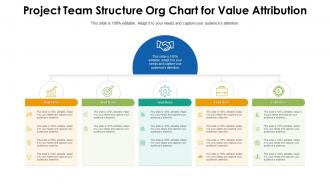
Projektteamstruktur-Organigramm für Infografik-Vorlage zur Wertzuordnung
Try Before you Buy Download Free Sample Product
Audience
Editable
of Time
Unsere Projektteamstruktur-Organigramm-Vorlage für die Wertzuordnung Infografik-Vorlage wurde thematisch gestaltet, um einen attraktiven Hintergrund für jedes Thema zu bieten. Verwenden Sie sie, um wie ein Präsentationsprofi auszusehen.
Funktionen dieser PowerPoint-Präsentationsfolien:
Dies ist eine einzelne Folie mit dem Titel Projektteamstruktur-Organigramm für die Wertzuordnungs-Infografikvorlage. Es wird mit hochwertigen vektorbasierten Visuals erstellt, die zu 100 Prozent bearbeitbar sind und zum sofortigen Download in Standard- und Breitbild-Seitenverhältnissen zur Verfügung stehen.
People who downloaded this PowerPoint presentation also viewed the following :
Inhalt dieser Powerpoint-Präsentation
Projektteamstruktur Organigramm für Wertzuordnung Infografik-Vorlage mit allen 2 Folien:
Verwenden Sie unser Projektteamstruktur-Organigramm für die Infografik-Vorlage zur Wertzuordnung, um effektiv Ihre wertvolle Zeit zu sparen. Sie sind vorgefertigt, um in jede Präsentationsstruktur zu passen.
FAQs for Project team structure org chart for value
Effective project teams typically include project managers, technical leads, developers or specialists, quality assurance professionals, and business analysts. These roles work collaboratively by ensuring clear accountability, maintaining technical excellence, and delivering stakeholder requirements, with many organizations finding that well-defined team structures enhance communication, streamline decision-making, and ultimately accelerate project delivery while reducing costs.
Agile project teams emphasize cross-functional collaboration, self-organization, and flat hierarchies with roles like Scrum Master and Product Owner, while traditional teams follow hierarchical structures with defined project managers and specialized departments. These approaches deliver different outcomes, with agile teams enabling faster iteration, enhanced flexibility, and continuous stakeholder feedback, while traditional structures provide clear accountability and systematic control, ultimately allowing organizations to choose based on project complexity and delivery requirements.
**INPUT**: What factors should be considered when determining the size of a project team? **OUTPUT**: Project team size depends on project scope, complexity, timeline constraints, budget limitations, required skill sets, and communication overhead considerations. Organizations find that smaller teams enhance agility and decision-making speed, while larger projects may require diverse expertise across multiple functions, ultimately balancing resource availability with coordination efficiency for optimal delivery outcomes. [Word count: 53 words]
A well-defined project team structure enhances communication by establishing clear reporting lines, designated decision-makers, defined roles and responsibilities, and streamlined information flow channels. Through structured hierarchies and communication protocols, organizations minimize confusion, reduce project delays, and accelerate decision-making processes, while enabling cross-functional collaboration that ultimately delivers faster project completion and improved outcomes.
Cross-functional team members bring diverse expertise, varied perspectives, enhanced problem-solving capabilities, reduced silos, and accelerated decision-making to project teams. These collaborative approaches streamline communication, minimize bottlenecks, and foster innovation by combining technical, operational, and strategic insights, with many organizations finding that cross-functional integration ultimately delivers faster project completion and higher-quality outcomes.
Leadership style significantly influences project team dynamics by shaping communication patterns, decision-making processes, collaborative approaches, and overall team cohesion within structured frameworks. Different leadership approaches, from collaborative to directive styles, create varying levels of autonomy, accountability, and innovation, with many organizations finding that adaptive leadership enhances team performance, streamlines project delivery, and ultimately drives better outcomes across complex initiatives.
Common challenges include skill gaps across disciplines, resource allocation conflicts, communication barriers between departments, role overlap confusion, and maintaining team cohesion during project phases. These structural issues often emerge in complex organizations where cross-functional teams must balance competing priorities, with many project managers finding that proactive planning and clear accountability frameworks ultimately streamline collaboration and enhance project outcomes.
Virtual teams can structure themselves effectively through clear role definitions, established communication protocols, defined accountability measures, and regular check-in schedules. These frameworks enable distributed organizations to maintain project momentum by streamlining coordination, enhancing transparency, and minimizing delays, with many companies finding that structured virtual approaches ultimately deliver faster project completion and improved resource allocation across global operations.
Stakeholder involvement significantly influences project team structure by determining communication channels, decision-making hierarchies, required expertise levels, and resource allocation priorities. High-stakes stakeholders often necessitate dedicated liaison roles, specialized reporting structures, and cross-functional teams, with many organizations finding that early stakeholder mapping ultimately streamlines project governance and enhances delivery outcomes.
Cultural differences significantly influence project team structures through varying communication styles, decision-making hierarchies, collaboration preferences, and time orientations across regions. Global organizations increasingly adopt hybrid structures combining centralized oversight with localized team autonomy, enabling teams to leverage cultural strengths while maintaining project cohesion, ultimately delivering enhanced cross-cultural innovation and market responsiveness.
Best practices for onboarding new project team members include structured orientation sessions, clear role definitions, comprehensive project documentation access, mentor assignment, and early integration into team workflows. These approaches streamline integration by establishing expectations, accelerating productivity, and building relationships, with many organizations finding that systematic onboarding reduces ramp-up time and enhances team cohesion significantly.
Project team structures evolve through dynamic scaling, role transitions, skill additions, and responsibility shifts as project phases change from initiation to closure. Through strategic workforce planning, organizations expand teams during development phases, streamline during testing periods, and transition specialists between workstreams, while maintaining core leadership continuity, ultimately delivering enhanced project outcomes and optimal resource utilization.
**INPUT**: What metrics can be used to evaluate the effectiveness of a project team structure? **OUTPUT**: Project team structure effectiveness metrics include delivery timeline adherence, budget variance, quality scores, team productivity rates, and stakeholder satisfaction indices. These measurements enable organizations to streamline resource allocation, enhance cross-functional collaboration, and minimize project risks, with many companies finding that structured evaluation ultimately delivers improved project outcomes and competitive advantage.
Project managers facilitate conflict resolution by establishing clear communication protocols, conducting neutral mediation sessions, and implementing structured problem-solving frameworks that address root causes rather than symptoms. Through active listening techniques and collaborative decision-making processes, teams in sectors like construction and software development find that early intervention, transparent role clarification, and focus on shared project objectives ultimately transform conflicts into opportunities for stronger team cohesion and improved outcomes.
Technology enhances project team effectiveness by enabling real-time collaboration, streamlining communication, automating task management, and providing centralized data access. While these tools significantly improve coordination and transparency across distributed teams, they can also create information overload and reduce face-to-face interaction, with many organizations finding that strategic technology integration ultimately delivers faster project delivery and enhanced team productivity.
-
Great designs, Easily Editable.
-
Informative design.
-
Illustrative design with editable content. Exceptional value for money. Highly pleased with the product.
-
Innovative and attractive designs.